
A win-back campaign is a targeted re-engagement sequence sent to customers who have stopped buying, logging in, or opening your emails, with the goal of pulling them back into your revenue cycle before they're gone for good. The path to measurable reactivation varies depending on your product's lapse window: identify your lapsed segment using RFM (Recency, Frequency, Monetary) scoring, selecting the lapse window based on average purchase or usage cycle (30 days for high-frequency apps, 90 days for retail, 14–60 days for B2B SaaS), then deploy a three-message sequence over 14–21 days with reasons to return that match their position in the lapse cycle.
The three-step mini-playbook looks like this.
First, define your lapse window based on your product's average purchase or usage cycle, then pull your highest-value lapsed customers into a priority segment.
Second, run a sequenced campaign: open with relevance (what's new, what changed, what they're missing), escalate to a value offer on the second or third send, and close with a final-chance message that includes an explicit unsubscribe option.
Third, measure reactivation rate against a holdout group, then suppress non-responders from future sends to protect deliverability.
Well-executed win-back campaigns can produce reactivation rates in the 10–30% range when properly segmented. And according to a Validity-sourced benchmark cited by Zendesk, nearly 50% of recipients who open a win-back email go on to read subsequent company emails. That second number is the real argument for running these programs: you're not just recovering one purchase, you're restoring a relationship.
Key Takeaways
Well-executed win-back campaigns, built on RFM segmentation and a three-step sequence, consistently produce reactivation rates in the 10–30% range and restore long-term engagement for nearly half of those who re-open.
| Point | Details |
|---|---|
| Define your lapse window first | Use your average purchase cycle plus a 20–30% buffer to set the trigger, not an arbitrary calendar date. |
| RFM segmentation drives results | Prioritize high-AOV, multi-purchase lapsers; suppress complaints, bounces, and prior non-responders before any send. |
| Sequence over single sends | A three-message sequence over 14–21 days, opening with relevance and escalating to an offer, outperforms single-blast programs. |
| Measure incremental lift, not raw rate | Always run a holdout group; reactivation rate without a holdout overstates true program impact. |
| Ashafrazier builds the full system | From RFM segmentation and offer design to holdout testing and KPI dashboards, Ashafrazier builds win-back programs that compound into long-term CLV growth. |
Table of Contents
- When should you trigger a win-back campaign?
- How do you define 'inactive' and build the right segments?
- Which channels and sequence should you use?
- What should your win-back emails say?
- How do you design offers that drive return without training bad behavior?
- What KPIs and benchmarks should you track?
- How do you A/B test and optimize win-back programs?
- Common mistakes, list hygiene, and compliance
- A practitioner's playbook and what real results look like
- The trade-off most marketers miss
- Ashafrazier builds win-back programs that actually move the revenue needle
- Sources
When should you trigger a win-back campaign?
The answer depends almost entirely on your product's natural usage cadence, not on an arbitrary calendar rule. A daily-use mobile app and a quarterly B2B software renewal have nothing in common when it comes to defining "inactive," and treating them the same way is one of the most common mistakes in lifecycle marketing.
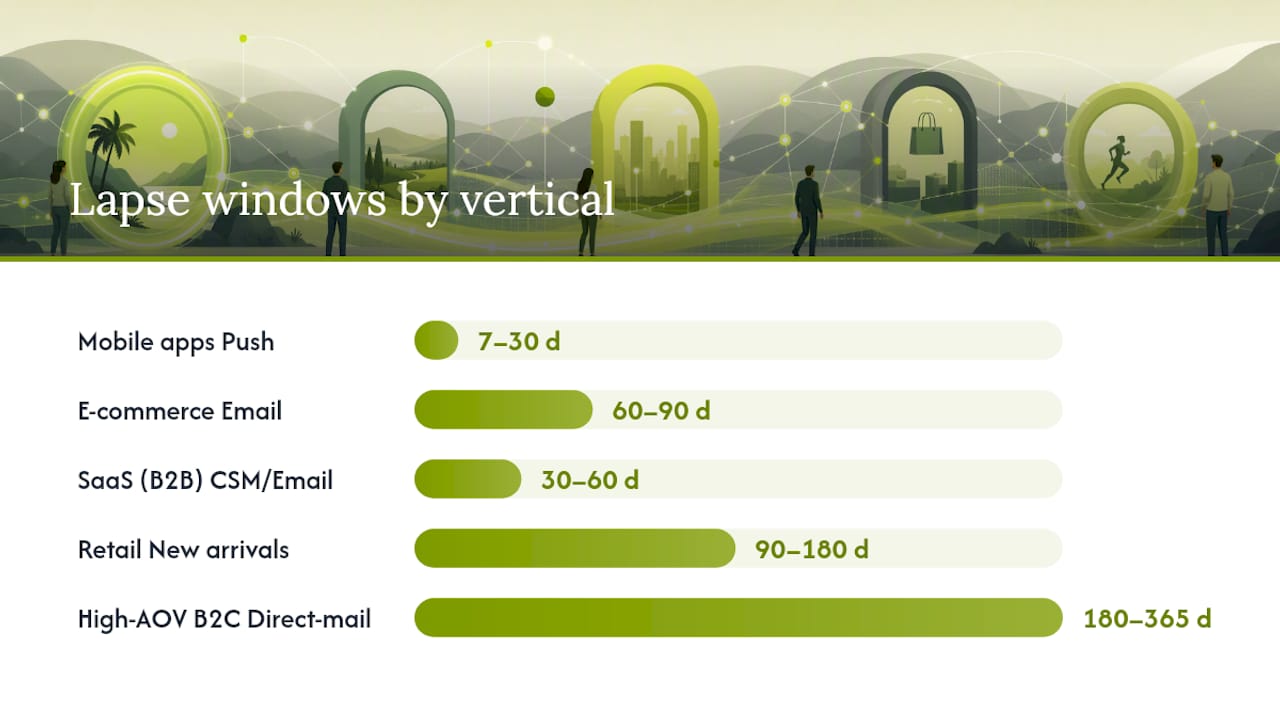
Lapse windows vary significantly by product type: roughly 30 days for high-frequency apps, 90 days for retail, and 14–60 days for B2B SaaS depending on usage patterns. These aren't arbitrary numbers. They reflect the point at which a customer's absence becomes statistically meaningful given their expected behavior.
| Industry vertical | Common lapse window | Recommended first action |
|---|---|---|
| Mobile apps (daily use) | 7–30 days | Push notification or in-app message |
| E-commerce (mid-frequency) | 60–90 days | Email with value reminder |
| Subscription SaaS (B2B) | 30–60 days | Usage-based email or CSM outreach |
| Retail (seasonal) | 90–180 days | Email with product update or new arrivals |
| High-AOV B2C (luxury, furniture) | 180–365 days | Direct mail or personalized email |
To set your own threshold, calculate your average purchase cycle or median days between sessions, then add 20–30% to that figure. That buffer is your lapse trigger. If your median customer buys every 45 days, a customer silent for 60 days is worth flagging. At 90 days, they're a priority.
A few hard rules on when to run re-engagement versus when to treat a contact as churned and suppress them:
- Run re-engagement when the customer has lapsed beyond your threshold but has no complaint history, no recent unsubscribe request, and at least one prior purchase or meaningful engagement event.
- Treat as churned and suppress when a contact has not responded to two or more prior win-back sequences, has filed a spam complaint, or has explicitly unsubscribed.
- Never route customers with negative CX tags (refund disputes, support escalations, fraud flags) into a win-back program without resolving the underlying issue first.
The cost logic matters here too. Win-back programs cost more than retention but significantly less than acquiring a new customer, so the decision to run one should always be weighed against your CAC and the CLV of the segment you're targeting.
How do you define 'inactive' and build the right segments?
Defining "inactive" without a framework produces over-broad targeting, which wastes budget and damages deliverability. RFM segmentation, which scores customers on Recency, Frequency, and Monetary value, gives you a structured way to prioritize who gets a win-back sequence and in what order.
Here's how to adapt RFM buckets to a win-back context. Recency is your primary filter: pull customers whose last purchase or login date exceeds your lapse threshold. Frequency and Monetary value then determine priority. A customer who bought six times and spent $800 in the past year gets a different sequence than someone who made one $20 purchase eighteen months ago.
A practical SQL-style segment logic for an e-commerce context:
SELECT customer_id, email, last_order_date, order_count, lifetime_value
FROM customers
WHERE last_order_date < CURRENT_DATE - INTERVAL '90 days'
  AND last_order_date >= CURRENT_DATE - INTERVAL '365 days'
  AND order_count >= 2
  AND lifetime_value >= 150
  AND unsubscribed = FALSE
  AND complaint_flag = FALSE
ORDER BY lifetime_value DESC;
For a SaaS product, swap last_order_date for last_login_date and lifetime_value for mrr_at_churn. For a mobile app, use last_session_date and sessions_last_90_days.
Priority order for which segments to target first:
- High-AOV lapsers with two or more prior purchases (highest CLV recovery potential)
- Recent high-frequency lapsers who dropped off suddenly (behavioral signal worth investigating)
- Campaign responders who opened or clicked a prior win-back email but didn't convert
- Single-purchase customers with high order values (worth one attempt)
- Low-value, single-purchase customers (lowest priority; suppress after one send)
Suppression rules to enforce before any send:
- All contacts who unsubscribed in the past 12 months
- Any address with a spam complaint on record
- Hard bounces and role-based addresses (info@, support@)
- Customers with open refund disputes or fraud flags
- Anyone who completed a prior win-back sequence without converting
Pro Tip: Before building your RFM segments, run a quick cohort analysis on your last win-back program. If a specific recency band (say, 91–120 days lapsed) consistently outperforms the 180+ day band, narrow your targeting to that window and reallocate budget from the low-probability tail.
Which channels and sequence should you use?
Email is the primary channel for most win-back programs, but it shouldn't be the only one. The right channel mix depends on where your customers are most reachable and how much they've disengaged. A customer who stopped opening emails but still uses your app is better reached via in-app messaging. A high-AOV B2C customer who hasn't responded to two email sends might be worth a direct mail piece.
Braze's guidance on winback orchestration makes the case clearly: cross-channel sequencing and suppression logic are what separate a reactivation program from one that accelerates churn. The goal is to reach the customer where they are, not to blast every channel simultaneously.
| Channel | Best for | Typical use case |
|---|---|---|
| All segments; primary channel | Full sequence delivery, offer communication | |
| SMS/push | Mobile-first apps, high-frequency retail | Short nudge after email non-open |
| In-app messaging | Active-but-email-silent SaaS users | Feature reminder, usage prompt |
| Direct mail | High-AOV B2C, luxury, furniture | Final attempt after email sequence fails |
Sample three-step multi-channel sequence:
- Day 0: Email 1, value reminder or "what's new" hook. No offer yet. Suppress anyone who opens and clicks within 48 hours (they're re-engaged).
- Day 7: Email 2 for non-openers; SMS or push for mobile-first segments. Introduce a soft incentive or personalized product recommendation.
- Day 14: Email 3, final chance. Include your strongest offer and a clear unsubscribe option. Suppress all non-responders from future marketing sends after this point.
For B2B SaaS, the sequence looks different: longer sales cycles and multiple stakeholders mean value-driven messaging (feature updates, performance improvements, case studies) outperforms discount-led hooks. A three-email sequence over 21–30 days, with a CSM outreach call on day 14, tends to outperform pure email alone.
A few orchestration rules to prevent cross-channel fatigue:
- Never send SMS and email on the same day to the same contact.
- Cap total touchpoints at five across all channels within a 30-day window.
- Suppress a contact from all channels the moment they convert or unsubscribe.
- Use channel preference data where available; if a customer has never opted into SMS, don't start there.
What should your win-back emails say?
The message architecture matters as much as the timing. Most failed re-engagement programs lead with a discount on send one, which trains customers to lapse intentionally and wait for the offer. The stronger approach opens with relevance, escalates to an incentive only if needed, and closes with a clean final-chance message.
Message type 1: value reminder / "what's new"
Subject line options:
- "Here's what you've missed, [First Name]"
- "We've been busy. Here's what changed."
- "Your account is waiting, and so is this."
Template:
Hi [First Name],
It's been a while, and a lot has changed since your last visit. We've added [specific feature / new product / improvement] that we think you'll find genuinely useful.
[One-line personalized hook based on their last purchase or usage behavior.]
Come take a look. No strings attached.
[CTA: See What's New]
Message type 2: offer / incentive (send 2 or 3 only)
Subject line options:
- "We want you back, [First Name]. Here's something to make it worth it."
- "A personal offer, just for you."
- "This one's yours. But only for 72 hours."
Template:
Hi [First Name],
We noticed you haven't been around lately, and we'd like to change that. As a thank-you for being a past customer, here's [10% off / $20 credit / free shipping on your next order].
Use code [WINBACK10] at checkout. Expires [Date].
[CTA: Claim Your Offer]
Message type 3: final chance
Subject line options:
- "Last chance, [First Name]. After this, we'll stop reaching out."
- "Should we say goodbye?"
- "One last thing before we go."
Template:
Hi [First Name],
We've reached out a couple of times and haven't heard back. We get it, life gets busy. This is our last message unless you'd like to stay in touch.
If you want to keep hearing from us, just click below. If not, no hard feelings.
[CTA: Keep Me In] [CTA: Unsubscribe]
Personalization tokens to include across all sends: [First Name], [Last Product Purchased], [Last Login Date], [Recommended Product Based on History], [Offer Code], [Expiry Date].
Pro Tip: On your final-chance email, A/B test the subject line framing. "Should we say goodbye?" consistently outperforms "Last chance" in open rate tests because it triggers curiosity and a sense of agency, not urgency fatigue.
How do you design offers that drive return without training bad behavior?
The discount trap is real. When customers learn that going quiet for 90 days reliably produces a 20% off coupon, you've accidentally built a churn-and-discount loop. The fix isn't to eliminate offers; it's to design them so they reward return, not absence.
Offer types by segment and product:
- Percentage discount (10–20%): Best for mid-frequency e-commerce with moderate AOV. Avoid for luxury or high-margin products where discounting erodes brand perception.
- Account credit or loyalty points: Works well for subscription products and loyalty program members. Feels like a reward rather than a clearance sale.
- Exclusive bundle or product upgrade: Strong for SaaS and software. Offering a feature tier upgrade for 30 days costs you little and demonstrates product value.
- Free shipping or bonus gift: Effective for e-commerce where shipping friction is a known drop-off driver.
- Early access or VIP status: High perceived value, near-zero cost. Works best for brands with an engaged community.
Before approving any financial incentive, run a quick margin check. Your offer should not exceed the gross margin on the expected reactivated order. If your product margin is 40% and your average order value is $100, your maximum offer cost is $40. Factor in email send cost and creative time, and your break-even reactivation rate becomes clear.
Behavioral design rules:
- Make offers time-limited (48–72 hours) and one-time-use. A public, repeatable promotion doesn't create urgency.
- Never replicate an offer that's currently live on your active customer list. If your homepage has a 15% off banner, your win-back offer needs to be different, not identical.
- Frame the offer as a personal gesture, not a clearance event. Copy matters: "We saved this for you" outperforms "Here's a discount."
A short compliance note: Under CAN-SPAM, every commercial email must include a clear opt-out mechanism and your physical mailing address. Promotional codes and coupons must reflect their stated terms accurately. If you're targeting any EU-based contacts, GDPR requires a valid legal basis for re-engagement contact; for lapsed subscribers, that typically means confirmed opt-in on record. When in doubt, consult your legal team before mailing to contacts who haven't engaged in over 12 months.
Pro Tip: For high-AOV segments, skip the discount entirely and test a "personal outreach" email from a named account manager or founder. The perceived effort of a one-to-one message often outperforms a 15% coupon at a fraction of the cost.
What KPIs and benchmarks should you track?
Measuring a win-back program without a holdout group produces numbers that look good but mean nothing. You need to know how many customers would have returned anyway, without your campaign, before you can claim credit for the ones who did.
Core KPIs and formulas:
- Reactivation rate: Reactivated customers ÷ total customers targeted × 100. Industry ranges run 10–30% for well-segmented programs.
- Conversion rate: Customers who completed a purchase (or key action) ÷ reactivated customers × 100.
- Cost per reactivation: Total campaign spend ÷ number of reactivated customers.
- Incremental lift: Reactivation rate in test group minus reactivation rate in holdout group. This is your true program effect.
- CLV delta: Average CLV of reactivated customers 90 days post-campaign minus their pre-lapse CLV trajectory. A positive delta confirms the program is building long-term value, not just pulling forward one purchase.
- Payback period: Cost per reactivation ÷ gross margin per reactivated customer. If payback exceeds 90 days, reconsider the offer structure.
Use the growth calculator to model CLV, CAC, and payback before committing to an offer tier. Running the numbers upfront prevents the common mistake of approving an incentive that costs more than the customer is worth.
Benchmarks to set expectations:
Reactivation rates in the 10–30% range are achievable with proper segmentation. Programs targeting the full lapsed list without RFM filtering typically land below 5%. The Validity-sourced benchmark showing nearly 50% of win-back openers reading subsequent emails is the more important long-term signal: a reactivated customer who stays engaged is worth multiples of the one who buys once and lapses again.
Attribution window guidance: Set your attribution window to match your product's purchase cycle. For e-commerce, 14–30 days post-send is standard. For SaaS, 30–60 days. Any conversion outside that window should be attributed to organic behavior, not the campaign, to avoid inflating your reported lift.
For a practical KPI dashboard framework that connects win-back metrics to broader growth reporting, the linked guide covers the full setup.
How do you A/B test and optimize win-back programs?
Most teams test subject lines and call it a day. That's the minimum. A properly structured win-back test program covers four dimensions: creative, offer, cadence, and holdout lift.
-
Subject line and creative A/B tests: Split your segment 50/50 on subject line variants. Run for at least 72 hours before declaring a winner. Minimum sample size: 500 per variant to detect a 2-percentage-point difference in open rate with reasonable confidence.
-
Offer tests: Test offer type before offer size. Does a loyalty credit outperform a percentage discount for your segment? Answer that first, then optimize the amount. Running both variables simultaneously makes the results unreadable.
-
Cadence tests: Test a 7-day gap between sends against a 14-day gap. Shorter cadences work for high-frequency products; longer gaps reduce fatigue for low-frequency buyers.
-
Holdout/cohort lift test: This is the one most teams skip, and it's the most important. Before launching, randomly assign 10–20% of your lapsed segment to a holdout group that receives no campaign. After the sequence completes, compare reactivation rates between the test group and the holdout. The difference is your true incremental lift.
Sample holdout design:
- Total lapsed segment: 10,000 contacts
- Holdout group (15%): 1,500 contacts, no campaign
- Test group (85%): 8,500 contacts, full sequence
- Minimum test duration: full sequence length plus one purchase cycle (e.g., 21 days sequence + 30 days observation = 51 days total)
On statistical significance: Don't call a winner until you've hit your minimum detectable effect. For a 10% baseline reactivation rate, detecting a 3-percentage-point lift requires roughly 1,700 contacts per group. Use a standard sample size calculator before you start, not after you see the results.
The optimization loop is simple: test, implement the winner, then immediately form a new hypothesis. The teams that compound gains fastest are the ones running one clean test per send cycle, not five simultaneous variables that produce uninterpretable data.
Pro Tip: Run your holdout group for 90 days, not just the campaign window. Some lapsed customers self-reactivate weeks after the sequence ends, and counting them in your test group inflates lift. The holdout tells you what would have happened anyway.
Common mistakes, list hygiene, and compliance
The fastest way to destroy a win-back program is to run it without suppression logic. Sending to contacts who already unsubscribed isn't just a deliverability problem; it's a CAN-SPAM violation.
Top program-level mistakes:
- Sending the same offer to lapsed customers that's currently live for active customers. There's no reason to return if the deal is always available.
- Running a single-send program and calling it a win-back campaign. One email is not a sequence; it's a blast.
- Routing customers with unresolved complaints or negative CX tags into a win-back flow. You'll accelerate their departure, not reverse it.
- Failing to suppress recent unsubscribes. This is both a legal risk and a deliverability killer.
Suppression checklist before every send:
- Unsubscribes from the past 12 months (minimum; honor all historical unsubscribes)
- Spam complaints on record
- Hard bounces
- Contacts who completed a prior win-back sequence without converting (suppress after final send)
- Negative CX tags: open refunds, fraud flags, support escalations
Re-engagement campaigns protect sender reputation precisely because they force you to clean your list. Removing unresponsive addresses improves your sender score, which improves inbox placement for your entire program, not just the win-back sequence. The list-cleaning benefit alone often justifies running the program.
Deliverability note: Before launching a win-back sequence to a large lapsed segment, warm up your sending volume gradually. Start with your highest-engagement lapsers (most recent, highest RFM scores) and expand to lower-probability segments over two to three weeks. Sending a cold blast to 50,000 lapsed addresses in one day is a reliable path to the spam folder.
U.S. compliance reminders:
- Every commercial email must include a clear, functional unsubscribe mechanism (CAN-SPAM).
- Honor unsubscribe requests within 10 business days.
- Include your physical mailing address in every send.
- Respect list-unsubscribe headers; major inbox providers (Gmail, Yahoo) now enforce them for bulk senders.
- For any contact who hasn't engaged in 12+ months, confirm your legal basis for contact before sending.
A practitioner's playbook and what real results look like
The following checklist reflects the program architecture used across multiple reactivation engagements. It's designed to be run in sequence, not in parallel.
Win-back program build checklist:
- Define your lapse window using average purchase cycle plus 20–30% buffer
- Pull your RFM segments and apply suppression rules before building any audience
- Confirm your holdout group is set and randomized before the first send
- Write your three-message sequence: relevance first, offer second, final chance third
- Set your offer within margin constraints (offer cost below gross margin per reactivated order)
- Configure suppression triggers: suppress converters immediately, suppress non-responders after send 3
- Set your attribution window and KPI reporting cadence before launch
- Run your first A/B test on subject line variants with a minimum of 500 per variant
- Review deliverability metrics (open rate, spam rate, bounce rate) after send 1 before proceeding
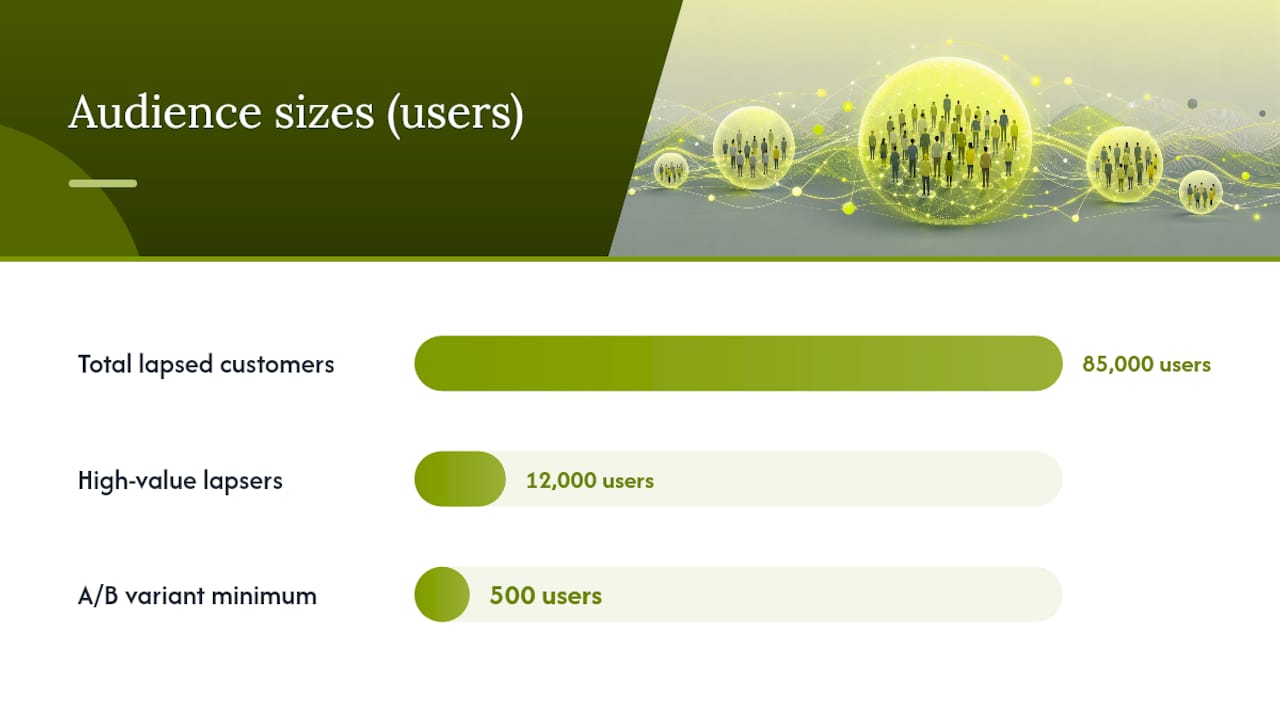
An anonymized case study: A mid-market e-commerce brand with roughly 85,000 lapsed customers (90+ days, no purchase) had been running a single promotional email to its full lapsed list twice a year. Reactivation was below 3%. The intervention: RFM segmentation pulled 12,000 high-value lapsers (two or more prior purchases, AOV above $120) into a three-step sequence over 21 days. Send 1 led with a product update and personalized recommendation. Send 2 introduced a $20 account credit with a 72-hour expiry. Send 3 was a final-chance message with a clear unsubscribe option. The holdout-measured incremental reactivation rate came in at 18%, and the reactivated cohort showed a 90-day CLV 2.3x higher than the brand's new-customer average, confirming that these were genuinely high-value customers worth recovering.
When to hire external help: Run the program in-house if you have a lifecycle marketer, an ESP with segmentation capabilities (Klaviyo or Braze both support RFM-based audience building and multi-step flows), and a data analyst who can set up holdout groups. Bring in a fractional CMO or consultant when the program is stalling at the segmentation or offer design stage, when you're seeing deliverability degradation you can't diagnose, or when the CLV math suggests the program should be generating significantly more revenue than it is. The fractional CMO vs. agency comparison is worth reading before making that call.
For a deeper look at how this kind of program fits into a full retention system, the retention marketing playbook covers the lifecycle architecture that makes win-back results compound over time.
Campaign Monitor is worth noting here as an ESP option for teams that need straightforward automation without the complexity of enterprise platforms. It supports basic segmentation and drip sequences, making it a reasonable entry point for smaller programs before graduating to Klaviyo or Braze.
The trade-off most marketers miss
Win-back campaigns get oversold as a revenue recovery tool and undersold as a diagnostic one. The most valuable output of a well-run reactivation program isn't the reactivated customers; it's the data on why customers lapsed in the first place.
When you run a properly segmented, holdout-tested win-back sequence and still see reactivation rates below 10% on your highest-value lapsers, that's not a campaign problem. That's a product or onboarding problem. The campaign just surfaced it. Most teams fix the subject line and run it again. The smarter move is to look at what those lapsers had in common, when they dropped off relative to their purchase or onboarding timeline, and what that tells you about where your product or experience is breaking down.
The other trade-off worth naming: win-back programs are not a substitute for retention. If you're running quarterly reactivation campaigns because your churn rate is high, you're treating the symptom. The program buys you time and recovers some revenue, but the underlying churn driver keeps producing new lapsed customers faster than you can win them back. The right sequence is to fix the retention leak first, then build the win-back program as a safety net for the customers who slip through anyway.
On tooling: Klaviyo and Braze are the two platforms I'd recommend for most teams running serious win-back programs. Klaviyo's RFM-based segmentation and flow builder make it the default choice for e-commerce. Braze handles cross-channel orchestration at scale and is the better fit for mobile-first products or enterprise programs with complex suppression logic. Neither platform does the strategic work for you, but both remove the technical friction that causes most programs to stall at the segmentation stage.
Finally, on resource allocation: if you're choosing between investing in a win-back program and investing in improving your onboarding or first-90-day experience, fix onboarding first. The customers you never lose are always cheaper than the ones you have to win back.
Ashafrazier builds win-back programs that actually move the revenue needle
Most win-back programs stall because the segmentation is too broad, the offer erodes margin, or the team doesn't have the bandwidth to run holdout tests and iterate. Ashafrazier's fractional CMO engagements are built specifically for this gap: hands-on program design that covers RFM segmentation, sequence architecture, offer structure, A/B test design, and KPI dashboard setup, all tied to your unit economics from day one.
The entry point is a growth audit that maps your current lapsed customer base, models the CLV recovery opportunity, and identifies the highest-priority segments to target first. From there, the engagement can expand to full program build, creative and offer design, and ongoing optimization. If you want to know whether your lapsed customer base justifies a serious win-back investment, start with the growth score calculator to run the CLV and payback numbers before committing to a build. Or, if you're ready to move faster, book a discovery call to discuss what a structured reactivation program would look like for your business.
Sources
The following resources are worth bookmarking if you're building or refining a win-back program.
- What Is a Winback Campaign? Strategy & Examples | Braze
- Customer Win-Back Campaigns: How to Get Previous Buyers Back on Track | HubSpot
- Customer win-back campaigns: How to build one + 10 templates | Zendesk
- Win-back Email Examples — how brands re-engage lapsed subscribers | BadRep
- Re-Engagement Campaigns: A Guide to Winning Back Inactive Subscribers | Mailmunch
- What is a winback campaign? Fix the timing, targeting, and ... | Hightouch