
Test the customer first, the offer second, the price last. That order isn't arbitrary. It's the sequence that keeps you from spending three months building something nobody wanted, then discovering the truth in a launch that flops. Here's the roadmap:
- Stage 1, customer profile: Run around a dozen interviews. If many independently confirm the same pain, you've got a real problem worth solving.
- Stage 2, value map: Put up a landing page describing the offer. A good demo-request conversion rate indicates the message is resonating.
- Stage 3, willingness to pay: Secure at least one paid pilot or observe a small paid conversion rate on a real transaction. Anything less than money changing hands is still a guess.
That third number is the one that separates a validated element from a hopeful assumption.
Key Takeaways
Validating a value proposition requires sequencing customer, offer, and price tests in that order, with a pre-set pass/fail threshold for each stage.
| Point | Details |
|---|---|
| Test customer first | Run 10 to 15 interviews; treat 60% pain confirmation as your desirability threshold. |
| Validate the offer second | Use a landing page with a 3% demo-request threshold before building anything. |
| Price test comes last | Require a paid pilot or a 2% paid-conversion signal before scaling spend. |
| Predefine your stopping rule | Set thresholds and sample sizes before launch, not after seeing results. |
| Bring in expert structure | Ashafrazier helps teams build the testing and messaging systems behind these experiments for high-consideration offers. |
Table of Contents
- Why Value Proposition Testing Should Follow This Order
- What Experiments Should You Run at Each Stage?
- How Do You Design a Test That Actually Proves Something?
- Running a 4 to 6 Week Value Proposition Test Sprint
- Turning Test Results Into a Validate, Iterate, or Stop Decision
- Templates and Tools to Run Your Own Tests
- What Actually Breaks Value Proposition Tests in Practice
- Why the Conventional Playbook Undersells Speed
- Get Help Building the Testing System, Not Just the Test
- Frequently Asked Questions
- Sources
Why Value Proposition Testing Should Follow This Order
Most founders build the thing first and pray the market wants it. That's backwards, and it's the single most expensive mistake I watch teams make. The fix is a funnel: confirm the customer exists before you sketch the solution, confirm the solution resonates before you touch pricing.
This isn't a theoretical preference. Strategyzer's roadmap for testing a value proposition lays out the same three stages: customer jobs, pains, and gains first; product and feature fit second; willingness to pay third. Skip a stage and you're optimizing a feature nobody needed, or pricing an offer that never had demand behind it.
Here's the sequence in practice:
- Desirability. Confirm the job-to-be-done, the pain, and the desired gain through interviews or a short screening survey. You're listening for language, not pitching a solution.
- Solution fit. Test messaging and feature priority with a card sort or a Max-Diff study. You're forcing trade-offs, not collecting polite agreement.
- Revenue. Build a fake-sales landing page, collect letters of intent, or charge a small pilot fee. Real money is the only signal that can't be faked by politeness.
Pro Tip: If you're tempted to skip straight to a landing page because "customer discovery takes too long," that's usually fear talking. Ten structured interviews take a week. A failed product launch takes a year and your runway.
What Experiments Should You Run at Each Stage?
Different questions require different instruments. Trying to answer a pricing question with a survey, or a positioning question with an A/B test, wastes time and gives you false confidence.
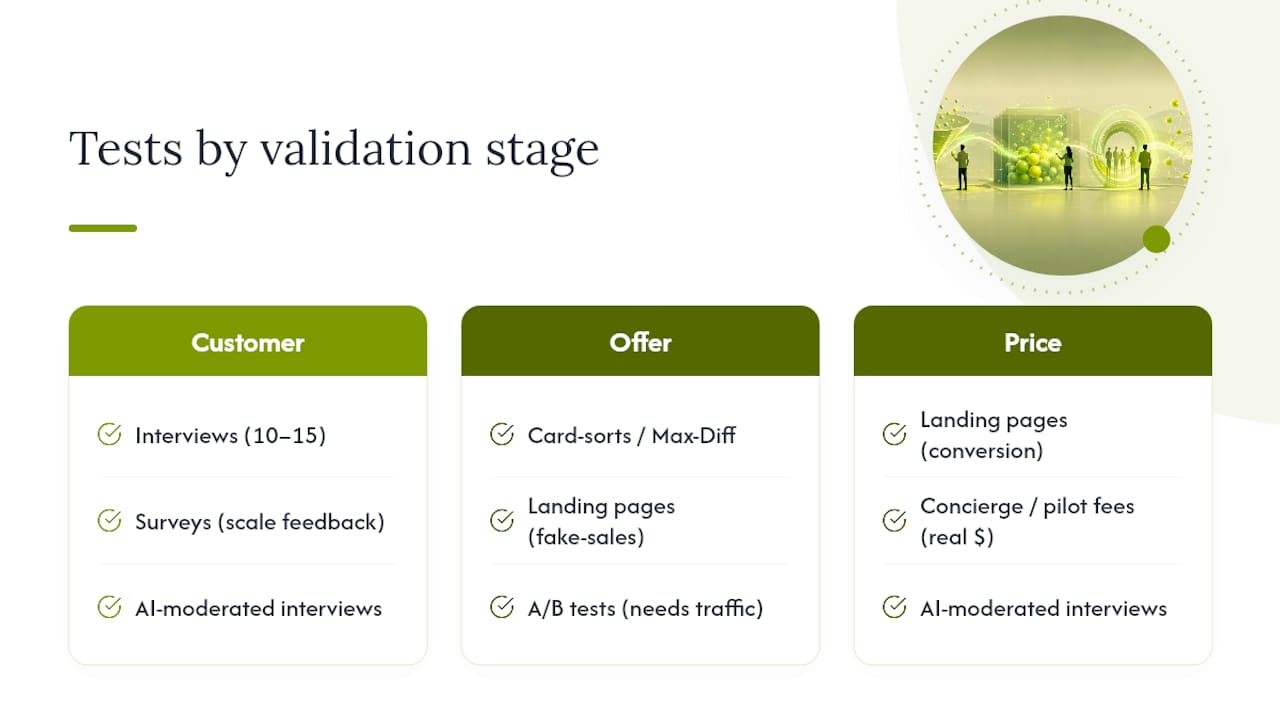
Customer discovery interviews are your foundation. Run 10 to 15 targeted, open-ended conversations with people who match your target segment. Score each one against a simple rubric: did they describe the pain unprompted, in their own words, without you leading them there? If fewer than six out of ten do, your customer profile assumption isn't holding up yet.
Card sorts and Max-Diff studies force trade-offs that a standard 1-to-5 rating scale can't. Ask someone to rate ten features and they'll rate all ten as "important." Force them to pick the top three and bottom three, and you get a real priority list. IDEO U's guide to testing value propositions recommends exactly this kind of forced-ranking exercise to avoid the equal-rating trap.
Landing pages and fake-sales tests measure desire with a click instead of a claim. Drive a few hundred visits from a channel you control, and watch whether visitors take the next step, whether that's a demo request, a waitlist signup, or an actual checkout.

Two visitor numbers matter here: enough traffic to trust the percentage, and a pre-set conversion threshold you commit to before launch.
A/B tests work best once you already have meaningful traffic and want to compare two messaging variants head to head, rather than validate whether the offer works at all.
Concierge tests and pilot fees are the gold standard because they involve real money changing hands. If someone will pay you $500 to manually deliver a service before you've built the product, that's a stronger signal than a hundred survey responses.
Surveys scale feedback cheaply, but they're vulnerable to the say-do gap: people say they'd buy something, then don't when the moment arrives. Use surveys to spot patterns, not to make a go/no-go call alone.
A newer option worth knowing: AI-moderated qualitative interviews can cover comprehension, belief, desire, and willingness to pay in a single structured session, compressing what used to take weeks of scheduling into a few days of automated outreach.
How Do You Design a Test That Actually Proves Something?
A test without a pre-registered threshold isn't a test. It's a story you'll tell yourself after the fact to justify whatever number you got. Write the hypothesis down before you launch anything.
- Use a hypothesis template. "If [target segment] experiences [specific pain], then [this value proposition] will cause [this behavior], measured by [this metric], by [this date]." Fill in every blank before you build anything.
- Separate primary and secondary metrics. Comprehension comes first (do they understand the offer in five seconds?), then intent (do they want it?), then action (will they pay for it?). Don't let a strong comprehension score convince you that intent or action will follow.
- Set sample sizes in advance. For qualitative interviews, 10 to 15 is a workable floor. For landing-page and A/B tests, run until you've got enough traffic to trust the number, not until the number looks good. Shopify recommends running A/B tests until you hit statistical significance, often around two weeks, while tracking bounce rate, time on page, and conversion rate as resonance signals.
Decide your stopping rule before launch, not after you've seen the data trending your way.
Running a 4 to 6 Week Value Proposition Test Sprint
You don't need a research department to run this well. You need a calendar and the discipline to stick to it.
- Pre-launch (days 1 to 5): Recruit 10 to 15 people matching your target profile, set up analytics on your landing page, build a control and one variant, and write your interview guide.
- Weeks 1 and 2: Run interviews and launch the landing-page test in parallel. Don't wait for one to finish before starting the other.
- Weeks 3 and 4: Refine messaging based on what you heard, then run an A/B test on the revised copy or launch a small paid pilot to test willingness to pay.
- Weeks 5 and 6 (if needed): Iterate again, or move to a scaled rollout if your thresholds were hit.
Recruit through LinkedIn outreach, your existing customer list, or a partner network like Apptenium's customer base, which has documented how SMBs source early testers for product feedback. Offer a small incentive, disclose that it's research, and get verbal consent before recording anything.
Pro Tip: Before you launch, click through your own landing page and interview funnel as if you were a stranger. Half the "inconclusive" tests I've seen were actually broken tracking pixels, not weak value propositions.
Turning Test Results Into a Validate, Iterate, or Stop Decision
Evidence rarely arrives clean. You'll usually have a strong interview signal and a weak landing-page number, or the reverse. The decision rule has to account for that mismatch instead of pretending it doesn't exist.
- Strong qualitative + strong quantitative: Validate the element and move to the next stage of the funnel.
- Strong qualitative + weak quantitative: The pain is real, but the message isn't landing. Iterate on the value map before touching the customer profile.
- Weak qualitative + any quantitative: Stop. You're likely solving a problem nobody actually has, regardless of what the landing page says.
- Strong on both, but small sample: Partially validated. Rerun at a larger sample before committing budget to scale.
Score each element on your Value Proposition Canvas as validated, partially validated, or invalidated, and only push messaging across paid channels once an element sits firmly in the validated column.
Templates and Tools to Run Your Own Tests
You don't need custom software to get moving. A five-second test script, a structured interview guide, a landing-page copy outline, and a one-page letter-of-intent template will cover most early-stage needs.
- Use existing survey platforms, landing-page builders, and analytics tools you already know rather than adding a new stack to learn.
- Pick one A/B testing platform and stick with it long enough to build institutional knowledge of how to read its reports.
- For high-consideration B2B offers, pair your test results with a Growth Score Calculator to check whether the willingness-to-pay signal actually supports healthy unit economics.
- Review how validated messaging translated into scaled results in a documented case study from a real growth engagement.
What Actually Breaks Value Proposition Tests in Practice
Most failed tests don't fail because the value proposition was wrong. They fail because the test was designed to avoid an uncomfortable answer.
That's negotiating with the data.
The teams that move fast do the opposite: they set the threshold in writing before launch, and when the number comes in below it, they treat it as information, not an insult. A $200 fake-sales page that fails in four days is cheaper than four months of engineering time spent defending a feature nobody asked for.
The cheapest lesson you'll ever learn is the one that costs you a landing page and a week of your time instead of a product launch and a quarter of runway.
Why the Conventional Playbook Undersells Speed
Most value proposition testing content treats every stage as equally rigorous, prescribing weeks of surveys before you're allowed to touch a landing page. That advice is backwards for anyone without a research budget. The evidence actually supports moving faster and cheaper than most guides admit: a scrappy fake-sales page with real traffic beats a polished survey with a hundred responses, because money is a harder signal than opinion.
Where conventional wisdom really falls short is in treating desirability, solution fit, and willingness to pay as a single test instead of three separate ones. Teams collapse them together, run one survey, and call the whole value proposition "validated." That's how weak offers slip through and get funded.
Prioritize the willingness-to-pay signal earlier than most guides suggest, even in a small, embarrassing way. A $50 pilot fee from a stranger tells you more than a thousand LinkedIn likes ever will. If you only have bandwidth for one rigorous test this quarter, make it the one that involves a real transaction.
Get Help Building the Testing System, Not Just the Test
Running one landing-page experiment is manageable alone. Building a repeatable system that tests, iterates, and feeds validated messaging into paid acquisition, without burning budget on channels before the offer is proven, is a different problem entirely. That's the gap Ashafrazier closes for growth teams in high-consideration markets: turning a one-off test into a compounding growth system that ties positioning, paid media, and owned channels together.
If you've already run interviews or a landing-page pilot and the signal is strong, the next question is how to scale it without inflating your customer acquisition cost. That's where a fractional CMO engagement or a direct growth consulting conversation with Asha Frazier fits: someone who's built these systems across high-consideration categories and knows how to translate a validated pilot into paid channel spend without the guesswork of another agency retainer. Book a conversation and bring your test data.
Frequently Asked Questions
What is value proposition testing? Value proposition testing is the process of running structured experiments (interviews, landing pages, pilots) to confirm that a target customer has the pain you think they have, that your offer solves it in a way they understand, and that they'll actually pay for it.
How many interviews do I need before I trust the results? Ten to fifteen targeted interviews is a workable floor for qualitative validation.
What's a good landing-page conversion rate for testing a value proposition? There's no universal number, but many teams set a 3% demo-request or signup threshold as a starting benchmark, adjusted for traffic quality and offer complexity.
Should I run an A/B test or a landing-page test first? Run a landing-page test first to confirm basic desirability and comprehension. Move to A/B testing once you have steady traffic and want to compare two specific messaging variants.
What's the strongest evidence that a value proposition works? Real money. A signed letter of intent, a paid pilot, or an actual transaction beats any survey or interview because it removes the say-do gap entirely.
Sources
- How to Test a Value Proposition like a Business Designer
- Roadmap to test your value proposition
- Value proposition testing guide 2026
- How to Test Value Propositions Using Surveys
Recommended
- Positioning Products That Are Hard to Market: How to Build Demand in a Skeptical World — Asha Frazier
- The Pain Ladder: Why You Should Only Sell to Level 3-4 Pain — Asha Frazier
- The 60-Day Turnaround: Taking a Cash-Burning DTC Brand to a $100M Exit — Asha Frazier
- Marketplace Growth: When to Push Supply vs. Demand (And What Actually Compounds) — Asha Frazier