
A thought leadership strategy is a documented plan for owning a specific point of view in front of a specific buyer, backed by evidence nobody else can claim. The first move isn't picking a content calendar. It's naming the position you're willing to defend and the exact audience you need to hear it. Done right, this compounds into reputation, inbound pipeline, and the kind of media attention that shortens sales cycles instead of just padding a LinkedIn profile.
TL;DR:
- A documented thought leadership strategy sharpens your position, audience targeting, evidence, and infrastructure, making your insights more defensible and impactful.
- Evidence such as original research, case studies with real numbers, and documented frameworks is crucial to differentiate your point of view from competitors.
- Content should focus on three layers—authority anchors, distribution fuel, and conversion assets—and match your company's growth stage for sustainable output.
- Distribution channels like LinkedIn and email are most effective for reaching buyers, while earned media benefits from timely, opinion-based pitches aligned with current news.
- Regular, disciplined production based on a single monthly interview and strict review limits builds a scalable, authentic thought leadership pipeline over time.
Table of Contents
- Why Thought Leadership Strategy Matters for Revenue
- The Four-Question Strategy Framework
- Building a Point of View Your Competitors Can't Copy
- What to Publish and How Often
- Where Thought Leadership Content Actually Gets Seen
- The Monthly System That Keeps Output Consistent
- How to Know If It's Working
- Signs Your Program Is Quietly Failing
- Scaling From First Draft to Compounding Program
- Notes From Running These Programs
- Build the Program Instead of Guessing at It
- Sources
Why Thought Leadership Strategy Matters for Revenue
Most executives treat thought leadership as a vanity exercise, something for the "brand awareness" line item that nobody defends in a budget review. That's backwards. When a program is built correctly, it influences four things finance actually cares about: pipeline velocity, media positioning, recruitment quality, and the warm introductions that never show up in a CRM but close deals anyway.
The evidence backs this up. According to a stat cited in industry research on executive content strategy, 75% of B2B decision-makers say thought leadership prompted them to research a vendor they hadn't previously considered. That's not brand lift. That's a buyer moving from unaware to active pipeline because a founder or executive said something worth remembering.
A documented thought leadership strategy also converts attention into something durable, because a strategy without a document is just a series of posts that happen to share a name.
Before you build a program, decide which of these outcomes you're actually optimizing for:
- Pipeline influence: shortening sales cycles by pre-answering objections before a rep ever gets on a call
- Media positioning: becoming the source journalists call when your category makes news
- Recruitment: attracting senior talent who want to work for a leader with a visible point of view
- Partner introductions: earning inbound interest from investors, board members, and potential partners who read before they reach out
Executive programs, where a single founder or C-suite leader carries the voice, tend to work best in high-consideration, high-trust markets where buyers research the person before they trust the company. Organizational programs, spread across several subject-matter experts, make more sense once you've validated a position and need volume without diluting a single leader's time. Trying to run both simultaneously in year one is how most programs collapse under their own ambition.
The Four-Question Strategy Framework
Every credible thought leadership program can be traced back to four questions, answered in order, in a document short enough to read in ten minutes. Skip the order and you'll end up with content before you have a position, which is how most executive programs die quietly. This structure draws on the framework used by executive strategists, who recommend keeping the whole document to somewhere between one and ten pages.
- Position. What do you believe that your competitors either don't believe or won't say out loud? Write it as a single sentence: "Most [category] companies fail because they optimize for X when they should optimize for Y." If the sentence could be signed by any competent executive in your space, it's not a position. It's furniture.
- Audience. Who specifically needs to hear this, and at what decision stage? A CFO evaluating vendors in Q3 needs different proof than a founder six months from a Series A raise. Naming a vague "target audience" instead of a decision-stage buyer is the single most common reason content gets produced but never gets read by anyone who can sign a contract.
- Evidence. What proof can you put behind the position that a competitor can't copy? This is where most strategies get thin, and where the next section goes deeper.
- Infrastructure. Who captures your insights, who produces the content, and who distributes it? Without an answer here, your position and evidence sit in a founder's head and never reach a buyer.
Run every candidate position through what FT Longitude calls the test against borrowed consensus: ask "who else could say this?" If the honest answer is "basically anyone in my category," the position needs sharper edges before it goes anywhere near a content calendar.
Not all evidence carries equal weight with buyers. In order of impact, the acceptable evidence types are:
- Original research or proprietary data — a survey, a benchmark study, or performance data pulled from your own client work.
- Case studies with real numbers — named outcomes, even directional ones, beat generic "we helped a client grow" language.
- P&L-level results — revenue or cost outcomes tied to a specific decision you made, which is far harder for a competitor to fake.
- Documented frameworks — a repeatable method, named and explained clearly enough that someone else could apply it.
- Client-facing anecdotes without hard numbers — useful for texture, but the weakest tier on its own.
Pro Tip: Write your one-sentence position, then hand it to three people outside your company and ask them to guess who wrote it. If they can't narrow it down to you or your close competitors, you haven't found your position yet. Sharpen it until the guess gets easier.
Building a Point of View Your Competitors Can't Copy
A defensible point of view lives at the intersection of three things: an opinion you're willing to defend publicly, evidence that backs it, and a decision your buyer is actually trying to make. Miss any one of those three and the content either sounds hollow, sounds academic, or never gets read by anyone with budget authority.
Most executives start with opinion and stop there. That's how you get LinkedIn posts full of confident claims with nothing behind them. The stronger move is to work backward from a buyer decision. What are prospects wrestling with right now, three weeks before they'd normally call you? Build the opinion around that exact moment, then attach the evidence that makes it credible.
Once you've got a core position, break it into three to five recurring themes. These aren't new ideas every month, they're the same handful of angles worked from different directions, repeatedly, until your name and the theme become associated in a buyer's mind.
- Position template: "[Category] companies waste [resource] because they focus on [common approach] instead of [your approach]."
- Theme naming: give each recurring theme a short, ownable label, something like "compounding growth loops" instead of a generic phrase like "sustainable marketing," because named frameworks get repeated by other people, and unnamed ones don't.
- Content filter: before publishing anything, ask whether it reinforces one of your three to five themes. If it doesn't, it's noise, even if it's well written.
Themes also solve a practical distribution problem: they give you a reason to say the same thing five different ways without repeating yourself, which is exactly what a real cadence requires.
What to Publish and How Often
A workable executive content stack has three layers, and confusing them is why most programs either burn out the leader or produce content nobody shares. The first layer is the authority anchor, a substantial piece, usually 1,200 to 2,500 words, built around original research, a named framework, or a detailed case study. This is the asset that takes real time to build and carries the most credibility weight.
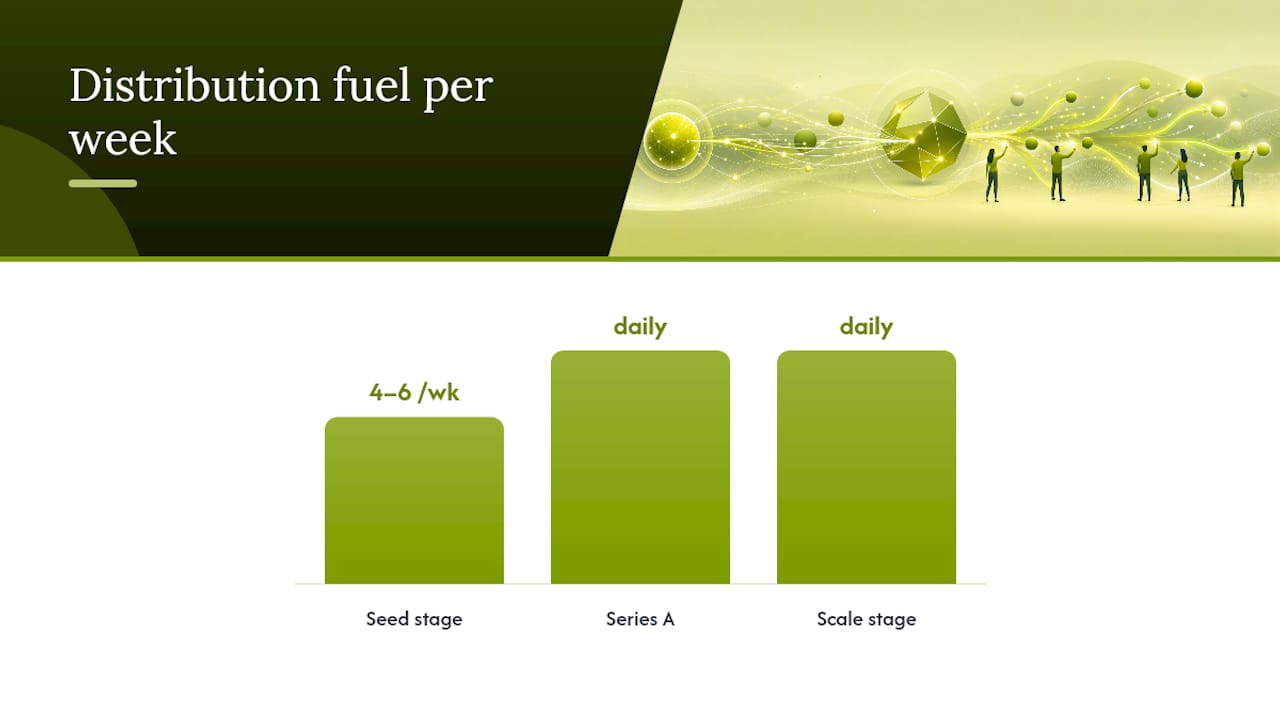
The second layer is distribution fuel, the short-form content, LinkedIn posts, email newsletter sections, and video clips, pulled directly from the anchor asset. One well-built anchor should produce eight to twelve pieces of fuel without the executive doing any additional work beyond the original interview or draft review.
The third layer is conversion content, shorter pieces aimed at buyers already in an active evaluation, things like a comparison framework, a pricing rationale, or an FAQ addressing objections sales hears every week.
Cadence should match company stage, not ambition:
- Seed stage: one anchor asset per month, four to six pieces of distribution fuel per week, almost no paid amplification. The goal is finding your voice, not scaling reach.
- Series A: one anchor every three weeks, daily distribution fuel across LinkedIn and email, light paid boosting on the strongest posts.
- Scale stage: weekly anchor-adjacent content across multiple executives, daily fuel, and a dedicated paid budget for amplifying anchors that show early engagement signals.
Repurposing an anchor asset means reframing it for the channel, not just cutting it shorter. A case study becomes a LinkedIn carousel highlighting the single most surprising number, a newsletter section framed as "what I learned building this," and a podcast talking point framed as a debate starter rather than a recap.
Where Thought Leadership Content Actually Gets Seen
Distribution decides whether your position reaches the buyer or just circulates among people who already agree with you. For B2B specifically, LinkedIn and email remain the two channels that consistently reach buying committees, not just individual readers. LinkedIn's own guidance recommends aligning on a clear brand perspective, setting measurable goals, and actively activating company leaders as publishers, not just approvers of someone else's copy.
Earned media works differently, and most executives pitch it wrong. Journalists and podcast hosts aren't looking for a company update, they want a documented take on something happening in the news right now. Rapid response to trending stories, paired with a willingness to go on record with a specific opinion, tends to land far more earned placements than a generic pitch about the company's mission.
- Send pitches with a one-sentence hook tied to a current event, not a company announcement
- Target podcasts where the host interviews operators, not just other marketers, since operator audiences convert to pipeline more often
- Reserve paid amplification for anchor assets that already show organic engagement, not for untested ideas
- Use paid spend to extend reach to a specific buying committee (job title targeting) rather than broad awareness
Pro Tip: Before pitching any podcast or publication, read or listen to three of their most recent pieces. A pitch that references something they actually covered last month gets a response rate several times higher than a cold, generic outreach email.
The Monthly System That Keeps Output Consistent
Executives don't have twenty hours a month for content. They have two to four, and a good production system is built entirely around that constraint. The engine is a single monthly extraction interview, roughly 45 to 60 minutes, where a writer or strategist pulls out the leader's current thinking on one theme.
That one interview should generate a full month of output: one authority anchor, six to eight LinkedIn posts, one newsletter section, and talking points for any podcast or press opportunity that comes up. According to the operational model described for executive content pipelines, this kind of disciplined pipeline, interview into repurposing into distribution, compounds authority in a way ad-hoc publishing never does, because the volume scales without adding hours to the executive's calendar.
Roles need to be explicit from the start:
- The executive talks. Nothing else. No drafting, no editing beyond a single review pass.
- The capture lead runs the interview and pulls the raw material into a brief.
- The producer writes the anchor and derivative assets against a documented content brief and a voice document, a running list of phrases, opinions, and speech patterns the leader actually uses.
- The reviewer applies a single-review service level agreement, one round of executive feedback, not five.
That single-review rule matters more than it sounds. Programs that let executives edit every draft multiple times lose momentum fast, and the content starts sounding like committee copy instead of a real voice.
The feedback loop closes the system. Sales conversations surface objections that become next month's theme. LinkedIn comment threads reveal which opinions actually provoke disagreement, which is usually a sign you've found a real position. Analytics on which anchor assets get shared by senior titles, not just total views, tell you which themes are resonating with buyers instead of just other marketers.
How to Know If It's Working
Vanity metrics kill more thought leadership budgets than bad writing does. Impressions and follower counts tell you almost nothing about whether a buyer moved closer to a decision. What matters is a metric hierarchy that ties content back to business behavior, not attention.
| Metric layer | What it measures | How to capture it |
|---|---|---|
| Pipeline impact | Deals influenced or sourced by content | Tagged links, CRM touch attribution on inbound leads |
| Position recognition | Whether your specific POV gets cited or repeated by others | Media mentions, "as [name] says" citations, inbound speaking invites |
| Audience quality | Who's actually engaging, not just how many | Job titles of commenters and shares, not raw engagement rate |
| Distribution reach | Where the content travels beyond owned channels | Podcast bookings, earned press placements, newsletter forwards |
Practical capture doesn't require expensive tooling. Tagged UTM links on every anchor asset tell you which piece drove a demo request. CRM fields that log "read [specific article]" as a touchpoint, gathered directly from sales conversations, connect content to closed revenue over a quarter. Even a simple inbox label for prospects who mention a specific post in an email gives you a qualitative signal that a spreadsheet full of impressions never will.
A useful measurement earns the trust HBR describes when it argues that demonstrable evidence tied to real outcomes is what actually earns and keeps buyer trust, not the volume of content published.
Report monthly on production consistency (did the anchor ship on schedule) and quarterly on pipeline and recognition metrics, since those move slower and get distorted by noise if you check weekly.
Signs Your Program Is Quietly Failing
Three failure patterns show up in almost every stalled thought leadership program, and all three are fixable without starting over.
- Borrowed consensus: if a competitor could publish your last five posts under their own name, you've drifted into safe, agreeable territory. Run every draft back through the "who else could say this?" test before it publishes.
- Over-reviewing: an executive who insists on three or four review rounds per piece isn't protecting quality, they're slowly draining the program's voice until it reads like legal copy. Cap review at one round, documented in advance.
- Vanity chasing: teams that optimize for likes and impressions instead of tagged pipeline touches will always report activity, never influence. If a monthly report doesn't include a pipeline number, it's not measuring the thing that matters.
A fourth, quieter failure: silence between anchor assets. A program that goes six weeks without publishing loses the compounding effect entirely, because audience memory for a POV fades fast without reinforcement.
Scaling From First Draft to Compounding Program
The first 90 days should be treated as an experiment, not a launch. Publish two or three anchor assets, watch which themes get genuine engagement from senior titles, and be willing to abandon a position that gets polite silence instead of real reaction.
- Months 1 to 3: run the monthly extraction cadence, test two or three positions, and measure which one produces actual sales conversations, not just likes.
- Months 4 to 9: double down on the theme that's working, add a second content pillar (podcast appearances or a newsletter, depending on where engagement concentrated), and start tracking pipeline-attributed touches formally.
- Months 9 to 18: consider adding a second executive voice only if the first program is running reliably without executive burnout, and only if the new voice targets a genuinely different buyer segment rather than duplicating the existing position.
Govern the program quarterly with a kill list: any theme, channel, or format that hasn't produced a pipeline touch or genuine engagement signal in a full quarter gets cut, no matter how much the team likes producing it. This is the same discipline behind engineering compounding systems instead of chasing one-off tactics. Growth that compounds requires cutting what doesn't work as ruthlessly as doubling down on what does.
Notes From Running These Programs
Most executive engagements I've been part of start the same way: a founder or CMO believes they don't have anything interesting to say, and forty minutes into the first extraction interview, it's obvious that's never true. What they usually lack isn't insight, it's a system that turns a scattered opinion into a documented, evidence-backed position someone can act on.
The engagements that work best run on a predictable rhythm: one evidence inventory up front (case studies, P&L outcomes, anything that qualifies as proprietary proof), one strategy document answering the four core questions, then monthly extraction sessions that feed the production pipeline. The ones that stall almost always skipped the evidence inventory and jumped straight to content, which produces confident opinions with nothing behind them.
The hardest trade-off is authenticity versus output. A producer who ghostwrites well can scale volume, but only if the voice document gets updated regularly and the executive stays disciplined about that single review pass. Loosen either constraint and the whole program drifts toward generic.
— Asha
Build the Program Instead of Guessing at It
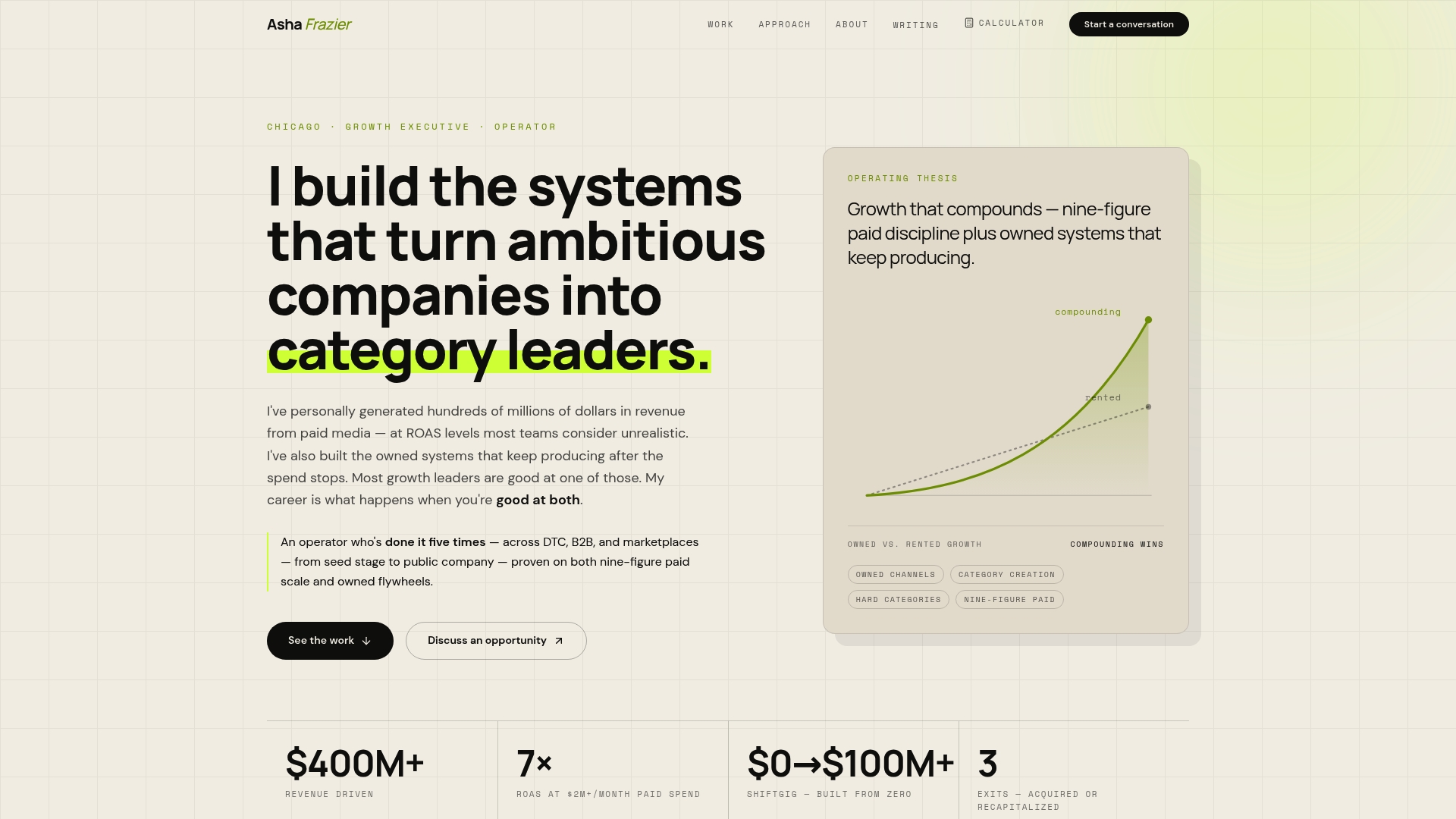
Most leaders reading this now have the framework. What they don't have is the two to four hours a month to run it, or the evidence inventory to back a position that actually holds up under scrutiny. That's the gap Asha Frazier closes: building the growth systems, positioning work, and production infrastructure that turn a leader's raw opinions into a compounding pipeline asset, not another content calendar nobody follows.
A typical engagement starts with discovery and an evidence inventory, pulling together the case studies, P&L outcomes, and proprietary data most executives already have but have never organized into proof. From there it moves into the monthly extraction and production cadence described above, paired with a distribution plan built around the channels your specific buyers actually use. You can review a documented example of this kind of outcome-driven work in the RealReal case study, which shows what disciplined positioning and channel work look like applied to a real business.
If you're ready to stop guessing at cadence and start with a documented four-question strategy built for your market, visit Asha Frazier's site to start a discovery conversation.
Sources
For readers who want to go deeper on specific pieces of this framework, these sources informed the recommendations above:
- Thought leadership strategy: a step-by-step guide to planning and building your strategy — FT Longitude
- How to Create Impactful Thought Leadership Content — LinkedIn
- Executive content strategy: how to turn leadership insights into SEO assets — ClusterMagic
- 3 ways marketers can earn and keep customer trust — Harvard Business Review