
Run these checks in this order and you will catch most of what's silently draining your budget: tracking integrity, wasted spend, account structure, targeting overlap, creative fatigue, landing page conversion, reporting accuracy, then platform-specific controls. Skip the order and you'll fix things that don't matter while the real leak keeps flowing. Here's the sequence:
- Signal integrity — verify conversions and events fire correctly before touching anything else
- Attribution and goals — confirm conversion definitions match what the business actually values
- Account structure — check naming, campaign separation, and duplication
- Targeting and overlap — find where your own campaigns are bidding against each other
- Creative audit — flag fatigue, gaps in format coverage, and stale assets
- Landing pages and CRO — confirm the click delivers on the ad's promise
- Reporting and dashboards — reconcile platform numbers against a source of truth
- Platform-specific controls — Google Ads, Performance Max, and Meta each have unique 2026 settings worth a dedicated pass
If you only have twenty minutes today, run check one. Everything downstream depends on it.
Key Takeaways
A paid media audit only works when tracking is verified before anything else, and findings are sequenced into a fix-first roadmap ranked by impact and effort.
| Point | Details |
|---|---|
| Verify tracking first | Confirm conversions and events fire correctly before touching bids, budgets, or creative. |
| Expect 20 to 40 percent waste | Most accounts have meaningful recoverable spend sitting in zero-conversion queries and overlapping audiences. |
| Sequence fixes by impact | Fix measurement, then active bleeding, then structure, then optimization, in that order. |
| Govern UTMs monthly | Inconsistent UTM values are a leading cause of attribution fragmentation in GA4. |
| Bring in Ashafrazier for execution | Asha Frazier's Revenue Compound System™ turns audit findings into a ranked, implemented roadmap tied to CAC and LTV. |
Table of Contents
- What Is a Paid Media Audit Checklist?
- What Should an Audit's Scope, Timeline, and Cost Look Like?
- Check 1: Is Your Conversion Tracking Actually Reliable?
- Check 2: Do Your Conversion Definitions Match Real Revenue?
- Check 3: Is Your Account Structure Helping or Hurting You?
- Check 4: Are Your Own Campaigns Competing Against Each Other?
- Check 5: Is Creative Fatigue Quietly Capping Your Performance?
- Check 6: Does Your Landing Page Deliver on the Ad's Promise?
- Check 7: Can You Trust Your Own Dashboards?
- What Platform-Specific Controls Need Checking in 2026?
- How Do You Turn Findings Into a Fix-First Roadmap?
- What Does a Repeatable Audit Template Look Like?
- How Does Asha Frazier's Revenue Compound Approach Differ?
- What Do Experienced Auditors Watch For That Others Miss?
- How Ashafrazier Turns This Checklist Into Results
- Sources
What Is a Paid Media Audit Checklist?
A paid media audit is a structured review of every campaign, tracking pixel, and dollar of spend across your advertising accounts, built to surface waste and misalignment before you commit more budget. Done right, it produces a ranked list of fixes, not a vague "your account needs work" summary. Teams run this kind of media campaign audit in a few recurring scenarios:
- A weekly health check to catch pacing anomalies and tracking breaks early
- A monthly remediation pass to clean up search terms and audience drift
- A pre-investment deep dive before a PE firm or new CMO takes over spend decisions
- A post-creative-refresh review to confirm new assets are actually performing
The mechanics touch GA4, Performance Max, and Consent Mode v2 configurations, all of which changed enough in the past two years that an audit built on 2023 assumptions will miss real problems.
What Should an Audit's Scope, Timeline, and Cost Look Like?
Scope should match the size of the fire. A quick health check catches active bleeding. A full structural audit rebuilds the foundation. Most accounts benefit from running both on a schedule rather than treating audits as a one-time event.
| Audit type | Frequency | Time required | What it covers |
|---|---|---|---|
| Quick sweep | Weekly | 20 minutes | Search terms, pacing, conversion anomalies |
| Monthly review | Monthly | 90 minutes | Attribution, audience overlap, creative fatigue |
| Structural audit | Quarterly | Half day | Account architecture, full remediation plan |
This cadence prevents waste from accumulating between deeper reviews. A complete engagement should hand you:
- A finished checklist with pass/warn/fail status per item
- A prioritized fix-first roadmap ranked by impact and effort
- Sample remediation tickets your team can assign directly
- A one-page executive summary for stakeholders who won't read the full audit
Check 1: Is Your Conversion Tracking Actually Reliable?
Nothing else in this audit means anything if your tracking is broken. Optimizing bids, testing creative, restructuring campaigns, all of it is wasted effort if the platform is optimizing toward the wrong signal or double-counting conversions. Verify measurement first, every time.
- Run Tag Assistant or GA4 DebugView on your top three conversion paths
- Confirm GA4 property settings match your actual conversion events, not defaults left over from setup
- Check Events and Conversions status in Google Ads and Meta Events Manager for delivery gaps
- Test server-side (CAPI) tracking against browser-side pixels for consistency
- Look for duplicate conversions firing on page refresh or back-button navigation
- Confirm attribution windows match your actual sales cycle, not platform defaults
Pro Tip: Run a single test purchase or lead submission through your funnel end to end, then check every platform's dashboard within an hour. If the numbers don't match across Google Ads, Meta, and GA4, you've found your first fix before you've even started the "real" audit.
Common failure points include Consent Mode v2 blocking ad_storage signals, GA4 filters silently excluding internal traffic from conversion counts, and CAPI deduplication keys that don't match browser-side event IDs.
- Cross-check every conversion source against a fourth reference point, like CRM data
- Flag anything reporting conversions with zero corresponding cost, a classic sign of tracking bleed
Check 2: Do Your Conversion Definitions Match Real Revenue?
A platform can report flawless performance while tracking the wrong thing entirely. Confirm that conversion values and attribution windows actually reflect your sales cycle rather than a default 30-day click window inherited from account setup.
- Verify primary conversions represent revenue events, not micro-actions like page scrolls or video views
- Check for conversion deduplication across platforms so the same sale isn't counted by both Google Ads and Meta
- Map every tracked event to actual revenue, confirming dollar values in the platform match real order values
- Compare attribution windows against your typical time-to-purchase, especially for high-consideration offers with multi-week sales cycles
Get this wrong and the damage compounds fast. A campaign crediting itself with conversions that closed through a completely different channel will show inflated ROAS, which pulls budget away from the channels that actually deserve it. Misplaced budget from bad attribution is one of the more expensive, least visible mistakes in a media campaign audit.
Check 3: Is Your Account Structure Helping or Hurting You?
Account architecture determines whether your bidding algorithms have clean signal to learn from or a mess of overlapping, competing campaigns. Review structure against a short set of standards:
- Consistent campaign naming that encodes goal, geography, and funnel stage
- One clear objective per campaign, not three goals fighting inside the same budget
- Brand and non-brand keywords fully separated, never blended in the same ad group
- Ad groups organized around tight keyword or audience themes, not broad grab-bags
The most common structural mistakes are duplicate targeting across campaigns, overlapping keywords bidding against each other, and budget fractured across near-identical campaigns that should have been consolidated months ago. Asha Frazier's team once inherited 99 city-level campaigns built for a single business, each one starving the others of budget and learning data.
- Identify campaigns targeting overlapping keywords or audiences
- Consolidate where consolidation improves signal density
- Rename everything using a consistent, documented convention
- Re-check bidding performance 14 days after any structural change
Check 4: Are Your Own Campaigns Competing Against Each Other?
Audience overlap is one of the sneakiest forms of wasted spend because both campaigns look fine in isolation. It's only when you compare them that you see you've been bidding against yourself.
- Measure overlap between prospecting and retargeting audiences using the platform's built-in audience targeting playbook
- Verify customer suppression lists are current, not months out of date, so you're not serving cold offers to existing customers
- Check lookalike audience freshness and confirm remarketing pool sizes are large enough to serve efficiently
- Pull the Search Terms report and flag any query with meaningful spend and zero conversions over the review period
- Add negative keywords for every wasteful query pattern you find, then recheck in two weeks
This single check regularly surfaces some of the fastest wins in the entire audit, because fixing it requires no new creative and no new landing pages, just cleaner targeting.
Check 5: Is Creative Fatigue Quietly Capping Your Performance?
Even a technically flawless account will underperform if the creative running inside it is stale. Build a simple asset inventory and track it over time rather than eyeballing performance once and moving on.
- Log every active asset: format, date last refreshed, CTR, and conversions attributed to it
- Check Ad Strength ratings and frequency scores for signs of fatigue
- Confirm format diversity across video, static, and carousel rather than leaning on one format
- Rank assets by spend impact, then prioritize refreshing the highest-spend, lowest-performing pieces first
- Frequency climbing while CTR falls is the clearest fatigue signal
- Kill underperforming assets fast; refresh mid-performers before they decay further
- New formats often outperform simply because the algorithm hasn't seen them yet, not because they're objectively better
Check 6: Does Your Landing Page Deliver on the Ad's Promise?
Traffic quality means nothing if the page it lands on kills the conversion. Post-click experience is where a surprising share of "underperforming campaigns" actually break down.
- Confirm the above-the-fold message matches the specific ad the visitor clicked, not a generic homepage
- Check CTA visibility and form flow, especially on mobile, where most paid traffic now lands
- Test page speed against a 3-second mobile load target
- Verify UTM parameters and click IDs (gclid, fbclid) pass through cleanly without being stripped or overwritten
Because Link Tracking Protection can strip click IDs in some browsers, treating UTMs as the authoritative signal and adding server-side tag capture protects your attribution data from silent gaps. Small, fast CRO tests, like moving the CTA above the fold or cutting a form field, often produce lifts within days rather than weeks.
Check 7: Can You Trust Your Own Dashboards?
Reporting is where bad news hides best, because a dashboard built on inconsistent inputs will always look coherent even when it's wrong. Reconcile before you report.
- Cross-check platform-reported spend and conversions against an independent source: billing statements, server logs, or GA4's own import data
- Standardize KPI definitions for CAC, LTV, and ROAS across every dashboard so teams aren't comparing different formulas under the same label
- Enforce UTM governance monthly, since inconsistent UTM values are the leading cause of channel fragmentation inside GA4
- Align dashboard KPIs to actual business outcomes rather than vanity platform metrics; Harvard Business School's guidance on marketing KPIs is a useful reference for that mapping
A monthly reconciliation plus a one-page executive summary covering spend, CAC, and pipeline impact keeps stakeholders focused on outcomes instead of channel-level noise.
What Platform-Specific Controls Need Checking in 2026?
Google Ads, Performance Max, and Meta each carry configuration risks that a generic checklist will miss entirely.
- Google Ads: confirm ad_storage consent signals are firing correctly, enhanced conversions are matching at expected rates, and account-level negative keyword lists are current
- Performance Max: review channel distribution and asset-group performance, check search themes for drift, and lock down URL expansion settings so the algorithm isn't sending traffic to unintended pages
- Meta: check event health inside Events Manager, confirm CAPI server-side signals match browser events, and review placement performance to exclude underperforming Audience Network inventory
- AI-readiness: verify brand exclusions are active, control URL expansion, and govern any auto-generated creative so automated targeting doesn't drift outside your intended audience
Audits consistently find that 20% to 40% of budget is going to traffic that was never going to convert, and much of that waste concentrates in exactly these platform-level blind spots, especially Performance Max's expanded reach settings.
How Do You Turn Findings Into a Fix-First Roadmap?
A long list of findings is useless without a way to sequence them. Score every item on impact versus effort, then work the matrix in a fixed order.
- Fix measurement problems first; nothing else can be trusted until tracking is verified
- Stop active bleeding second, like a brand campaign leaking spend to competitor queries
- Fix structural issues third, since restructuring resets learning periods and shouldn't wait
- Optimize creative and bidding last, once the foundation underneath them is solid
- High impact, low effort: stopping brand query leakage, adding obvious negative keywords
- High impact, high effort: full account restructuring, migrating to server-side tracking
- Low impact, low effort: minor creative swaps, small budget reallocations
A realistic roadmap runs 30/60/90 days: days 1 to 30 fix measurement and stop bleeding, days 31 to 60 restructure and rebuild audiences, days 61 to 90 optimize creative and scale what's working. The first 30 days matter most because early wins fund the rest of the roadmap.
What Does a Repeatable Audit Template Look Like?
An audit only earns trust if two different people running it a month apart get comparable results. That requires a template, not a checklist scattered across sticky notes and screenshots.
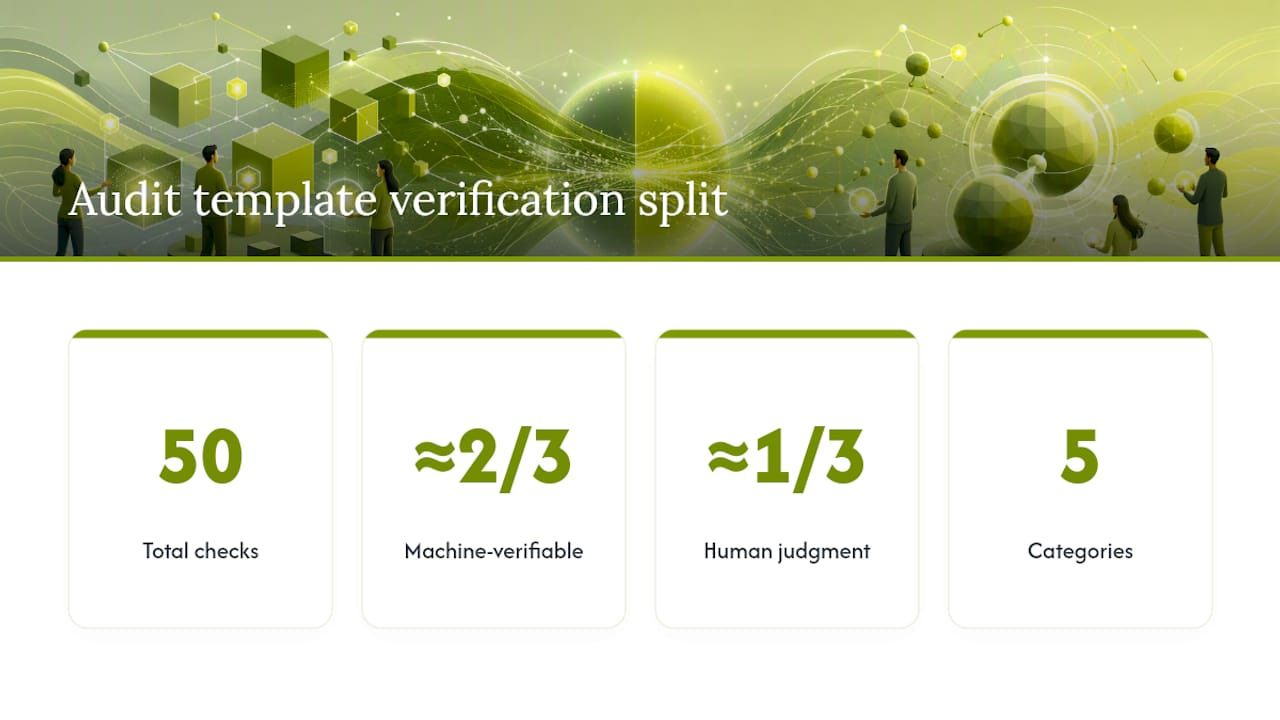
Each row should capture: check ID, audit area, the exact test performed, a pass/warn/fail/unverified status, an evidence field (screenshot or export link), severity, affected spend, and a remediation recommendation. A well-built 50-point template splits checks this way, with roughly two-thirds of items machine-verifiable and the rest requiring human judgment.
Sample rows might cover: conversion tracking accuracy (measurement), zero-conversion search terms above a spend threshold (wasted spend), duplicate campaign targeting (structure), bid strategy versus conversion volume (bidding), and asset refresh date versus fatigue signals (creative). Once scored, convert every fail into a ticketed remediation item with an owner and a deadline, not a bullet point that quietly disappears.

How Does Asha Frazier's Revenue Compound Approach Differ?
Most paid media underperformance isn't a bidding mistake. It's structural rot that built up over 12 to 36 months of campaigns launched, half-abandoned, and never cleaned up, disconnected from the business's actual unit economics. Asha Frazier built the Revenue Compound System™ specifically to close that gap between what an account measures and what the business actually needs to grow.
- The system maps every audit checkpoint back to CAC, LTV, and payback period, not isolated platform metrics
- It treats paid media and owned channels as one connected growth system rather than separate budgets
- Fifteen-plus years of engagements, including a documented turnaround recovering wasted spend and rebuilding structure, inform the checklist itself
The account isn't underperforming because someone set a bad bid. It's underperforming because nobody has connected what the ad platform reports to what the business actually needs to survive its next twelve months.
What Do Experienced Auditors Watch For That Others Miss?
The messes that do the most damage aren't dramatic. They're small inconsistencies that compound quietly over years: mixed UTM and gclid usage across teams, duplicate conversions nobody noticed, campaigns competing against each other for the same keyword, Performance Max URL expansion sending traffic somewhere nobody approved.
None of it looks urgent in isolation. All of it adds up. Before recommending a single dollar of new spend or a major restructure, run the 20-minute sweep first. It's boring, and it's the check that saves you from fixing the wrong problem.
How Ashafrazier Turns This Checklist Into Results
Running this checklist yourself gets you a diagnosis. Turning that diagnosis into recovered revenue, without pausing campaigns for months or guessing at priorities, is where most internal teams stall out.
Ashafrazier runs this exact audit process as the first phase of every engagement, then does what most agencies won't: builds the prioritized fix-first roadmap and implements it directly, tied to real CAC and LTV targets instead of platform vanity metrics. This works best for founders, growth leaders, and PE-backed leadership teams who need someone to own execution, not just hand over another slide deck. Engagements run as project-based audits or ongoing retainers depending on how deep the rebuild needs to go, and the ideal fit for many multi-location or private-equity-backed operators is a fractional CMO engagement rather than a one-off report.
If you want a clearer read on where your own numbers stand before you commit to anything, run them through the Growth Score Calculator to see your current CAC, LTV, and payback period side by side.
Sources
A few sources are worth reading directly if you want to go deeper on any single check in this paid media audit checklist:
- Google Ads Audit Checklist: A 50-Point Template for 2026 | Soku
- The 2026 UTM Tagging Guide: A Complete, Dated Reference for Marketing Teams - Terminus Blog
For a closer look at applied audit and remediation work, Asha Frazier's case studies and blog archive cover specific engagements in more depth than this checklist alone can.