
Size your marketing budget with a revenue-percentage benchmark or a bottom-up pipeline target, then split it 70/20/10 across proven, strategic, and testing channels, adjusted for your company's stage. The operational piece most teams skip is to pre-authorize a quarterly reallocation band, typically 10 to 15% of total spend, so money can move to what's working without a committee vote. Once that's set, follow the seven-step process below to build the actual plan.
TL;DR:
- Most companies should adjust their marketing budget by stage, with early-stage firms allocating more to proven channels and mature companies favoring high-confidence spend.
- Regular data audits and scenario-based planning are essential to avoid inertia, ensuring reallocations are evidence-driven and responsive to external market shifts.
- Establishing clear triggers for reallocation, along with quarterly pacing and contingency reserves, allows fast responses to changes like CAC fluctuations or competitive actions.
- Integrating marketing and sales data, defining shared metrics, and aligning both teams’ pipeline goals prevent disputes and improve budget agility.
- Leadership must empower decision-makers with authority and discipline to reallocate funds based on real-time data, rather than sticking to rigid, year-old plans.
Table of Contents
- What Should Your Marketing Budget Allocation Look Like Right Now?
- Why Marketing Budgets Fail and How to Fix Them
- How to Create a Marketing Budget Allocation That Finance Approves
- Channel Allocation Models: Making 70/20/10 Work at Your Stage
- Pacing, Contingency, and Reallocation Rules That Actually Work
- Measurement and Governance: The Metrics That Keep Everyone Honest
- Asha Frazier's Frameworks for Turning Budgets Into Systems
- Connecting Your Marketing Budget to Business Strategy
- How External Factors Should Change Your Budget Allocation
- Marketing Technology for Tracking and Optimizing Budget Allocation
- Who Should Be in the Room for Budget Decisions
- Getting Marketing and Sales on the Same Budget Page
- What Leadership Actually Needs to Get Right
- Getting Help Building an Allocation System That Actually Runs
- Sources
What Should Your Marketing Budget Allocation Look Like Right Now?
Most leaders ask the wrong first question. They want to know "how much should I spend" before they know "what am I spending it on and why." Fix the order, and the number gets easier to defend.
Gartner's CMO Spend Survey puts the average marketing budget at 7.7% of company revenue in 2026, but that average hides massive variation by sector and growth stage. A company burning capital to win share behaves nothing like a mature player defending margin, and your allocation should reflect that difference, not a generic industry number.
Use these guardrails to sanity-check whatever number finance hands you:
- Total spend: anchor near the 7.7% average, then adjust up for early-stage growth pressure or down for a mature, retention-heavy business.
- Channel split: 70% proven channels with a documented CAC and payback period, 20% strategic bets with early signal but incomplete data, 10% pure testing with no performance history yet.
- Testing budget: treat that 10% as a genuine research line, not a leftover. Give it a 90-day evaluation window before judging results.
- Contingency reserve: hold back 5 to 10% of total spend, untouched until a defined trigger fires.
- Quick audit: if you can't name your CAC by channel, your payback period, or your last reallocation date, your budget is running on inertia, not evidence.
If your current plan fails two or more of those checks, you're not managing a budget. You're managing last year's guesswork with this year's number attached to it.
Why Marketing Budgets Fail and How to Fix Them
Most marketing budgets don't fail because the number was wrong. They fail because the structure around the number was never built to flex. I've watched companies set a budget in November, lock it, and then spend twelve months defending decisions that stopped making sense in February.
Here are the four failure patterns I see most often, in order of how much damage they do:
- Static annual planning. A single number, split evenly across twelve months, treated as gospel until the next planning cycle. Markets don't move on your fiscal calendar, so a budget that can't move with them guarantees waste. Scenario-based forecasting instead, built around baseline, growth, and conservation cases, gives you a plan you can actually execute when reality diverges from the forecast, which it always does.
- Allocating by habit, not evidence. Money keeps flowing to the channel that's always gotten money, regardless of what CAC or LTV data says this quarter. This is the single most expensive failure mode because it's invisible. Nobody flags a decision that "worked last year" until the payback period has quietly doubled.
- Disconnected data sources. Marketing pulls numbers from one platform, finance pulls from another, and nobody agrees on what "performance" means. Without a shared source of truth, every reallocation conversation turns into a negotiation instead of a decision, as explained in this marketer's guide on why measure campaign performance. Unifying that data is one of the highest-leverage moves available, because it converts subjective arguments into evidence-based calls almost overnight.
- Under-resourced testing and contingency. Teams spend everything on proven channels because testing feels risky, then have zero flexibility when a channel saturates or a competitor moves. No reserve, no experiments, no way to adapt.
Pro Tip: Before you touch your channel mix, fix your data source problem. A perfect allocation model built on bad or fragmented numbers still produces bad decisions. Get marketing and finance looking at the same dashboard before you argue about where the next dollar goes.
The fix for all four isn't more spreadsheets. It's a documented cadence: quarterly reforecasting instead of annual lock-in, allocation decisions tied to CAC and payback data instead of tenure, one shared measurement source between marketing and finance, and a testing budget with real teeth behind it. None of this requires new headcount. It requires someone with the authority to say "we're changing course" and a process that makes that decision fast instead of political.
How to Create a Marketing Budget Allocation That Finance Approves
Building a budget that survives contact with a board meeting takes more than a spreadsheet with last year's numbers bumped up 10%. It takes a process finance can follow and defend on its own, without you in the room. Here's the sequence I use with growth teams.
1. Define outcomes and revenue targets first
Start with the business number, not the marketing number. What revenue does the company need to hit this year, and what does the sales pipeline need to look like to get there? Your budget exists to serve that target, not the other way around. If leadership wants $20 million in new revenue and your historical close rate on marketing-sourced pipeline is 20%, you need $100 million in qualified pipeline. That figure, not an arbitrary percentage, is your real starting point.
2. Pick your sizing method
You have two credible options, and the right one depends on how mature your revenue engine is.
- Revenue-percentage benchmarking: take a percentage of projected revenue, informed by the 7.7% average Gartner reports, adjusted for your stage and sector. Works well for companies with stable, predictable revenue.
- Bottom-up pipeline target: work backward from the pipeline number you need, divide by your historical cost-per-pipeline-dollar by channel, and build the budget from there. Works better for earlier-stage companies where a flat percentage of a small revenue base doesn't cover what you actually need to spend to grow.
Most mature companies benefit from running both and reconciling the gap. If they land far apart, that gap is telling you something important about either your growth ambition or your channel efficiency.
3. Audit last year's performance by channel
Before you allocate a dollar forward, know what every channel actually returned. Pull CAC, payback period, and pipeline contribution for each channel over the last four quarters, not just the last one. A channel that looked great in Q1 and collapsed by Q4 tells a different story than the annual average suggests. This is also where you separate real performance from attribution noise, a distinction the LTV:CAC framework makes concrete instead of theoretical.
4. Allocate by outcome and funnel stage
Don't just split spend by channel. Split it by what each dollar is supposed to accomplish: demand generation, brand building, or retention and expansion. Then map that against funnel stage, top, middle, and bottom, because a channel like paid search behaves completely differently depending on whether it's capturing existing demand or trying to create it. Retention spend gets skipped constantly in this exercise, and it's usually the cheapest revenue you can buy.
5. Set testing briefs with 90-day success criteria
Every dollar in your 10% testing bucket needs a brief before it gets spent: what hypothesis you're testing, what metric decides success, and a 90-day window to reach a verdict. Without that discipline, tests run indefinitely and never graduate to proven or get killed. Define the promotion criteria in advance so a channel that clears the bar moves into the proven bucket with a documented handoff, not a vague "let's keep watching it."
6. Establish quarterly pacing and contingency reserves
Build your budget in quarterly increments, not one annual lump sum, with a contingency reserve of 5 to 10% held in reserve for the year. Define upfront who can authorize contingency spend and at what dollar threshold, so a market shift doesn't sit in an approval queue for three weeks while a competitor takes the opportunity.
7. Model scenarios and publish switch triggers
Build three versions of the plan: baseline, growth, and conservation, matching the scenario-based approach that holds up under real market volatility. For each scenario, publish the specific trigger that moves you from one to another: a revenue miss of a defined percentage, a CAC spike past a set threshold, or a funding event. Then align your reporting structure and KPI dashboard with finance from day one, so nobody discovers a mismatch mid-quarter, and assign a named owner for each channel's numbers.
That's a budget finance can interrogate and approve in one meeting, because every number traces back to a decision, not a guess.
Channel Allocation Models: Making 70/20/10 Work at Your Stage
The 70/20/10 split gets cited constantly, and it deserves the attention, but most people apply it without understanding why the ratios exist. Prooflytics frames the model as one layer in a five-part budget structure, and the logic behind the split matters more than the exact numbers.
Seventy percent goes to proven channels: the ones with a documented CAC, a known payback period, and enough history to model expected returns. Twenty percent goes to strategic bets: channels showing early signal but lacking the volume or duration to be called "proven" yet. Ten percent goes to genuine testing: new channels, new formats, or new audiences with no performance history at all. The ratio exists to protect you from two opposite failures at once. Over-invest in "proven" and you eventually hit saturation with no pipeline of what comes next. Over-invest in testing and you starve the channels actually generating revenue today.
Stage changes the math meaningfully:
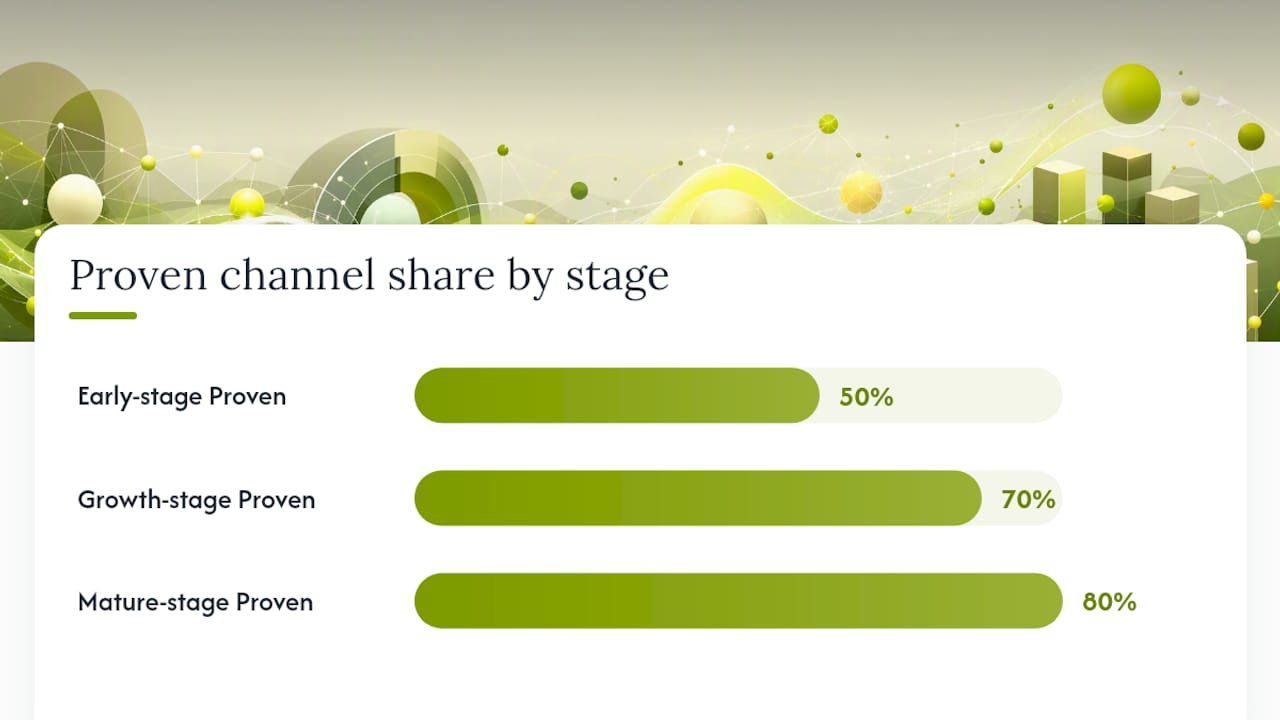
- Early-stage companies often run closer to 50/30/20, because almost nothing has a long enough track record to count as "proven," and the cost of missing a channel that could work outweighs the inefficiency of testing more aggressively.
- Growth-stage companies tend to land near the textbook 70/20/10, with a handful of channels graduated into the proven bucket and a disciplined testing pipeline feeding the next wave.
- Mature companies frequently shift toward 80/15/5, leaning harder into optimized, high-confidence channels, though this comes with real saturation risk if the strategic and testing buckets get starved for too many quarters in a row.
One category worth watching regardless of stage: retail media has become one of the fastest-growing lines in e-commerce budgets, and Gartner's spend data flags it as an area absorbing a growing share of digital ad dollars.
What actually promotes a channel from testing to proven? Three conditions, all required together: a CAC and payback period that hold steady across at least two consecutive quarters, a sample size large enough that the result isn't noise, and a documented attribution methodology that both marketing and finance agree measures the channel fairly. A channel that hit its number once, with an attribution model nobody's checked, isn't proven. It's lucky. The Channel Priority Matrix gives you a structured way to make that call instead of relying on gut feel.
Pacing, Contingency, and Reallocation Rules That Actually Work
An annual budget with no reallocation mechanism is a bet, not a plan. The fix is building explicit rules into the budget itself, before you need them, so a reallocation decision takes a day instead of a month of internal debate.
Grammarly's engineering team built an internal tool called BEAM to automate exactly this kind of constrained reallocation across channels, illustrating a broader point: even with algorithmic optimization, you still need explicit guardrails on how much spend can shift and how fast, or you introduce more risk than you remove.
Set these triggers in the budget document itself, not in a separate memo nobody reads:
- CAC change trigger: a channel's CAC rises or falls by a set threshold (commonly 15 to 20%) for two consecutive months, triggering a mandatory review.
- Saturation trigger: marginal return on additional spend in a channel drops below your minimum acceptable payback period.
- Test pass/fail trigger: a testing-bucket channel hits its 90-day evaluation window and either graduates to strategic or gets cut.
- Competitive trigger: a competitor's move (a price change, a major campaign, a market entry) materially shifts the cost or effectiveness of a channel you rely on.
Reallocation bands of 10 to 15% per quarter give teams room to respond to real signal without turning every budget conversation into a renegotiation of the entire plan.
Contingency reserves deserve their own category, separate from the reallocation band. Practitioner guidance consistently points to ring-fencing 5 to 10% of total budget as a true emergency reserve, untouched by routine performance shifts and reserved for genuine surprises: a sudden market opportunity, a competitor's misstep you can capitalize on, or a macro shock that changes customer behavior overnight.
Build a simple approval matrix so nobody has to guess who signs off:
- Under 5% of quarterly budget: marketing lead approves directly.
- 5 to 15%: marketing lead plus finance partner, approved within 48 hours.
- Above 15% or touching contingency reserve: CFO and CMO joint sign-off, with a same-week decision requirement.
Speed is the entire point. A trigger that takes three weeks to act on has already cost you the opportunity it was designed to capture.
Measurement and Governance: The Metrics That Keep Everyone Honest
A budget is only as credible as the measurement system behind it. If marketing and finance are looking at different numbers, every allocation decision turns into a negotiation instead of a fact-based call.
Set a small number of top-level metrics everyone agrees on before you argue about channel-level detail:
- Marketing efficiency ratio: revenue generated per dollar of marketing spend, tracked quarterly.
- LTV:CAC ratio: the single number finance trusts most, because it ties acquisition cost directly to long-term value rather than a single conversion event. Ashafrazier's breakdown of the LTV:CAC ratio walks through how to calculate it without the common errors that inflate it artificially.
- Pipeline-per-dollar by channel: the metric that actually informs reallocation decisions, since it connects spend directly to revenue outcomes rather than clicks or impressions.
The bigger governance question is which attribution model to trust, and the honest answer is neither one alone. Platform-level attribution (last-click or multi-touch inside ad platforms) gives you fast, granular, real-time signal but systematically over-credits lower-funnel channels and misses brand and offline influence entirely. Marketing mix modeling gives you a more accurate read on incremental impact across the full mix, but it runs on a lag and requires more data infrastructure to maintain. Objective Platform's guidance on measurement-first allocation recommends using MMM to validate the incremental lift that platform attribution tends to overstate, then reconciling the two rather than picking a side.
Cadence matters as much as the metrics themselves. Run monthly operational reviews focused on pacing and early trigger signals, and quarterly strategic reviews where reallocation decisions actually get made. A growth marketing KPI dashboard built around these metrics, shared between marketing and finance in the same view, is what turns this from theory into a habit your team actually keeps.
Asha Frazier's Frameworks for Turning Budgets Into Systems
Fifteen years of building growth systems across paid and owned channels has taught me one consistent lesson: the companies that win aren't the ones with the biggest budgets. They're the ones with the clearest rules for moving money when the data changes.
The Channel Priority Matrix is the tool I use most often to rank channels for funding, and it works because it forces a decision on two axes at once: evidence strength (how much reliable performance history exists) and strategic value (how much a channel matters even before it's fully proven). A channel with strong evidence and strong strategic value gets funded first. A channel with weak evidence and low strategic value gets cut, regardless of how much internal momentum it has. This removes the politics that usually decide which channels survive a budget cycle.
That same evidence-first approach produced measurable results in a B2B marketplace where CAC dropped from $150 to $11 per brand, documented in this case study, by rebuilding the acquisition funnel around the channels the data actually supported instead of the ones the team assumed were working.
Pro Tip: Build your reallocation checklist and testing brief as standing templates, not one-off documents. Every reallocation decision should answer the same five questions: what's changing, why, what's the trigger, who approved it, and what's the review date. Every test should define its hypothesis, success metric, and 90-day evaluation window before a dollar gets spent. Standardizing the format is what makes fast decisions safe decisions.
Two templates I recommend every team keep on hand:
- A reallocation checklist: trigger identified, data source confirmed, approval level determined, amount moved, and review date set.
- A testing brief: hypothesis, success metric, budget cap, 90-day evaluation date, and promotion criteria to strategic status.
None of this requires exotic tooling. It requires discipline applied consistently, quarter after quarter.
Connecting Your Marketing Budget to Business Strategy
A marketing budget that isn't tied to a specific business objective is just a number waiting to be cut when the next belt-tightening exercise arrives. The budgets that survive scrutiny are the ones built backward from the company's actual goals, not forward from last year's line items.
If the company's stated priority is entering a new market segment, your budget allocation should visibly reflect that: more testing spend directed at new-segment acquisition, more strategic-bucket investment in the channels most likely to reach that audience. If the priority is protecting margin during a slower growth year, your allocation should lean harder into retention and expansion spend, where the cost per dollar of revenue retained is almost always lower than the cost of new acquisition.
This connection needs to be explicit in the budget document itself, not implied. Every major line item should trace to a stated business objective: revenue growth, margin protection, market expansion, or category defense. When a budget review happens, and it will, that traceability is what separates a defensible plan from one that gets cut on sentiment alone.
It also changes how you talk to your board and your executive team. Instead of presenting spend by channel, present it by business outcome, with channel detail as supporting evidence. That reframe alone often resolves half the tension between marketing and finance, because finance isn't arguing with a marketing tactic anymore. They're evaluating a business investment against a stated company goal, which is a conversation they're built to have.
How External Factors Should Change Your Budget Allocation
Your budget doesn't exist in a vacuum, and treating it like a fixed annual document ignores how fast the variables around it move. Economic conditions, competitive behavior, and market shifts all change the return on the same dollar spent in the same channel, sometimes within a single quarter.
Economic tightening typically compresses customer budgets and lengthens sales cycles, which means channels optimized for fast conversion often underperform while channels that build long-term trust and pipeline, content, retention, referral, hold up better relative to cost. A recession-era budget usually needs more weight on retention and less on aggressive top-of-funnel acquisition, because the math on new customer payback periods gets worse right when capital gets more expensive.
Competitive moves matter just as much. A competitor launching an aggressive campaign in a channel you rely on can spike your CAC in that channel within weeks, which is exactly the kind of shift your quarterly reallocation triggers should catch and respond to. Watching competitive spend patterns, even informally, gives you an early warning system that a purely internal metrics review misses.
Broader market changes, a platform algorithm update, a new regulation affecting data targeting, a shift in how your audience discovers products, all demand the same response: a scenario already modeled, a trigger already defined, and a team already authorized to act on it. The companies that get hurt by external shifts aren't the ones facing the toughest conditions. They're the ones whose budget had no mechanism for responding to conditions changing at all.
Marketing Technology for Tracking and Optimizing Budget Allocation
The right technology stack doesn't replace judgment in a budget decision, but it removes the lag between a channel underperforming and someone noticing. Most budget waste isn't a bad decision. It's a good decision made three weeks too late because nobody was looking at the right dashboard.
At minimum, your stack needs three components working together: a unified reporting layer that pulls spend and performance data from every channel into one view, a CRM or revenue platform that connects marketing spend to actual pipeline and closed revenue rather than clicks or leads, and an attribution or mix-modeling tool that helps separate real incremental impact from noise. Fospha's 2026 planning guidance emphasizes exactly this: unifying disconnected reporting sources reveals headroom and saturation points that siloed dashboards hide entirely.
More advanced teams are experimenting with algorithmic allocation tools that use constrained optimization models to suggest spend shifts automatically, the same category of tool Grammarly's engineering team built internally with BEAM. These systems can process signal faster than a quarterly human review, but they still need explicit constraints on how much and how fast they're allowed to move money, or they introduce a different kind of risk: rapid, automated overcorrection based on short-term noise.
You don't need enterprise software to start. A shared spreadsheet with consistent definitions, updated weekly, beats three disconnected platforms that never talk to each other. The technology matters less than the discipline of everyone looking at the same numbers on the same schedule.
Who Should Be in the Room for Budget Decisions
Budget planning fails more often from unclear ownership than from bad math. When everyone assumes someone else is tracking a trigger or approving a shift, decisions stall exactly when speed matters most.
Four roles need clearly defined responsibility, ideally documented in the budget itself. The CMO or marketing lead owns the overall allocation strategy and is accountable for hitting the pipeline and revenue targets the budget was built to serve. The CFO or finance partner owns the sizing methodology and approval thresholds, and needs visibility into performance data in real time, not just at quarter-end. Channel owners are accountable for the CAC, payback, and pipeline contribution of their specific channel, and should be the first to flag a trigger before it escalates. Executive leadership sets the business objectives the budget serves and needs to see spend translated into those objectives, not raw channel-level detail, in every review.
Communication cadence matters as much as the roles themselves. A monthly operational check-in between marketing and finance catches pacing issues early. A quarterly strategic review, with executive leadership present, is where reallocation decisions actually get ratified and where the scenario models built during planning get tested against reality.
Getting Marketing and Sales on the Same Budget Page
Few things damage a marketing budget's credibility faster than sales and marketing operating from different definitions of a "qualified lead" or disagreeing on what pipeline actually converted. If those two teams aren't planning budget together, the CAC and payback numbers driving your reallocation decisions are built on a fault line.
Start with a shared definition of pipeline stages and a joint agreement on what counts as marketing-sourced versus marketing-influenced revenue. This single alignment step resolves more budget disputes than any amount of additional reporting sophistication, because it eliminates the "that wasn't really a marketing lead" argument before it starts.
From there, build a joint quarterly planning session where marketing presents its channel allocation and sales presents its pipeline coverage needs, and the two get reconciled in the same room rather than in separate documents that get compared after the fact. If sales needs more qualified pipeline in a specific segment, that should show up directly in marketing's testing or strategic budget allocation for the next quarter, not get raised as a complaint three months later.
The teams that get this right treat the marketing budget and the sales quota as two expressions of the same underlying revenue target, reviewed together, adjusted together, and measured against the same pipeline-per-dollar metric. That alignment is what makes a reallocation decision fast and uncontested instead of a fight over whose numbers are right.

What Leadership Actually Needs to Get Right
The technical parts of this, the sizing formula, the 70/20/10 split, the trigger thresholds, are the easy part. The hard part is building an organization willing to act on the data once it's in front of them. I've seen companies build sophisticated dashboards, define perfect trigger thresholds, and then still leave a failing channel funded for two more quarters because nobody wanted to be the one who said "stop."
That's a leadership failure, not a data failure. Enabling reallocation means giving someone explicit authority to move money without a committee vote, and it means treating a reallocation decision as evidence of good management, not as an admission that the original plan was wrong. Every budget is a hypothesis. Refusing to update it when the evidence changes isn't discipline. It's just a slower way of losing.
My honest advice to anyone rebuilding a budget this quarter: get finance in the room before you finalize the split, not after. A budget marketing builds alone and hands to finance for approval invites exactly the kind of second-guessing that kills fast reallocation later. A budget built jointly, with shared triggers and shared metrics from day one, becomes a document both sides defend instead of one side has to sell.
— Asha
Getting Help Building an Allocation System That Actually Runs
Everything in this playbook is executable in-house, but building the measurement infrastructure, the reallocation triggers, and the finance alignment while also running your day-to-day campaigns is a lot to ask of one team. This is exactly the gap fractional CMO and growth engagements exist to close. When you need someone who's built both the paid and owned side of a growth system, and can sit in the room with finance and defend the numbers, that's a different kind of hire than another agency retainer.
The case study on RealReal shows what that looks like when the channel mix, attribution, and reallocation rules are rebuilt from the ground up rather than patched quarter to quarter.
If you're not sure whether your current spend is sized correctly for your stage, run the Growth Score Calculator to get a fast read on your LTV, CAC, and payback period before your next planning cycle. From there, request a consultation to talk through whether a fractional CMO engagement fits where your growth system stands today.