
A winning LinkedIn ads strategy drives measurable pipeline by combining account-focused targeting, funnel-mapped formats, and a 90-day measurement cadence — not just impressions and clicks. Before you spend a dollar, lock in these five actions:
- Define your campaign objective by funnel stage (awareness, consideration, or conversion) and select the matching Campaign Manager objective.
- Build your audience from account lists or Matched Audiences before relying on LinkedIn's broad professional filters.
- Match your ad format to your objective: Sponsored Content for TOFU, Lead Gen Forms for MOFU/BOFU, Sponsored Messaging for high-intent accounts.
- Set a 90-day measurement window. LinkedIn pipeline influence rarely shows in 30 days; most qualified opportunities surface between day 60 and day 90.
- Connect Campaign Manager to your CRM before the first ad goes live, so every lead routes, scores, and attributes correctly from day one.
What to expect: By day 30, you should have enough impression and click data to validate audience quality. By day 60, form fills and lead quality signals should be visible in your CRM. By day 90, you can make a defensible claim about pipeline contribution and cost per opportunity.
Table of Contents
- How do you plan LinkedIn campaigns by objective and funnel stage?
- What targeting options give you the best results on LinkedIn?
- Which ad formats work best at each funnel stage?
- How should you set your LinkedIn Ads budget and bidding strategy?
- What creative and landing experience actually converts on LinkedIn?
- How should you structure your LinkedIn Campaign Manager account?
- How do you measure LinkedIn Ads performance and attribute pipeline?
- How do you run A/B tests and optimize LinkedIn campaigns?
- What advanced tactics move the needle for experienced LinkedIn advertisers?
- What are realistic LinkedIn Ads benchmarks and a 90-day diagnostic timeline?
- How do LinkedIn Ads fit into a revenue-driving growth system?
- Key Takeaways
- What actually works on LinkedIn Ads right now
- Ashafrazier builds LinkedIn growth systems that generate pipeline, not just leads
- Further reading and primary sources
How do you plan LinkedIn campaigns by objective and funnel stage?
Most teams light capital on fire on LinkedIn because they skip the planning step that matters most: mapping each campaign to a specific funnel stage before choosing a format, audience, or bid strategy. The platform's Campaign Manager forces you to pick an objective at the campaign level, and that choice shapes everything downstream — delivery algorithm, eligible formats, and optimization signals.
Funnel-stage mapping:
- TOFU (awareness and engagement): Use Brand Awareness or Video Views objectives. Ask for attention, not commitment. The offer at this stage is a point of view, a short video, or a Thought Leader Ad from a credible voice inside your company.
- MOFU (consideration and evaluation): Use Website Visits or Engagement objectives. Ask for a content download, a webinar registration, or a document preview. This is where Document Ads and Lead Gen Forms earn their keep.
- BOFU (conversion and pipeline): Use Lead Generation or Website Conversions objectives. Ask for a demo request, a discovery call, or a free assessment. Audience should be retargeting or ABM account lists showing prior engagement.
Budget allocation starting point: A reasonable split for a B2B team with a $10,000 monthly LinkedIn budget is roughly 30% TOFU, 40% MOFU, and 30% BOFU. Shift spend toward BOFU as your retargeting pools grow and as MOFU conversion rates stabilize. If BOFU CPL is running well below your target, pull budget from TOFU first.
Offer-signal fit check: Before any spend, answer these four questions. Does your offer match the intent level of the audience you're targeting? Is there a clear, low-friction path from ad click to conversion? Does your landing page or Lead Gen Form confirm the promise the ad made? And do you have a CRM workflow ready to route and follow up on every lead within 24 hours? If any answer is no, fix it before the campaign launches — no bid strategy rescues a broken offer.
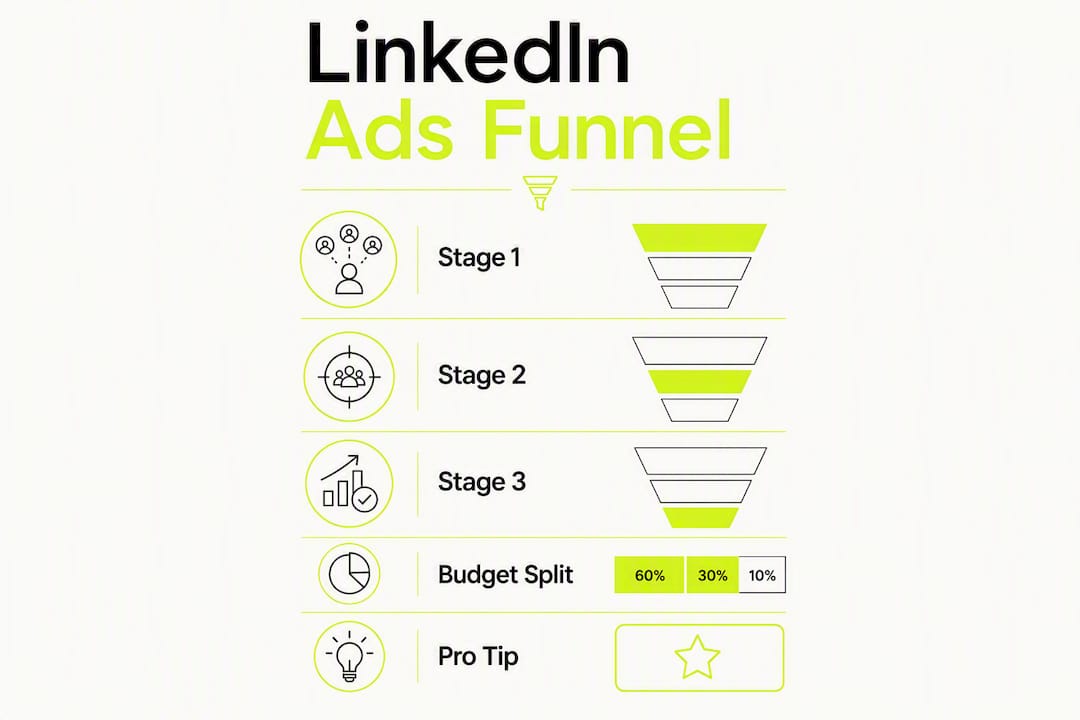
Pro Tip: If you're unsure which funnel stage to prioritize, start with MOFU. It produces the fastest feedback loop: you get real conversion data, real lead quality signals, and a retargeting pool you can use for BOFU within 30 days.
What targeting options give you the best results on LinkedIn?
LinkedIn is the only paid channel that lets you filter simultaneously by job title, seniority, company size, department, and skills. That precision is exactly what makes it powerful for B2B — and exactly what makes it expensive when used carelessly. Tight ICP definitions are not optional; they are the primary lever between a campaign that builds pipeline and one that burns budget on irrelevant impressions.

Professional attribute filters
Use company size and industry to anchor your ICP, then layer job title or job function plus seniority to reach the right buying-group members. Skills targeting is underused: it lets you reach practitioners who have self-identified expertise, which often outperforms job title alone for technical or specialized roles. Location targeting at the metro or state level keeps CPMs manageable compared to national campaigns.
Avoid stacking too many filters at once. An audience of 50,000 members is generally the floor for Sponsored Content campaigns; below that, frequency rises fast and costs spike. For Sponsored Messaging, smaller audiences (10,000–50,000) are workable because the format is one-to-one by nature.
Account-Based Marketing workflow
ABM on LinkedIn starts with an account list — a CSV of target company names uploaded to Matched Audiences. From there, you layer the buying-group filters (titles, seniority, functions) on top of the account match to reach the right people at the right companies. The activation cadence matters: run TOFU Thought Leader Ads to the full buying group first, then retarget engages with MOFU content, then push BOFU offers to accounts showing multi-asset engagement.
Matched Audiences and Predictive Audiences are the features that separate teams generating 3x pipeline from teams burning money on broad awareness. Matched Audiences require a seed list (account CSV, contact list, or website retargeting pixel). Predictive Audiences use LinkedIn's model to find lookalikes from that seed — useful once your seed list has at least 300 matched members.
Targeting comparison
| Targeting approach | Best objective | Audience size | Cost efficiency | Pipeline signal |
|---|---|---|---|---|
| ABM account list | MOFU/BOFU | Small (10K–50K) | High | Strong |
| Broad professional filters | TOFU | Large (200K+) | Low | Weak |
| Matched Audiences (contact/retargeting) | MOFU/BOFU | Medium (50K–300K) | High | Strong |
| Predictive Audiences (lookalike) | TOFU/MOFU | Medium–Large | Medium | Moderate |
| Skills + seniority | TOFU/MOFU | Medium | Medium | Moderate |
Pro Tip: Upload your CRM's closed-won accounts as a Matched Audience seed, then build a Predictive Audience from it. You're now targeting companies that look like your best customers — not just companies that match a demographic profile.
Which ad formats work best at each funnel stage?
LinkedIn offers more than 12 ad formats, and the wrong format at the wrong stage is one of the fastest ways to waste budget. The decision is simpler than it looks when you map format to intent level.
Format-to-objective mapping
| Format | Best funnel stage | Objective alignment | Key strength |
|---|---|---|---|
| Thought Leader Ads | TOFU | Brand awareness, engagement | Human voice drives trust; outperforms company page posts for engagement |
| Single Image Sponsored Content | TOFU/MOFU | Awareness, website visits | Versatile; strong for driving traffic to gated content |
| Video Ads (7–15 seconds) | TOFU/MOFU | Video views, engagement | Category education; short-form performs best for B2B |
| Document Ads | MOFU | Engagement, lead gen | Senior decision-makers read PDFs in-feed; strong for evaluation stage |
| Lead Gen Forms | MOFU/BOFU | Lead generation | Deliver 2–3x higher conversion rates versus external landing pages and 25–35% lower cost per lead |
| Sponsored Messaging (Message Ads) | BOFU | Lead gen, website conversions | Direct, personal; best for high-intent ABM accounts |
| Dynamic Ads | BOFU | Follower, spotlight | Personalized at scale; effective for retargeting |
| Text Ads | TOFU/MOFU | Website visits | Low cost; useful for budget-constrained awareness plays |
Lead Gen Forms
LinkedIn Lead Gen Forms open natively inside the platform and pre-populate from the member's profile, removing the friction of a landing page redirect. Practitioners report 25–35% lower cost per lead compared to external landing pages. Use them for demo requests, content downloads, and event registrations — any offer where the primary ask is contact information and the conversion path should be as short as possible.

Thought Leader Ads
Thought Leader Ads let you boost an employee's organic post as a paid unit. LinkedIn users engage with people, not logos, and this format capitalizes on that behavior. Use them at TOFU to build category authority, seed ABM sequences with a human voice, and warm up accounts before pushing conversion offers. The creative is already written — your job is to select posts that address a real buyer problem, not company news.
Document Ads are criminally underused for mid-funnel work. A well-designed PDF that a senior decision-maker can read directly in the feed, without clicking away, removes a significant barrier to engagement. Pair them with a Lead Gen Form gate at the end for a seamless MOFU experience.
How should you set your LinkedIn Ads budget and bidding strategy?
LinkedIn's auction is more expensive than most paid social channels, and the cost drivers are specific: audience specificity, ad format, industry vertical, and geographic targeting all affect CPMs and CPCs materially. Going in without a bidding plan means the algorithm will spend your budget fast and teach you very little.
Bidding sequence:
- Start with Maximum Delivery (LinkedIn's automated bid strategy) for the first two to four weeks. This gives the algorithm room to find the lowest-cost conversions within your budget and generates the impression and click data you need to make informed manual adjustments.
- Move to Target Cost once you have at least 50 conversions in a campaign. Target Cost lets you set a ceiling on what you're willing to pay per result, and LinkedIn's system optimizes toward that target.
- Use Manual CPC bidding for campaigns where you have strong historical data and want precise control over spend pacing, particularly for high-value BOFU campaigns with small, well-defined audiences.
CPC vs. CPM vs. CPV:
- CPC works best for MOFU and BOFU campaigns where every click should have conversion intent.
- CPM is appropriate for TOFU brand awareness plays where reach and frequency matter more than individual clicks.
- CPV (cost per view) applies to video campaigns and makes sense when the goal is category education rather than direct response.
Pacing and frequency: LinkedIn's default pacing is even delivery across the campaign flight. For short campaigns (under 30 days), standard pacing is fine. For longer flights, monitor frequency at the audience level — above 4–5 impressions per member per month, engagement rates drop and CPMs rise. Rotate creative every three to four weeks to reset frequency fatigue.
Primary cost drivers to watch: Targeting very senior titles (C-suite, VP) in competitive industries like enterprise software or financial services will push CPMs significantly higher than targeting manager-level roles in less contested verticals. Sponsored Messaging typically costs more per send than Sponsored Content per impression, but the conversion rate differential often justifies it for BOFU ABM plays.
What creative and landing experience actually converts on LinkedIn?
LinkedIn's feed is professional, not casual. The creative that performs is direct, benefit-led, and written for someone who is busy and skeptical — not someone scrolling for entertainment. Generic brand messaging gets ignored; specific, problem-aware copy gets clicks.
Creative checklist:
- Hook in the first line: The first 150 characters of your ad copy are what members see before "see more." Lead with the problem or the outcome, not your company name.
- Benefit-led body copy: State what the reader gets, not what your product does. "Cut your CAC by a third" outperforms "Our platform uses AI to optimize your campaigns."
- Human-focused imagery: Photos of real people in professional contexts consistently outperform product screenshots and abstract graphics on LinkedIn.
- Format-specific creative tips: For video, keep it to 7–15 seconds for TOFU and lead with the insight in the first three seconds. For Document Ads, design the first page as a cover that earns the scroll.
- CTA clarity: Match the CTA to the offer. "Download the report" for content, "Book a 20-minute call" for demos, "See how it works" for mid-funnel video.
Headline and CTA formulas by funnel stage:
- TOFU: "[Provocative claim about their industry] — here's what the data shows."
- MOFU: "How [company type] reduced [specific pain] by [outcome] — free guide."
- BOFU: "Ready to [specific outcome]? Book a 20-minute strategy call."
Landing page quick audit: If you're sending traffic to an external page rather than a Lead Gen Form, check three things. First, does the page headline match the ad's promise exactly? Second, is the form above the fold with no more than four fields? Third, is there a clear confirmation message that sets expectations for follow-up? A mismatch between ad promise and landing page experience is one of the top causes of high CPL on LinkedIn.
Personalized creative improved CPL by more than 20% in global campaign tests, with U.S. campaigns seeing CPL drops of approximately 33% in some practitioner tests. Personalization here means creative that speaks to a specific role, industry, or pain point — not just inserting a first name.
Pro Tip: For BOFU campaigns targeting a small ABM account list, write ad copy that references the account's industry or a specific challenge that segment faces. The audience is small enough that hyper-relevant copy is feasible, and the CPL improvement is substantial.
How should you structure your LinkedIn Campaign Manager account?
Clean account structure is not administrative housekeeping. It is the foundation that makes reporting accurate, scaling fast, and optimization decisions defensible. Messy structure means you cannot tell which audience, format, or offer is driving results — and you end up guessing instead of compounding.
Recommended campaign structure
Organize campaigns by funnel stage and audience type, not by creative variation. Each campaign should represent one audience segment at one funnel stage. Creative variations live as multiple ads within a single campaign, where LinkedIn's rotation logic can test them against each other.
Example structure:
- TOFU — Broad ICP: Thought Leader Ads and Single Image ads targeting professional filters (industry, function, seniority). Objective: Brand Awareness or Engagement.
- TOFU — ABM account list: Thought Leader Ads targeting matched account list. Objective: Engagement.
- MOFU — Website retargeting: Document Ads and Lead Gen Forms targeting visitors who engaged with TOFU content. Objective: Lead Generation.
- MOFU — ABM engaged accounts: Lead Gen Forms targeting accounts that engaged with TOFU ads. Objective: Lead Generation.
- BOFU — High-intent ABM: Sponsored Messaging and Single Image ads targeting accounts showing multi-asset engagement. Objective: Website Conversions or Lead Generation.
Naming convention
Use a consistent naming format that encodes the key variables: [Brand]_[Funnel Stage]_[Audience Type]_[Format]_[Date]. For example: AF_MOFU_ABM-Engaged_LeadGenForm_2026-Q1. This makes filtering in Campaign Manager and exporting to spreadsheets frictionless, and it prevents the "what was this campaign for?" problem that plagues teams six months into a program.
Pre-launch verification checklist
- LinkedIn Insight Tag installed and firing on all key pages
- UTM parameters appended to all destination URLs (consistent taxonomy across campaigns)
- Conversion events defined in Campaign Manager and verified with test clicks
- CRM integration active and lead routing rules confirmed
- Audience sizes above minimum thresholds (300+ for Matched Audiences, 50,000+ for Sponsored Content)
- All creatives reviewed and approved by LinkedIn (allow 24–48 hours for review)
- Daily and lifetime budgets set with appropriate pacing rules
- Campaign start and end dates confirmed
Simplifying campaign architecture pays compounding dividends. The lessons from killing 99 city-level campaigns to consolidate signal apply directly here: fewer, better-structured campaigns learn faster and scale more cleanly than a sprawling account with fragmented data.
How do you measure LinkedIn Ads performance and attribute pipeline?
LinkedIn's native reporting tells you what happened inside the platform. It does not tell you what happened to revenue. Closing that gap requires deliberate instrumentation before the first ad runs, not a retroactive fix after 90 days of disconnected data.
Tracking implementation
- Install the LinkedIn Insight Tag on your website and verify it fires on all conversion pages.
- Define conversion events in Campaign Manager that match your actual business outcomes: form fills, demo bookings, trial starts, not just page views.
- Append UTM parameters to every destination URL using a consistent taxonomy (
utm_source=linkedin,utm_medium=paid,utm_campaign=[naming convention],utm_content=[ad variant]). - Where possible, implement the LinkedIn Conversions API (CAPI) to pass server-side conversion signals back to Campaign Manager. Qualified Lead Optimization — LinkedIn's method for using first-party CRM signals to train delivery — requires CAPI or a direct CRM sync to function.
- Sync LinkedIn leads to your CRM in real time. Every Lead Gen Form submission should create or update a contact record, trigger a lead score, and route to the appropriate sales rep within minutes.
Attribution reality
LinkedIn's default attribution is last-touch within the platform window. That model undercounts LinkedIn's contribution to pipeline because most B2B buyers engage with multiple touchpoints before converting. Account-level, multi-touch attribution — where you measure engagement across the full buying group, not just the last click — gives a more accurate picture of LinkedIn's pipeline influence. Tools that aggregate account-level engagement signals across campaigns provide a cleaner view than campaign-level last-touch alone.
Key metrics to monitor
| Metric | What it measures | Target range (B2B) |
|---|---|---|
| Account match rate | Quality of uploaded account lists | 70%+ |
| CPL (cost per lead) | Efficiency of lead generation | Varies by industry; benchmark against your target CPO |
| Lead-to-opportunity rate | Lead quality from LinkedIn | 10–25% for well-targeted campaigns |
| Cost per opportunity | Pipeline efficiency | Tied to your unit economics and ACV |
| Multi-asset engagement rate | Buying-group activation depth | Rising trend over 60–90 days |
| Pipeline influenced | Revenue in active deals with LinkedIn touchpoints | Primary 90-day success metric |
Attribution is where most B2B teams leave money on the table. The B2B funnel diagnostic framework for identifying where pipeline bleeds applies directly to LinkedIn measurement: if leads are entering but not converting to opportunities, the problem is usually lead quality (audience), offer relevance, or follow-up speed — not the platform.
How do you run A/B tests and optimize LinkedIn campaigns?
Testing on LinkedIn without a framework produces noise, not learning. The most common mistake is changing multiple variables at once — creative, audience, and offer simultaneously — and then having no idea which change drove the result. One variable at a time is the only way to build repeatable knowledge.
Test priority order
- Offer: Test the conversion offer before anything else. A stronger offer (a specific ROI calculator vs. a generic whitepaper) will outperform any creative optimization.
- Audience: Test audience definition second. ABM account list vs. broad professional filters, or one ICP segment vs. another.
- Creative: Test image vs. image, headline vs. headline, or format vs. format only after offer and audience are validated.
- Landing page or form: Test form length, page headline, or CTA copy last.
Experiment design rules
- Run each test for a minimum of two weeks and until each variant has at least 500 impressions and 50 clicks. Decisions made on smaller samples are statistically unreliable.
- Use LinkedIn's built-in A/B testing tool for audience experiments, or duplicate campaigns manually for creative tests, keeping all other variables identical.
- Set a kill threshold before the test starts: if a variant's CPL is more than 50% above the control after the minimum sample, pause it.
- Set a scale threshold: if a variant's CPL is more than 20% below the control with sufficient sample, shift budget toward it and retire the control.
Audience expansion
Once your core ABM audiences are performing, expand reach with Predictive Audiences built from your best-performing Matched Audience seeds. Short-form video (7–15 seconds) is a strong test format for expanding reach into new audience segments, particularly for category education at TOFU. LinkedIn's Audience Network extension can increase reach beyond the LinkedIn feed into partner sites, but monitor it separately — Audience Network placements often have lower engagement quality than in-feed placements and should be evaluated as a distinct line item.
- Expand audiences gradually: add one new segment per test cycle, not multiple simultaneously.
- Use engagement retargeting (members who watched 50%+ of a video or opened a Lead Gen Form) to build warm MOFU pools from TOFU expansion campaigns.
- Avoid the LinkedIn Audience Network for BOFU campaigns where conversion quality is the primary metric.
What advanced tactics move the needle for experienced LinkedIn advertisers?
Teams that have the basics running — clean structure, validated audiences, consistent creative rotation — can layer in higher-order tactics that compound pipeline influence without proportionally increasing spend.
ABM sequencing template
A three-stage ABM sequence on LinkedIn runs like this:
- Stage 1 (weeks 1–4): Run Thought Leader Ads and Single Image Sponsored Content to the full target account list. Goal: get multiple buying-group members at each account to see your point of view. Measure: account-level reach and engagement rate.
- Stage 2 (weeks 5–8): Retarget accounts where at least two buying-group members engaged with Stage 1 content. Use Document Ads or Lead Gen Forms with a specific, evaluation-stage offer (a benchmark report, a case study, a live demo). Measure: form fills and lead quality.
- Stage 3 (weeks 9–12): Push Sponsored Messaging and high-intent Sponsored Content to accounts where a lead has been created. Coordinate with BDR outreach — LinkedIn ad exposure before a cold email or call measurably improves reply rates.
Cross-channel orchestration
LinkedIn does not operate in isolation. The accounts you're targeting on LinkedIn are also seeing your display ads, receiving your BDR emails, and potentially watching your CTV spots. Coordinating these channels around the same account list and the same message amplifies each channel's effectiveness. Intent-driven activation — targeting accounts that are actively researching your category — is the highest-leverage input to this coordination: when you know an account is in-market, every channel you activate against it becomes more efficient.
Conversation Ads (a form of Sponsored Messaging) work well within ABM workflows for accounts in Stage 2 or Stage 3 of the sequence. They allow a branching conversation structure that lets the prospect self-select their interest level, which produces higher-quality leads than a single CTA message.
Pro Tip: Refresh your Matched Audience seeds every 30–60 days. CRM data ages fast, and a stale account list means you're paying to reach companies that have already closed, churned, or moved out of your ICP. A clean seed produces a cleaner Predictive Audience.
What are realistic LinkedIn Ads benchmarks and a 90-day diagnostic timeline?
Setting expectations correctly at the start of a LinkedIn program is the difference between a team that optimizes intelligently and a team that panics and kills campaigns before they have enough data to learn from.
Cost ranges (B2B, U.S. market): LinkedIn CPCs typically run higher than other paid social platforms, reflecting the premium on professional audience data. Sponsored Content CPCs commonly range from $5 to $15+ depending on audience specificity, industry, and format. CPMs for brand awareness campaigns vary widely by targeting precision and competitive pressure. Lead Gen Form campaigns in well-targeted B2B programs deliver 2–3x higher conversion rates and 25–35% lower cost per lead than external landing pages; in competitive verticals or when targeting C-suite, CPLs may run significantly higher.
90-day diagnostic timeline:
- Day 1–30: Validate audience quality. Are your Matched Audiences achieving 70%+ match rates? Are impression volumes consistent with your audience size estimates? Is click-through rate above 0.4% for Sponsored Content? If not, the audience definition or creative is the problem.
- Day 31–60: Validate lead quality. Are form fills converting to qualified leads in your CRM at a rate above 10%? Is the lead-to-opportunity rate trending upward? If CPL is high but lead quality is strong, the economics may still work — calculate cost per opportunity, not just cost per lead.
- Day 61–90: Validate pipeline contribution. Are LinkedIn-influenced accounts moving through pipeline stages? Is multi-asset engagement at target accounts increasing? If pipeline is not materializing by day 90, the issue is almost always one of three things: audience mismatch, a weak or misaligned offer, or a broken attribution model that is hiding LinkedIn's actual contribution.
Common pitfalls that delay pipeline: Targeting too broadly (relying on job title alone without company size or industry filters), running BOFU offers to cold audiences who have never seen your brand, and failing to connect Campaign Manager to CRM so leads route and score correctly. Fix these before diagnosing the platform.
If campaigns are not contributing to pipeline within 90 days, the issue is usually audience definition, the offer, or the attribution model — not the platform itself.
How do LinkedIn Ads fit into a revenue-driving growth system?
LinkedIn Ads do not generate pipeline on their own. They generate pipeline when they are part of a system: connected to CRM, coordinated with sales, measured at the account level, and fed by a strong offer. The platform is the distribution mechanism; the system is what converts distribution into revenue.
System integration checklist
- CRM sync active: every Lead Gen Form submission creates a contact and triggers lead scoring within minutes.
- Lead routing rules defined: high-intent leads (BOFU form fills from ABM accounts) route directly to a named account executive, not a generic sales queue.
- Automated nurture sequences active for MOFU leads who are not yet sales-ready, with LinkedIn retargeting coordinated with email cadence.
- Account-level engagement dashboards built: sales can see which target accounts have been exposed to LinkedIn campaigns and which buying-group members have engaged.
- Attribution model agreed upon between marketing and sales before the program launches, so pipeline credit is not disputed after the fact.
Operational roles and cadence
Someone needs to own audiences (updating account lists, refreshing seeds, monitoring match rates), and someone needs to own pipeline reporting (connecting LinkedIn engagement to CRM opportunity data). These are not the same job. In a lean team, the same person can do both, but the tasks need a weekly cadence — not a monthly review.
The Partnerslate case study demonstrates what happens when LinkedIn Ads are integrated into a full GTM motion with proper attribution and CRM routing: CAC drops, lead quality improves, and sales velocity increases because reps are working accounts that have already been warmed by coordinated paid and owned channel exposure.
Building that system is the work. LinkedIn is just the channel.
Key Takeaways
A successful LinkedIn ads strategy requires account-focused targeting, funnel-mapped formats, and a 90-day pipeline measurement cadence connected to CRM — not just impressions and clicks.
| Point | Details |
|---|---|
| Map objectives to funnel stage | Define your Campaign Manager objective by TOFU, MOFU, or BOFU before choosing format or audience. |
| Prioritize audience quality | Matched Audiences and ABM account lists consistently outperform broad professional filters for pipeline contribution. |
| Use Lead Gen Forms for MOFU/BOFU | Native forms deliver 2–3x higher conversion rates than external landing pages, with 25–35% lower cost per lead. |
| Measure at 90 days, not 30 | Pipeline influence from LinkedIn typically surfaces between day 60 and day 90; early exits kill programs before they learn. |
| Ashafrazier builds the full system | Ashafrazier integrates LinkedIn Ads into a complete growth system, including CRM routing, attribution setup, and offer development, to drive measurable pipeline. |
What actually works on LinkedIn Ads right now
The conventional wisdom on LinkedIn advertising says to run awareness campaigns at scale, build a large audience, and let the platform's algorithm do the work. That advice is expensive and slow. What actually moves pipeline in this environment is the opposite: smaller, higher-quality audiences, formats that reduce friction, and a measurement system that connects ad spend to revenue before the campaign launches.
The highest-ROI levers right now, in order of impact: ABM account lists with buying-group coverage, Thought Leader Ads for TOFU trust-building, Lead Gen Forms for MOFU conversion, and intent-driven activation for BOFU sequencing. These are not new ideas, but most teams underinvest in the first and third while overinvesting in broad Sponsored Content that generates impressions but not pipeline.
By company stage, the priority shifts. Early-stage companies should focus almost entirely on MOFU Lead Gen Forms and Thought Leader Ads — the goal is to build a retargeting pool and validate the offer before scaling spend. Scale-ups with validated ICPs should layer in ABM sequencing and cross-channel coordination. Enterprise teams with large account lists and dedicated sales coverage should be running full three-stage ABM sequences with Sponsored Messaging at BOFU and Conversation Ads for high-intent accounts.
The cautionary note: broad awareness campaigns without a measurement system are the most common way to burn LinkedIn budget without generating pipeline. If you cannot connect a LinkedIn impression to a CRM opportunity within 90 days, you do not have a LinkedIn strategy. You have a media buy.
Ashafrazier builds LinkedIn growth systems that generate pipeline, not just leads
Most LinkedIn programs stall because the ads are running but the system behind them is not. No CRM routing. No attribution. No offer that matches the audience's intent level. The result is a high CPL, a frustrated sales team, and a marketing leader defending spend that cannot be tied to revenue.
Ashafrazier works with founders, growth executives, and GTM leaders at scale-ups and companies in high-consideration markets to build the full system: offer development, audience architecture, campaign structure, CRM integration, attribution setup, and the measurement cadence that connects LinkedIn spend to pipeline. The average ROAS across Ashafrazier's client engagements is 7x, built on the same funnel-first, account-focused approach described in this guide.
This is not a retainer for managing ads. It is a growth system engagement that produces compounding results — paid and owned channels working together, measured at the account level, and built to scale. If your LinkedIn program is running but not generating qualified pipeline, or if you're planning a new program and want to build it right the first time, start with a growth diagnostic to identify the highest-leverage gaps in your current system. You can also run your unit economics through the Growth Score Calculator to establish the CPL and cost-per-opportunity targets your LinkedIn program needs to hit before you spend a dollar.
Further reading and primary sources
The sources below were used for benchmarks, format guidance, and advanced tactics throughout this guide. Each is worth bookmarking for ongoing reference as LinkedIn's ad platform evolves.
- LinkedIn Lead Gen Forms: Complete Guide — FinalLayer — Conversion rate benchmarks and setup best practices for native lead forms.
- LinkedIn Ads for B2B: the tactical guide — Factors.ai — Practitioner-level guidance on audience targeting, ABM sequencing, and the 90-day pipeline diagnostic.
- 5 B2B LinkedIn Ads tests to run in 2026 — Search Engine Land — Testing frameworks for video, personalization, and Qualified Lead Optimization.
- LinkedIn Ads Guide — Hootsuite — Broad reference for campaign types, ad specs, and measurement setup.
- Ashafrazier blog — practitioner essays on funnel alignment and campaign optimization — Tactical posts on offer development, CAC reduction, and compounding growth systems.
Recommended
- Lowering CAC in a B2B Marketplace: From $150 to $11 Per Brand — Asha Frazier
- Things I've Learned — Asha Frazier
- Curing "Merry-Go-Round" Sickness: Why Your B2B Funnel Is Bleeding Cash (And the Exact Playbook to Fix It) — Asha Frazier
- Marketplace Growth: When to Push Supply vs. Demand (And What Actually Compounds) — Asha Frazier