
A lead nurture strategy systematically moves prospects from awareness to purchase by delivering the right content, on the right channel, at the right time. Its job is not to close deals fast. It builds trust so that when a prospect is ready to buy, your company is the obvious choice.
Start now, in this order: pick one persona you understand well, choose one channel where that persona already pays attention, and build a single three-touch sequence around one specific problem they have. Do not try to build the whole system in the first week. Most teams see measurable movement in MQL-to-SQL conversion within a few months of launching even a minimal sequence, as long as they measure it consistently.
Key Takeaways
A lead nurture strategy succeeds when segmentation, scoring, and content mapping work together inside a measured, multichannel workflow with a proven holdout test behind it.
| Point | Details |
|---|---|
| Lead with trust, not the close | Structure every touch to educate or reduce uncertainty, since high-consideration buyers self-educate before talking to sales. |
| Build the seven core components first | Segmentation, scoring, content mapping, triggers, cadence, exit rules, and handoff criteria all need to exist before you write sequences. |
| Use a holdout test to prove lift | Randomly withhold nurturing from 10 to 20 percent of new leads and compare SQL conversion after one sales cycle. |
| Watch for structural failures | No exit rules, stale segmentation, and broken sales handoffs break more programs than bad copy does. |
| Treat nurturing like unit economics | Ashafrazier builds nurture systems measured against CAC and LTV impact, not just open and click rates. |
Table of Contents
- Why a Lead Nurture Strategy Matters More in 2026
- What Are the Core Components of a Lead Nurture Program?
- How Do You Build a Lead Nurture Strategy Step by Step?
- What Does a Working Nurture Sequence Actually Look Like?
- How Do You Measure Whether Nurturing Is Working?
- What Technology and Team Do You Need to Run This?
- What Breaks Most Nurture Programs?
- What Do Practitioners Actually Learn Running These Programs?
- My Take on Why Most Nurture Programs Underperform
- How Ashafrazier Helps You Build a Nurture Program That Pays Back
- Where to Read More on Lead Nurturing
- Sources
Why a Lead Nurture Strategy Matters More in 2026
B2B buying cycles have stretched, not shrunk. Buyers now self-educate across a dozen touchpoints before a sales rep ever hears from them, and a large share of that research happens on a phone during a commute or between meetings. A substantial and growing portion of web traffic now originates on mobile devices, which means an email that renders badly on a five-inch screen is losing you deals before the prospect ever reaches your site.
Nurturing exists because most leads are not ready to buy the moment they raise their hand. Companies that build a real sequence, instead of a single follow-up email, typically see:
- Higher MQL-to-SQL conversion, because leads arrive at sales already educated on your value proposition.
- Lower customer acquisition cost, since nurtured leads need fewer expensive touches from a sales rep to close.
- Faster sales cycle velocity once trust has already been established before the first call.
- Stronger brand recall in categories where the buying committee takes months to decide.
The strategic logic here is not complicated, even if the execution is. The primary goal of lead nurturing is building trust, not forcing an immediate close, which matters most in high-consideration markets where a wrong purchase is expensive and reputational risk is real. Skip this step, and you are asking sales reps to build trust from zero, on a live call, with a stranger.
What Are the Core Components of a Lead Nurture Program?
Before you write a single email, you need the scaffolding that makes emails worth sending. Seven components determine whether a nurture program actually performs or just generates noise in an inbox.
Segmentation groups leads by shared traits, whether that is industry, company size, role, or where they entered your funnel. Lead scoring assigns numeric weight to fit and behavior so your team knows who is worth a sales rep's time today versus who needs three more months of nurturing. Content mapping matches specific assets to specific funnel stages, so a top-of-funnel prospect gets an explainer, not a pricing sheet. Triggers and automation fire the next message based on real behavior, like a pricing-page visit or a webinar registration, rather than a fixed calendar date. Cadence governs how often and how aggressively you reach out, which is the single most abused variable in most programs. Exit and disqualification rules remove leads who go cold, unsubscribe, or convert, so your active list stays clean. Sales handoff criteria define the exact moment a lead becomes sales's responsibility, with agreed response-time expectations on both sides.
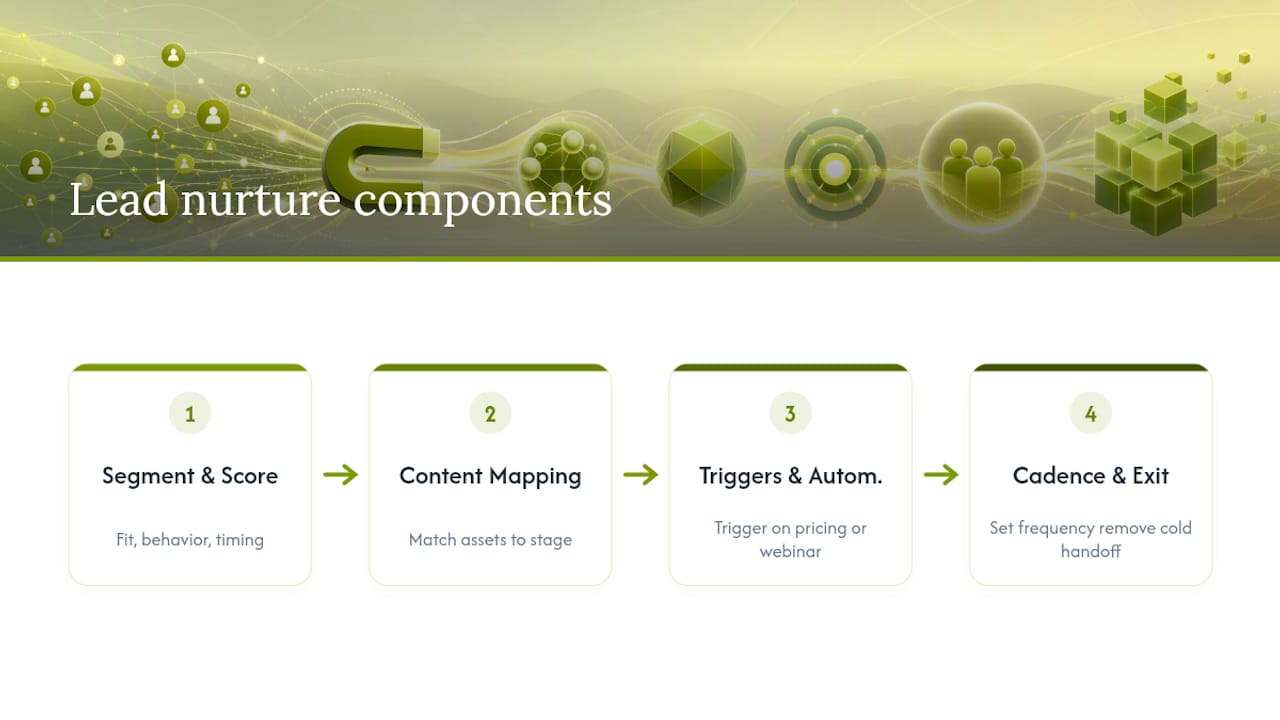
Content mapped to buyer stage inside an automated, multichannel program is what separates a working nurture strategy from a scattershot email calendar. Get the mapping wrong, and even perfect copy fails to convert.
Pro Tip: Build your first scoring rubric around three factors only: fit (does this person match your buyer persona), behavior (are they engaging with high-intent content like pricing or demos), and timing (has engagement accelerated recently). Weight behavior and timing higher than fit alone. A perfect-fit lead who has gone cold for six weeks is a worse bet than an imperfect-fit lead who just opened three emails in two days.
Most programs should start with email as the primary channel, then layer in LinkedIn outreach, retargeting ads, or SMS once the email sequence proves it converts. Adding four channels on day one, before you know which message resonates, usually just multiplies your failure points.
How Do You Build a Lead Nurture Strategy Step by Step?
This is the operational sequence. Each step has a deliverable, an owner, and a way to know you're done before moving to the next.
1. Map the sales process and define goals. Sit down with sales leadership and document every stage a lead passes through, from first touch to closed deal, along with the average time spent at each stage. Define what "success" means numerically: a target MQL-to-SQL rate, a target time-to-first-response, or a specific reduction in sales cycle length.
- Artifact: a documented sales stage map with average dwell time per stage.
- Owner: growth or revenue operations lead, with sales leadership sign-off.
- Done when: marketing and sales agree on stage definitions in writing.
2. Build buyer personas and identify intent signals. Salesforce recommends grounding nurture design in buyer personas and sales-cycle mapping, because a VP of Finance and a Director of Operations need different formats, different proof points, and different cadences even inside the same deal.
- Artifact: two to four personas with role, priorities, objections, and preferred content format.
- Owner: marketing strategist, informed by sales interviews.
- Done when: sales confirms the personas match real accounts they're working today.
3. Audit existing content against the funnel. Inventory every asset you already have and tag it by funnel stage and persona. Most teams discover they have twelve pieces of bottom-funnel content and almost nothing for early-stage education, which is exactly backward for a long buying cycle.
- Artifact: a content map spreadsheet with gaps flagged red.
- Owner: content lead.
- Done when: every funnel stage has at least one asset per persona.
4. Design workflows and triggers. Decide what event starts each sequence (form fill, content download, demo request) and what behavior moves a lead forward or exits them from the flow entirely.
- Artifact: a workflow diagram showing trigger, branch logic, and exit points.
- Owner: automation engineer or marketing operations.
- Done when: every branch has a defined next action, with no dead ends.
5. Build sequences and set the multichannel cadence. Write the actual emails and any supporting touches (LinkedIn message, retargeting ad, SMS). B2B buyers often require eight or more touches before agreeing to a first meeting, so a three-email sequence is rarely enough on its own for a cold prospect.
- Artifact: finished sequence copy, loaded into your automation platform, with channel and timing specified per touch.
- Owner: content lead plus automation engineer.
- Done when: the sequence is tested end-to-end in a staging environment.
6. Set measurement rules and sales handoff criteria. Define which metrics you'll track weekly, who owns the dashboard, and the exact score or behavior threshold that triggers a sales handoff with a guaranteed response window.
- Artifact: a measurement dashboard and a written SLA between marketing and sales.
- Owner: data analyst, with sales operations co-sign.
- Done when: both teams can pull the same numbers and agree on what they mean.
7. Pilot, iterate, and scale. Launch on one segment first. Watch performance for at least one full sales cycle length before declaring success or failure, then expand to additional personas and channels.
- Artifact: pilot results summary with a go/no-go recommendation.
- Owner: growth or revenue operations lead.
- Done when: leadership approves scaling budget and headcount based on pilot data.
For staffing, a lean pilot can run with one marketing operations person splitting time across steps 1 through 6, plus a content contributor. Scaling past two or three personas usually requires a dedicated automation engineer and a data analyst, because manual QA on multiple branching workflows becomes its own full-time job. Budget four to six weeks to complete steps 1 through 5 for a first pilot, and another four to eight weeks of live data before scaling decisions.
What Does a Working Nurture Sequence Actually Look Like?
Theory is cheap. Here is a six-touch sequence built for a mid-funnel B2B lead who downloaded a guide but hasn't engaged with sales.
- Day 0, email: Deliver the requested asset immediately, with one line asking what problem brought them to it.
- Day 3, email: Share a related educational piece that addresses a common objection tied to that first asset.
- Day 7, LinkedIn: A short, personal connection request referencing the content they downloaded, not a pitch.
- Day 10, email: A case-relevant proof point, such as a short outcome story from a similar company size or industry.
- Day 16, retargeting ad: A light-touch brand awareness ad reinforcing the core value proposition, running to anyone who opened the prior two emails.
- Day 21, email: A low-pressure invitation to a short call or demo, framed as diagnostic rather than sales-driven.
A high-performing nurture email follows a consistent anatomy: a subject line under eight words that promises specific value, preview text that extends rather than repeats the subject line, a body built around one idea instead of three, a single clear call to action, and a sender name from a real person rather than a department alias.
Three snippets worth adapting:
- Welcome email opener: "Thanks for grabbing [asset name]. Most people using it run into [specific problem] around week two, so here's how to get ahead of it."
- Mid-funnel educational email opener: "You're not alone if [specific objection] is holding you back. Here's what three companies your size did instead."
- Soft demo invite: "No pitch, just fifteen minutes to see if [specific outcome] is realistic for a company your size. Worth a look?"
How Do You Measure Whether Nurturing Is Working?
Vanity metrics like open rate feel good in a weekly report and mean almost nothing on their own. The metrics that matter connect directly to pipeline and revenue.
| Metric | Why It Matters | How to Measure It |
|---|---|---|
| Open rate | Signals subject line and sender relevance | Email platform reporting, tracked weekly by segment |
| Click rate | Shows content relevance beyond the subject line | Link tracking inside your automation platform |
| MQL-to-SQL rate | The core proof that nurturing improves lead quality | CRM stage-change tracking, compared pre- and post-nurture |
| Time-to-MQL | Reveals whether sequences accelerate or stall momentum | Timestamp difference between first touch and MQL status |
| Unsubscribe rate | An early warning sign of over-emailing or poor targeting | Email platform unsubscribe tracking against total sends |
| Contribution to revenue | Ties the entire program back to dollars, not activity | Multi-touch attribution model in your CRM or analytics layer |
To prove causation rather than correlation, run a holdout test: randomly assign a portion of new leads (10 to 20 percent is typical) to receive no automated nurturing, while the rest flow through your sequence. Tag both groups in your CRM, then compare SQL conversion and revenue contribution between them after one full sales cycle. If the nurtured group doesn't meaningfully outperform the holdout, the sequence needs rework before you scale it. Only some B2B marketers currently run automated sequences at all, which means most of your competitors have no comparable data and are guessing. A working holdout test is a real competitive edge. Tracking this consistently over time is easier with a structured KPI dashboard built specifically around MQL-to-SQL velocity rather than generic marketing metrics.
What Technology and Team Do You Need to Run This?
The tech stack doesn't need to be exotic, but it does need five capabilities: a CRM with workflow automation, an email platform that supports dynamic content by segment, behavioral or event tracking on your website, an analytics layer that connects marketing activity to CRM stage changes, and clean integrations so data flows between all of it without manual exports.
Team roles worth defining explicitly, even on a small team where one person wears several hats:
- Program owner (growth or marketing operations): accountable for overall performance and cross-team alignment.
- Content lead: writes and maintains sequence copy and the content map.
- Automation engineer: builds and QA's the actual workflows and triggers.
- Data analyst: owns the dashboard and the holdout testing methodology.
- Sales SLA owner: ensures handed-off leads get contacted inside the agreed window.
A minimal viable stack (CRM plus one email automation tool) is enough for a first pilot. Add AI-driven personalization or short personalized video, through a partner like Astreaux for automated outreach at scale, once you've validated that a manual sequence converts, not before. AI amplifies a working message; it doesn't fix a broken one.
What Breaks Most Nurture Programs?
Run these tests continuously once your first sequence is live: subject line A/B tests, cadence spacing tests (three days apart versus seven), channel mix tests (email-only versus email-plus-LinkedIn), and break-up email tests for leads who've gone cold.
The failures that kill programs are rarely creative. They're structural:
- No exit rules, so converted or dead leads keep getting emailed, tanking deliverability.
- Stale segmentation, where personas built two years ago no longer match who's actually buying.
- No sales handoff SLA, so hot leads sit untouched for days.
- Over-emailing, which shows up as rising unsubscribe rates before it shows up anywhere else.
- Broken attribution, crediting the last touch when five earlier touches did the real work.
Fix these with hard guardrails: automatic exit after conversion or 90 days of inactivity, a content refresh review every quarter, and a capped maximum of two touches per week per lead unless they've explicitly requested more.
What Do Practitioners Actually Learn Running These Programs?
A few patterns hold up consistently across high-consideration markets, where the sales cycle is long and trust is the product being sold before the actual product is. First, specificity beats cleverness every time: a mid-funnel email naming the exact objection a buyer has outperforms a generically "engaging" one built around a hook. Second, sales and marketing alignment is not a meeting, it's a shared scoring definition and a written SLA; without both, the handoff always breaks down under pressure. Third, a nurture program lives or dies on data quality, because segmentation built on stale or incomplete lead data misfires no matter how good the copy is.
One anonymized example: a B2B marketplace client came in with a nurture sequence that treated every lead identically regardless of company size, resulting in high email fatigue and weak sales handoff. Rebuilding segmentation around company size and behavioral intent, then rewriting the sequence around persona-specific objections, cut acquisition cost dramatically while improving lead quality reaching sales, a dynamic detailed further in this CAC reduction case study.

Pro Tip: Once a sequence proves lift in a holdout test, scale it by persona, not by volume. Roll it out to your next most similar segment before blasting it company-wide. Programs that scale too fast lose the specificity that made the original sequence work in the first place.

My Take on Why Most Nurture Programs Underperform
Here's my one-sentence philosophy: nurturing only works when every touch earns the right to the next one, and most programs fail because they mistake volume for value. In practice, I treat a nurture sequence the same way I treat a paid acquisition channel: it gets measured against unit economics, not vanity engagement, and it gets killed or rebuilt fast if it isn't moving leads toward revenue within a defined window. Too many teams treat nurturing as a "set it and forget it" email calendar instead of a system with the same discipline applied to CAC and payback that they'd apply to a paid channel. If you want to see how that unit-economics lens changes the calculus, the growth executive services page walks through how it applies across both paid and owned channels.
How Ashafrazier Helps You Build a Nurture Program That Pays Back
Most companies trying to fix a broken nurture program either hire an agency that treats email as a content calendar, or they buy another automation tool and hope the software does the strategic thinking for them. Ashafrazier builds the actual growth system underneath the sequences: the segmentation logic, the scoring rubric, and the attribution model that ties nurture activity to revenue and unit economics, not just open rates.
With over 15 years building integrated paid and owned growth systems across high-consideration markets, Asha Frazier has helped companies cut acquisition costs while scaling qualified pipeline, the kind of dual-discipline work most growth consultants don't combine. If you want to know where your current nurture program actually stands against your unit economics, run the numbers through the Growth Score Calculator to see your LTV to CAC ratio and payback window before deciding what to fix first.
Where to Read More on Lead Nurturing
A few sources are worth bookmarking if you want to keep building on this playbook.
- Forbes Business Council breaks down why trust, not speed, should anchor your nurture strategy.
- Adobe Business explains how multichannel automation and stage-mapped content work together at scale.
- Salesforce covers persona-building and sales-cycle mapping in more depth.
- Statista tracks mobile traffic share, useful for justifying mobile-first email design.
- Sendspark offers a practical walkthrough of automated sequence adoption and impact.
Sources
- How To Build An Effective Lead Nurturing Strategy — Forbes
- Share of website traffic coming from mobile devices — Statista
- Lead nurturing: definition, strategy & examples — Adobe Business
- What is Lead Nurturing? — Salesforce
- Automated Lead Nurturing: Step-by-Step Guide | Sendspark
Recommended
- Curing "Merry-Go-Round" Sickness: Why Your B2B Funnel Is Bleeding Cash (And the Exact Playbook to Fix It) — Asha Frazier
- Lowering CAC in a B2B Marketplace: From $150 to $11 Per Brand — Asha Frazier
- Things I've Learned — Asha Frazier
- Marketplace Growth: When to Push Supply vs. Demand (And What Actually Compounds) — Asha Frazier