
The fastest way to improve lead quality is to align capture and scoring to your actual ideal customer profile, then route high-intent leads to sales immediately. Everything else, nurture sequences, dashboards, weekly syncs, is scaffolding around that core move. If you get ICP alignment and fast routing right, conversion rates climb before you touch anything else.
Start here:
- Audit your last 90 days of closed-won deals to find the real firmographic and behavioral pattern, not the one in your buyer persona deck.
- Add one qualifying question to your highest-traffic conversion form. One good question outperforms five generic ones.
- Build a basic score-based routing rule so your top-tier leads hit a rep's calendar within minutes, not days.
Pro Tip: Firms that contact leads within an hour convert them at dramatically higher rates than firms that wait even a few hours. Speed is not a nice-to-have here. It's the single fastest lever you have.
Watch your lead-to-MQL rate and average response time over the next two weeks. If those two numbers move, everything downstream tends to follow.
Key Takeaways
Improving lead quality requires aligning capture and scoring to your real ICP, then routing high-intent leads to sales within minutes, not days.
| Point | Details |
|---|---|
| Audit closed-won first | Extract firmographic and behavioral patterns from actual customers before touching targeting or forms. |
| Fix capture before scoring | Progressive profiling and one predictive question outperform long forms and generic scoring alone. |
| Route fast, always | A 5 to 10 minute response window on high-intent leads meaningfully increases meeting-book rates. |
| Track six metrics together | Lead→MQL, MQL→SQL, cost per SQL, response time, engagement score, and win rate reveal the full picture. |
| Use Ashafrazier to operationalize | The Growth Score Calculator and a short consulting engagement can standardize scoring and SLAs in weeks, not quarters. |
Table of Contents
- What Does Lead Quality Actually Mean?
- Why Does Lead Quality Break Down?
- How Do You Improve Lead Quality at Capture and Beyond?
- Which Metrics Actually Prove Lead Quality Is Improving?
- What Does a Lead Quality Operating Model Look Like?
- Does This Actually Work in Practice?
- The Traps I See Most Often
- How Ashafrazier Helps You Operationalize This
- Sources
What Does Lead Quality Actually Mean?
Lead quality comes down to two things: fit and intent. Fit measures whether a lead matches your ideal customer profile, right company size, right role, right industry. Intent measures whether they're behaving like someone close to a buying decision, requesting a demo, comparing pricing, returning to your site multiple times in a short window. A lead can have great fit and zero intent, or a lot of intent and terrible fit. Quality means both are present at once.
This matters because volume without quality quietly wrecks your forecasting, inflates your customer acquisition cost, and burns out your sales team chasing dead ends. A rep who spends three calls qualifying a lead that was never going to buy isn't just wasting time, they're not spending that time on someone who would.
Picture two leads from the same campaign: a VP of Operations at a 200-person company who downloaded a pricing guide after visiting your product page twice, versus a student who filled out a contact form for a class project. Same cost per click. Wildly different value. One becomes a $40,000 contract. The other becomes a wasted SDR hour. Quality is the difference between those two outcomes, and most teams still measure success by counting form fills instead of counting outcomes.
Why Does Lead Quality Break Down?
Most lead quality problems trace back to four operational failures, and you can usually diagnose all four in an afternoon.
- Misaligned targeting. Run a closed-won audit against your current ad targeting and form fields. If the firmographic pattern in your best customers doesn't match who's actually filling out your forms, your targeting has drifted. This is often the single biggest cause of low-quality volume, and it's invisible until you go looking for it.
- Weak form design and no enrichment. Forms that ask for name, email, and nothing else generate volume but no signal. If you're not enriching submissions with firmographic or technographic data the moment they arrive, your sales team is qualifying blind.
- Broken routing and slow response. Leads sitting in a queue for six hours, or worse, going to the wrong rep entirely, lose momentum fast. Undefined handoff rules between marketing and sales are a quiet tax on every lead you generate.
- Vanity metrics. Counting total leads or cost per lead without tracking conversion to SQL or closed revenue hides the real problem. A campaign that produces 500 cheap leads and zero qualified pipeline looks fine on a leads-generated dashboard and terrible everywhere else.
Test for these in order. Targeting and forms are upstream problems; fix them first, because no amount of downstream nurturing repairs a lead that should never have entered the funnel.
How Do You Improve Lead Quality at Capture and Beyond?
This is where the actual work happens, and it splits into six areas: targeting, forms, enrichment, scoring, routing, and nurture. Treat each as a testable lever, not a one-time fix.
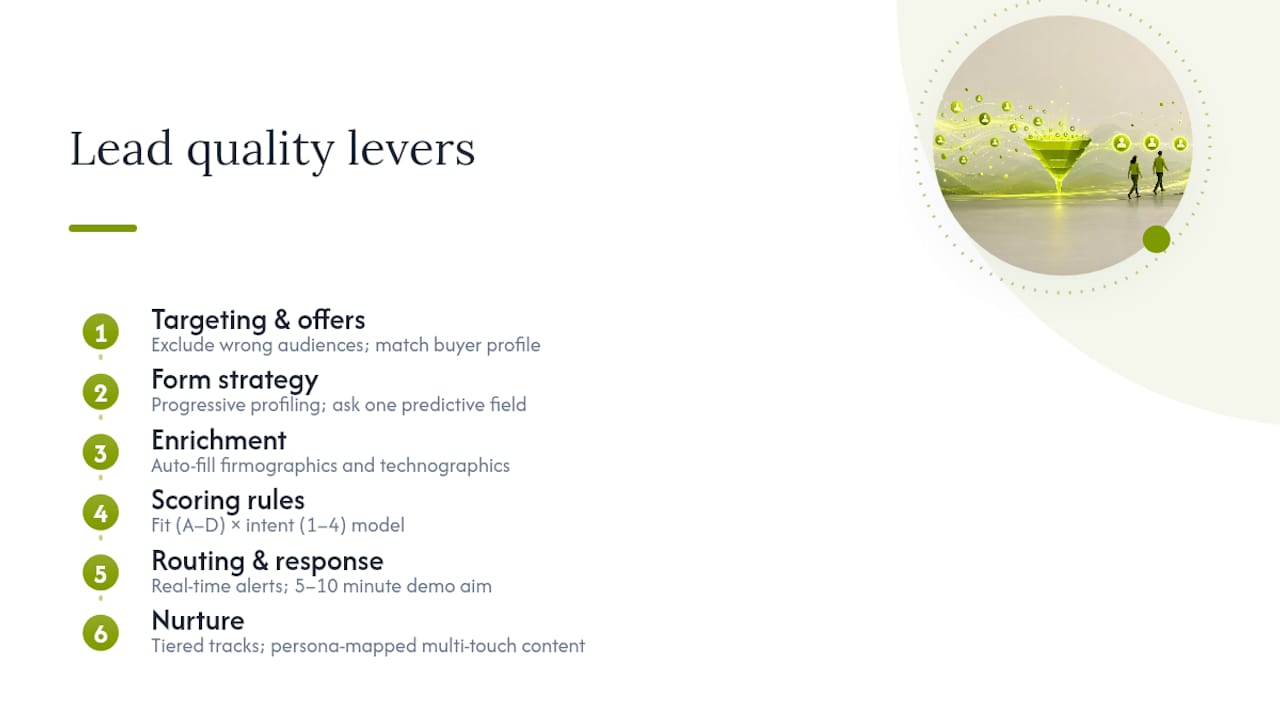
Targeting and offers. Your ad targeting and your offers need to speak to the same buyer. If your closed-won audit shows your best customers are 50 to 200 person companies in a specific vertical, build negative audiences that exclude everyone outside that range. Swap generic "learn more" offers for higher-intent ones, ROI calculators, pricing guides, live demos, that naturally filter out casual browsers before they ever reach a form.

Form strategy. Progressive profiling is the fix for the classic tradeoff between short forms (high volume, low signal) and long forms (high signal, low volume). Ask for the single most predictive field on the first interaction, typically company size or role, and enrich the rest after submission rather than front-loading ten fields that kill conversion. Requiring a work email on higher-intent offers is a simple, high-leverage filter that costs you almost nothing in volume.
Enrichment. The moment a form is submitted, firmographic and technographic enrichment should run automatically, filling in company size, industry, tech stack, and revenue band before a rep ever sees the record. Progressive profiling paired with post-submission enrichment balances conversion and qualification better than either tactic alone.
Scoring rules. Build your model on two axes: fit (A through D) and intent (1 through 4). A structured fit-and-intent model lets you route combinations differently, an A1 or A2 goes straight to an account executive same day, a B1 or B2 goes to an SDR, and C or D grade leads drop into nurture. Weight sequences of behavior more heavily than single actions: someone who visits pricing, downloads a case study, and returns within 48 hours is a stronger signal than one high-value click in isolation. Add negative scoring for disqualifying signals, personal email domains, competitor employees, job titles with no buying authority.
Routing and response. Real-time alerts and calendar links for top-tier leads shrink the gap between interest and contact. Aim for a 5 to 10 minute response window on demo requests specifically; anything slower and you're competing with whoever responded first. Routing high-score leads to a calendar link immediately also shortens the overall sales cycle, not just the initial response.
Nurture. Not every lead is ready today, and tiered nurture tracks by grade keep B and C leads warm without burning SDR time. Multi-touch nurture with content mapped to buyer personas converts leads that looked low-intent at first touch. For larger accounts, coordinate content across the buying group rather than nurturing one contact in isolation. A structured account-based approach to multi-stakeholder engagement tends to outperform single-contact nurture when deal sizes justify the extra coordination.
Finally, check your ad creative and landing pages against what you're actually selling. Mismatched expectations, a landing page promising "free trial" for a sales-led product, generate leads that disqualify themselves in the first call. Fixing that mismatch at the top of the funnel filters junk before it ever reaches a rep.
Which Metrics Actually Prove Lead Quality Is Improving?
Six metrics tell you almost everything: lead-to-MQL rate, MQL-to-SQL rate, cost per SQL, average response time, an engagement-quality score, and win rate. Track all six together, because any one of them in isolation can lie to you.
| Metric | What it tells you |
|---|---|
| Lead → MQL rate | Whether capture and targeting are filtering effectively |
| MQL → SQL rate | Whether scoring and routing are handing sales the right leads |
| Cost per SQL | The true cost efficiency of a channel, not just cost per lead |
| Average response time | How fast marketing and sales convert intent into contact |
| Engagement-quality score | Composite signal from downloads, visits, and webinar attendance |
| Win rate on SQLs | Whether the leads that reach sales actually close |
Engagement-quality scoring that blends multiple behavioral signals predicts conversion more reliably than any single metric like page views or email opens.
Set a baseline for each metric before you change anything, then run channel-level tests measuring the delta in SQL conversion and downstream revenue, not just lead volume. If total leads drop 20% but SQL conversion climbs 40%, that's not a decline, that's your funnel finally filtering correctly. Review the dashboard with sales monthly at minimum. The benchmark data on capital-efficient growth is worth checking against your own numbers before you assume your conversion rates are underperforming.
What Does a Lead Quality Operating Model Look Like?
You don't need a complicated org chart to make this stick. You need four roles with clear ownership and a monthly rhythm.
- Marketing owns targeting, capture design, and top-of-funnel scoring inputs.
- RevOps owns the scoring model, routing logic, and CRM integration that keeps data consistent across systems.
- SDRs own first response and initial qualification against the SLA.
- AEs own feedback on lead quality, closed-won data, and win/loss inputs that feed back into scoring.
Set explicit SLAs: A-grade leads get contacted within 10 minutes, B-grade within an hour, C-grade enter nurture automatically. Run a monthly closed-loop review where sales feeds win/loss data back into the scoring model, and marketing adjusts targeting based on what actually closed. Integrated CRM and automation is what makes this feedback loop possible instead of theoretical.
Pro Tip: Test one scoring change at a time. If you adjust weighting and routing rules simultaneously, you'll never know which change actually moved the numbers.
Does This Actually Work in Practice?
A progressive qualification redesign paired with improved scoring drove a 284% increase in MQL generation, alongside better MQL-to-SQL conversion, all within a short measurement window.
That result comes from a documented case study on B2B lead generation optimization, and the pattern holds across most engagements built this way: the two tactics that consistently deliver the largest gains are progressive qualification (asking fewer, smarter questions) and scoring-driven routing (getting the right leads to the right rep fast). A similar dynamic showed up in Ashafrazier's work with Codapet, where fixing the handoff between capture and sales response produced measurable downstream gains without any increase in ad spend.
If you're starting from scratch, here's the pilot:
- Audit the last 90 days of closed-won deals for ICP signals.
- Add one qualifying question to your highest-value landing page.
- Layer in real-time enrichment and a scoring rule that routes top-tier leads to a calendar link with a 5 to 10 minute response SLA.
- Measure the lead-to-SQL delta by channel after 30 days.
The Traps I See Most Often
Three traps trip up most teams. First, treating scoring as a set-it-and-forget-it project instead of tuning it against closed-won data every 60 to 90 days. Second, mistaking a drop in lead volume for a failure when it's actually the filter working. Third, letting marketing and sales define "qualified" differently, which quietly poisons every metric downstream.
For smaller teams without a RevOps function, two shortcuts help: use a single spreadsheet-based fit score before building anything automated, and let one person own the SLA conversation between marketing and sales instead of spreading it across a committee. Run the numbers on your own funnel using the Growth Score Calculator before you commit to a bigger overhaul.
— Asha
How Ashafrazier Helps You Operationalize This
Most teams know they should score leads and set SLAs. Far fewer actually build the system that makes it stick, because it requires touching ad targeting, CRM logic, and sales process at the same time, not in sequence.
That's the gap Ashafrazier closes. Building integrated paid media and owned channel systems for companies in high-consideration markets means the scoring model, the routing rules, and the ad targeting get built as one connected system instead of three disconnected projects handed to three different teams. The Growth Score Calculator is the starting point: it models your CAC, LTV, and payback period so you know exactly which lead quality fixes will move revenue before you spend a dollar testing them. A short engagement with Ashafrazier can standardize your scoring model, set realistic SLAs between marketing and sales, and deliver a working pilot inside 60 days. If you're ready to see what that looks like for your funnel specifically, start with Asha Frazier's consulting page and request a conversation about your current lead quality numbers.
Sources
- The Short Life of Online Sales Leads — Harvard Business Review
- Monday
- 7 effective lead nurturing tactics — HubSpot
Recommended
- The 60-Day Turnaround: Taking a Cash-Burning DTC Brand to a $100M Exit — Asha Frazier
- Curing "Merry-Go-Round" Sickness: Why Your B2B Funnel Is Bleeding Cash (And the Exact Playbook to Fix It) — Asha Frazier
- Things I've Learned — Asha Frazier
- The First 30 Days: Audit, Cut, Optimize, Explore — Asha Frazier