
For most revenue-focused SaaS companies, the highest-ROI Google Ads architecture combines four intent tiers (brand, category, problem-aware, and competitor-adjacent), a remarketing layer, offline conversion imports wired to your CRM, and a bidding progression that starts at Maximize Conversions before touching Target CPA. That architecture, executed in the right sequence, is what separates teams building pipeline from teams lighting capital on fire.
The 30-day action checklist:
- Confirm product-market fit and a minimum of 30 conversions per month before enabling Smart Bidding
- Capture GCLID on every form submission and map it to CRM milestones (MQL, SQL, Opportunity, Closed-Won)
- Separate brand, category, and problem-aware queries into distinct campaigns from day one
- Install Google Tag Manager and GA4, verify GCLID capture, and set up offline conversion import (OCI) before spending at scale
- Build negative keyword lists before launch, not after wasted spend accumulates
- Set landing pages to match ad intent precisely: demo pages for demo ads, trial pages for trial ads
Statistic: WordStream's PPC-for-SaaS guidance cites that Google Ads requires roughly 30 conversions per campaign per month for Smart Bidding to work reliably. Campaigns that fall below that threshold and still run Target CPA or Target ROAS are optimizing on noise.
Pro Tip: Never activate Target ROAS before your offline conversion import is live and validated. Doing so tells Google's algorithm to optimize on form fills, which in SaaS almost always means optimizing on the wrong signal.
Key Takeaways
The single most important principle in this playbook: Google Ads for SaaS produces pipeline only when offline conversion imports are live, CRM milestones are mapped to conversion actions, and bidding progression follows conversion volume thresholds rather than platform defaults.
| Point | Details |
|---|---|
| Wire OCI before scaling | Capture GCLID on every form, map CRM milestones, and assign pipeline values before increasing spend. |
| 30 conversions/month threshold | Smart Bidding requires roughly 30 conversions per campaign monthly to optimize reliably. |
| Four-campaign architecture | Separate brand, category, problem-aware, and competitor-adjacent campaigns from day one. |
| Bidding progression matters | Start with Maximize Conversions, move to value-based bidding after OCI is live and validated. |
| Ashafrazier builds the system | Ashafrazier's growth consulting covers OCI setup, campaign architecture, and pipeline-weighted measurement for SaaS teams. |
Table of Contents
- Is your SaaS actually ready to run Google Ads?
- Which Google ad types should SaaS teams actually use?
- How should you structure your SaaS Google Ads account?
- Do your landing pages match what your ads promise?
- How do you wire bidding and measurement for pipeline optimization?
- How do you keep buying committees engaged across a 90-to-180-day cycle?
- What should you test first in your SaaS ad campaigns?
- What does safe scaling actually look like for SaaS?
- What benchmarks should SaaS teams use to judge performance?
- The most expensive SaaS Google Ads mistakes, and how to fix them
- What I prioritize when running Google Ads for SaaS
- Ready to build a pipeline-first Google Ads system?
- Sources
Is your SaaS actually ready to run Google Ads?
The question most founders skip is the most expensive one to get wrong. Google Ads for software companies works when the underlying unit economics can absorb the cost of paid acquisition and still produce a positive LTV:CAC ratio. Without that foundation, you are paying to accelerate a leaky funnel.
Readiness checklist:
- You have clear product-market fit signals: retention above your category benchmark, organic word-of-mouth, and a defined ICP with documented pain points.
- Your LTV:CAC ratio is at least 3:1 on closed-won customers, not projected customers.
- You have a sales or onboarding process that can handle inbound volume without a 5-day response lag.
- You can generate at least 30 qualifying conversion events per month across your funnel (trial starts, demo requests, or qualified form submissions).
- You have GA4 and Google Tag Manager installed and verified, with GCLID capture on all conversion forms.
Scalarly's practical guide makes a point worth internalizing: most Google Ads programs for SaaS take 3–6 months to show meaningful results. That timeline demands patience and a measurement system built around leading indicators (pipeline created, demo-to-opportunity rate) evaluated monthly, and lagging indicators (closed-won revenue, CAC payback) evaluated quarterly.
Campaign objectives by company stage:
| Stage | Primary Objective | Optimization Target | Key KPI |
|---|---|---|---|
| Startup (pre-scale) | Pipeline generation | Demo or trial start | CPL, demo-to-SQL rate |
| Scale-up | Pipeline value | SQL or Opportunity | Pipeline-CAC, MQL-to-close rate |
| Established | Revenue efficiency | Closed-Won value | ROAS on pipeline, LTV:CAC |
The right first optimization target is almost never a raw form fill. Map your conversion events to a pipeline milestone: demo start beats contact form, SQL beats demo start, and Opportunity beats SQL. The further down the funnel your optimization signal sits, the more the algorithm learns to find buyers rather than browsers.
Which Google ad types should SaaS teams actually use?
The short answer: Search first, remarketing second, everything else only after those two are producing reliable pipeline signal. Google's dominant share of mobile search makes Search the primary demand-capture channel for SaaS, but the mix shifts as the funnel matures.
Ad type map by funnel stage:
- Search (demand capture): Targets buyers actively searching for your category or problem. Highest intent, highest CPC, most direct path to pipeline. Start here.
- Display remarketing (nurture): Keeps your brand visible to trial abandoners, pricing-page viewers, and demo requesters across the Google Display Network. Critical for SaaS buying cycles that run 60–180 days.
- YouTube/Video (top-of-funnel education): Effective for categories where buyers need to understand the problem before they search for a solution. Works best when paired with a strong content strategy and a mid-funnel retargeting sequence.
- Performance Max / Demand Gen (audience expansion): Use only after Search and remarketing are stable. Performance Max consolidates inventory across Search, Display, YouTube, Gmail, and Discover. Demand Gen targets interest-based audiences with visually rich creative. Both require strong asset packs and clear conversion signals to avoid wasted spend on low-intent inventory.
The concentration of digital ad revenue among a few major sellers reinforces why Google remains the default starting point for SaaS demand capture. The platform's inventory depth and intent-signal quality are unmatched for category-level search.
SaaS campaigns face three structural constraints that change how you run these ad types: thin category search volume (many SaaS categories have fewer monthly searches than consumer categories), long sales cycles with buying committees, and attribution gaps between ad click and closed revenue. These four structural realities require a different operator playbook than what works for e-commerce or local services.
When Performance Max or Demand Gen runs alongside Search, monitor search impression share and watch for cannibalization of brand and high-intent queries. If Performance Max is absorbing budget that should go to exact-match brand terms, exclude those terms from the asset group or restructure campaign priorities.
Pro Tip: For vertical-specific SaaS categories, including healthcare SaaS where regulatory context shapes buyer behavior, your creative asset pack should lead with compliance proof points, customer outcomes, and security certifications rather than feature lists. Vertical proof converts; generic feature copy does not.
How should you structure your SaaS Google Ads account?
Account structure is where most SaaS teams bleed money silently. Mixing intent tiers in a single campaign forces the algorithm to serve the same ad to a buyer who has never heard of your category and one who is ready to book a demo. The result is diluted signal and wasted spend.
The four-campaign architecture:
- Brand campaign: Your brand name, product name, and branded variants. Protect this with exact match. CPCs are low, conversion rates are high, and this campaign tells you your baseline demand.
- Category/non-brand campaign: Keywords describing what your product does ("project management software," "B2B sales automation tool"). This is your primary demand-capture campaign.
- Problem-aware campaign: Keywords describing the pain your product solves ("reduce sales cycle length," "automate onboarding emails"). Buyers here are earlier in the funnel but often higher quality because they are searching for outcomes, not products.
- Competitor-adjacent campaign: Generic conquest terms (not competitor brand names, which carry legal and policy risk) that capture buyers evaluating alternatives. Use with caution and a dedicated landing page.
Ad group design rules:
- Keep 5–20 keywords per ad group, tightly themed around a single intent.
- Use exact match for high-value, high-intent terms. Use phrase match for expansion with control. Use broad match only in campaigns with strong conversion signal and negative keyword coverage.
- Build a shared negative keyword list before launch. Add brand terms as negatives to non-brand campaigns, competitor terms as negatives to category campaigns, and irrelevant job titles or industries that waste impressions.
- For SaaS categories with thin search volume, theme-based ad groups (grouping 3–8 closely related keywords) outperform single-keyword ad groups because they accumulate conversion data faster.
Connecting your ad platform to CRMs like HubSpot or Salesforce enables complete conversion tracking and audience creation, which is the foundation of every structural decision above. Without CRM integration, your ad groups are flying blind.
For keyword discovery, use Google Keyword Planner for volume and CPC estimates, GA4 behavior data to identify high-engagement content topics, and your CRM's closed-won deal notes to find the exact language buyers use when they describe their problem.
Pro Tip: A lesson from consolidating 99 city-level campaigns into a tighter structure: fewer, better-defined campaigns accumulate conversion signal faster and give Smart Bidding a cleaner data set to work with. Fragmentation is the enemy of algorithmic learning.
| Campaign Type | Ad Group Theme | Match Type Priority | Typical CPC Range |
|---|---|---|---|
| Brand | Brand name variants | Exact | $1–$5 |
| Category | Core product category | Exact + Phrase | $8–$25 |
| Problem-aware | Pain-point queries | Phrase + Broad (with negatives) | $4–$15 |
| Competitor-adjacent | Generic conquest terms | Exact + Phrase | $10–$30 |
Do your landing pages match what your ads promise?
Ad-to-page alignment is the single fastest lever for improving conversion rate without increasing spend. A demo ad that lands on a homepage is not a funnel. It is a friction machine.
Intent-to-page mapping:
- Demo request ad → dedicated demo landing page with social proof (customer logos, case study snippets), a short form (name, email, company, role), and a clear next-step confirmation.
- Trial signup ad → trial landing page with a frictionless signup path, a one-sentence value proposition, and a trust signal (security badge, "no credit card required").
- Pricing ad → pricing page with clear tier comparison, an FAQ addressing common objections, and a CTA that routes to either trial or demo based on company size.
- Content/gated offer ad → landing page with a preview of the content, a minimal form (email only or email + company), and an immediate delivery mechanism.
Technical must-haves before spending:
- PageSpeed score above 80 on mobile (Google's Core Web Vitals directly affect Quality Score and cost-per-click).
- Google Tag Manager installed with GA4 configured and conversion events firing correctly.
- GCLID capture on every form submission, stored in your CRM as a hidden field.
- Server-side event tracking for high-value conversions where browser-side tracking is unreliable.
- Privacy compliance: CCPA-compliant consent management if you are targeting California users.
SaaS advertising best practices consistently point to vertical proof, clear product outcomes, and a friction-minimizing path to a mid-funnel action as the conversion drivers that matter most. Case study snippets, customer logos, and specific outcome metrics ("reduced onboarding time by 40%") outperform generic benefit statements on every page type.
Pro Tip: For demo vs. trial CTAs: if your ACV is above $10,000, default to demo. If it is below $5,000, default to trial. The form length should reflect the qualification bar: a demo form can ask for company size and role; a trial form should ask for as little as possible. Every extra field costs you conversions.
How do you wire bidding and measurement for pipeline optimization?
This is the section most SaaS teams skip, and it is the reason most SaaS Google Ads programs fail to produce pipeline. Optimizing on form fills when your sales cycle is 90 days is the equivalent of measuring a marathon at the 400-meter mark.
Bidding progression:
- Maximize Conversions (weeks 1–8): Start here. Let the algorithm accumulate data without a CPA constraint. Use a daily budget cap as your guardrail, not a bid constraint.
- Maximize Conversion Value (weeks 8–16, after OCI is live): Once offline conversion imports are flowing and you have assigned pipeline values to CRM milestones, switch to value-based bidding. The algorithm now optimizes for pipeline dollars, not form fills.
- Target CPA or Target ROAS (after 30+ conversions/month, consistently): Graduate to constrained bidding only when you have reliable conversion volume. Setting Target CPA too early starves the algorithm of data and causes erratic performance.
Google and Microsoft both require roughly 30 conversions per campaign per month for Smart Bidding to work reliably. Below that threshold, manual CPC or Maximize Conversions without a target is the safer choice.
Offline conversion import implementation checklist:
- Capture GCLID on every form submission as a hidden field, stored in your CRM (HubSpot or Salesforce).
- Map CRM milestones to conversion events: MQL, SQL, Opportunity, and Closed-Won each get a distinct conversion action in Google Ads.
- Assign pipeline values to each milestone (use average deal size multiplied by stage conversion rate as a proxy).
- Upload conversion data on a weekly cadence minimum. Daily uploads produce faster algorithm learning.
- Verify OCI is working: check the "Conversions" column in Google Ads for imported events within 48 hours of upload.
Connecting HubSpot or Salesforce to your ad platform is the mechanical step that makes this pipeline-weighted system possible. Without CRM integration, you are assigning equal value to every form fill, which means the algorithm cannot distinguish a VP of Engineering from a student doing research.
Post-OCI verification steps:
- Confirm GCLID is populating in CRM records for all new leads.
- Check that conversion imports are appearing in Google Ads within the expected window.
- Verify that pipeline-weighted values are flowing correctly by comparing CRM opportunity values to Google Ads conversion value reports.
- Review the "All Conversions" column, not just "Conversions," to see the full attribution picture including view-through and cross-device paths.
How do you keep buying committees engaged across a 90-to-180-day cycle?
Gartner's research on B2B buying journeys documents that B2B buyers spend most of their purchase time researching independently. That means your ad is competing for attention during a window you cannot fully control, which makes remarketing lists and RLSA disproportionately valuable for SaaS.
Audience segments to build from day one:
- Trial abandoners: Users who started a trial but did not complete onboarding or reach a key activation milestone. Highest-intent segment outside of demo requesters.
- Pricing-page viewers: Buyers actively evaluating cost. Serve them comparison or ROI-focused creative.
- Demo requesters (pre-call): Warm leads who have not yet spoken to sales. Use sequential creative to reinforce the value proposition before the call.
- MQLs from CRM (Customer Match): Upload your MQL list to Google Ads as a Customer Match audience. Use it to raise bids on Search and to create lookalike expansion audiences.
- High-LTV customer lookalikes: Upload your closed-won customer list and let Google build a similar audience for prospecting campaigns.
RLSA and Customer Match tactics:
Use RLSA to raise bids by 20–50% for pricing-page viewers and trial abandoners on your category keywords. These users have already demonstrated intent; paying more to recapture them is almost always worth it. Customer Match lets you target known contacts across Search, YouTube, and Gmail, which is particularly effective for multi-stakeholder deals where the economic buyer and the technical evaluator are different people.
For display remarketing, use sequential creative: first exposure shows the product outcome, second shows a customer proof point, third shows a direct CTA (demo or trial). This mirrors the independent research journey Gartner documents and keeps your brand visible without burning frequency on a single message.
Pro Tip: If your remarketing audiences are too small to serve (Google requires at least 1,000 users for Display and 1,000 for Customer Match on Search), broaden your RLSA by adding all website visitors with a 90-day window to your category campaigns at a modest bid adjustment (+10–15%). This maintains scale without sacrificing relevance.
What should you test first in your SaaS ad campaigns?
Experimentation without a hypothesis is just spending money on uncertainty. The highest-leverage tests for SaaS Google Ads target the three variables that most directly affect pipeline: headline intent match, CTA framing (demo vs. trial), and trust-proof elements on landing pages.
Experiment priorities, in order:
- Headline intent match: Test a feature-led headline ("Automate Your Sales Pipeline") against an outcome-led headline ("Close 30% More Deals Without Extra Headcount"). Outcome-led headlines typically win for mid-funnel buyers.
- CTA framing: "Book a Demo" vs. "See It in Action" vs. "Start Free Trial." The right CTA depends on ACV and sales motion. Test one variable at a time.
- Trust-proof elements: Customer logo strip vs. specific outcome metric vs. G2 or Capterra rating. For regulated verticals like healthcare SaaS, compliance certifications often outperform logos.
- Pricing messaging: Transparent pricing on the landing page vs. "pricing on request." Transparent pricing tends to improve lead quality by self-qualifying budget-fit buyers.
How to set up and run experiments:
- Use Google Ads Campaign Experiments for ad-level tests. Set a 50/50 traffic split and a minimum 4-week window.
- For landing-page tests, use a server-side A/B testing tool (VWO, Optimizely, or similar) rather than client-side tools that can slow page load and affect Quality Score.
- Define your success metric before launching: pipeline-weighted conversion rate, not raw click-through rate.
- Wait for statistical significance before calling a winner. For SaaS with 30-day sales cycles, this typically means 4–8 weeks per test.
- Document the hypothesis, the variant, the result, and the decision (roll or kill) in a shared experiment log.
Pro Tip: Run no more than two active experiments per campaign at once. More than that and you lose the ability to attribute results cleanly. Discipline in experimentation compounds faster than volume of tests.
What does safe scaling actually look like for SaaS?
Scaling a SaaS Google Ads program before the foundation is solid is how teams end up with $50,000 months and no pipeline to show for it. The machine has to work at small scale before you feed it more capital.
Scale sequencing:
- Phase 1 (months 1–3): Stabilize core campaigns. Validate OCI, confirm GCLID capture, and hit 30+ conversions per month on your primary conversion event. Do not expand budget until these are confirmed.
- Phase 2 (months 3–6): Validate bidding progression. Move from Maximize Conversions to Maximize Conversion Value. Monitor pipeline-CAC weekly. Add remarketing campaigns and Customer Match audiences.
- Phase 3 (months 6+): Expand volume. Broaden match types cautiously (phrase to broad on proven ad groups). Replicate winning ad groups with adjusted budgets. Add new intent tiers (problem-aware, competitor-adjacent) only after category campaigns are profitable.
Guardrails for safe scaling:
- Set a pipeline-CAC threshold before scaling. If your target CAC is $5,000 and your current pipeline-CAC is $8,000, do not increase budget until the gap closes.
- Use bid limits (max CPC caps) in Maximize Conversions mode to prevent runaway CPCs during algorithm exploration.
- Refresh creative assets every 6–8 weeks to prevent ad fatigue, particularly in remarketing campaigns where frequency accumulates quickly.
- Monitor funnel inefficiencies at each stage: if demo-to-SQL rate drops as volume increases, the quality of inbound leads has degraded and scaling is premature.
| Phase | Budget Focus | Leading Indicators to Watch | Scale Signal |
|---|---|---|---|
| Phase 1 (months 1–3) | Core Search campaigns | GCLID capture rate, conversion volume | 30+ conversions/month confirmed |
| Phase 2 (months 3–6) | Add remarketing + Customer Match | Pipeline-CAC, demo-to-SQL rate | Pipeline-CAC within 20% of target |
| Phase 3 (months 6+) | Expand match types + new intent tiers | Opportunity creation rate, ROAS on pipeline | Consistent positive pipeline-CAC |
What benchmarks should SaaS teams use to judge performance?
Benchmarks are directional, not prescriptive. A CPC that looks expensive in isolation may be entirely rational when your ACV is $50,000. The only benchmark that matters is whether your pipeline-CAC is below your LTV-to-CAC threshold.
Long-tail search terms can carry CPCs around $2.69 while broader category terms in competitive SaaS verticals routinely run $12–$25 per click. The gap reflects intent quality: a buyer searching "best CRM for B2B sales teams" is further along than one searching "what is CRM software."
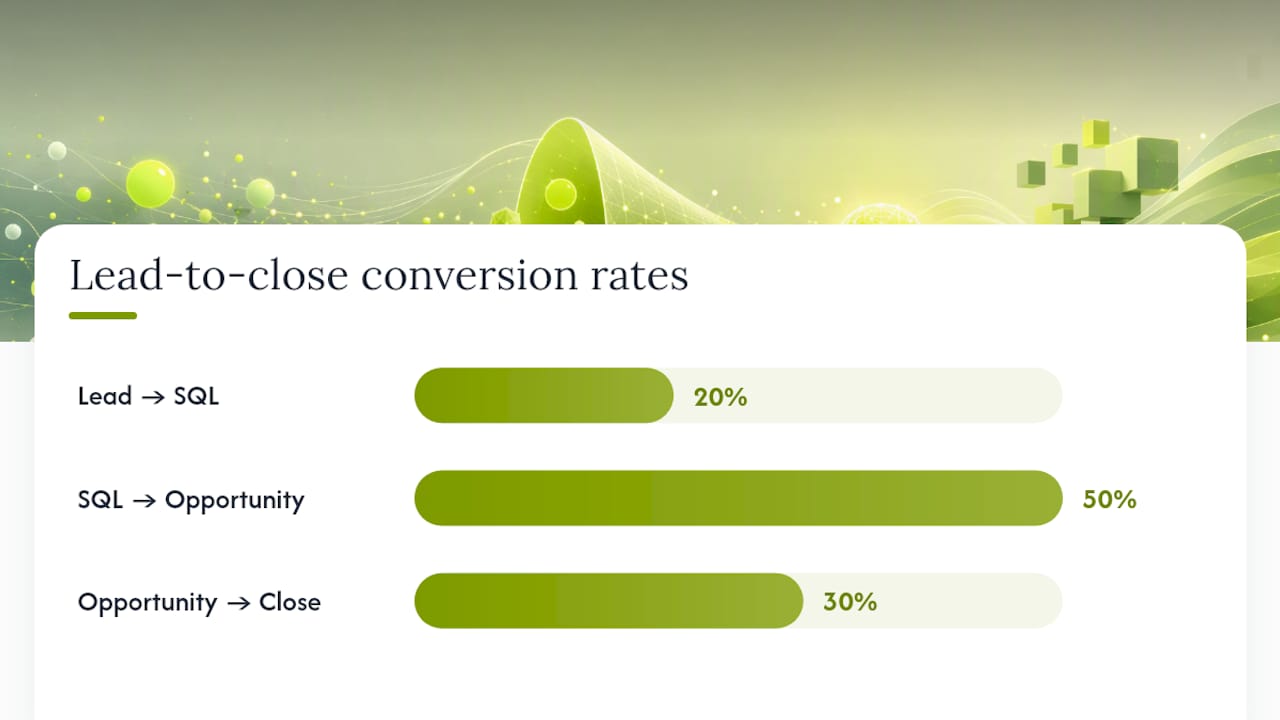
How to convert CPL to pipeline-CAC:
- Take your cost per lead (CPL) from Google Ads.
- Multiply by your lead-to-SQL rate (e.g., 20% of leads become SQLs).
- Multiply by your SQL-to-opportunity rate (e.g., 50% of SQLs become opportunities).
- Multiply by your opportunity-to-close rate (e.g., 30% of opportunities close).
- The result is your pipeline-CAC per closed customer from paid search.
If that number is below one-third of your average customer LTV, the channel is working. If it is above half of LTV, you have a structural problem in either lead quality, sales conversion, or both.
Proof points from the playbook in practice:
The B2B CAC reduction from $150 to $11 per brand documented in Ashafrazier's work came from exactly this kind of structural audit: identifying where the funnel was leaking, tightening the conversion mapping, and reallocating budget to the intent tiers producing pipeline rather than volume. The PartnerSlate case study demonstrates the same principle applied to a SaaS-adjacent marketplace: integrated paid and owned systems, not isolated ad campaigns, produced compounding results.
The highest-leverage move in any SaaS Google Ads program is not finding a cheaper keyword. It is wiring your CRM to your ad platform so the algorithm optimizes on pipeline value rather than form fills. Every structural decision in this playbook flows from that single principle.
PPC for SaaS requires offline conversion tracking, remarketing, and landing-page optimization as core tactics, and the conversion volume thresholds for Smart Bidding are non-negotiable. Campaigns that hit 30+ pipeline-weighted conversions per month and have OCI live consistently outperform those that do not, regardless of budget size.
The most expensive SaaS Google Ads mistakes, and how to fix them
Most SaaS teams make the same mistakes in the same order. The good news is that each one has a clear fix.
High-priority mistakes:
- Optimizing on raw form fills: Every form fill is not equal. A student downloading a whitepaper and a VP of Sales requesting a demo are not the same conversion event. Fix: map conversion actions to CRM milestones and assign pipeline-weighted values before enabling Smart Bidding.
- Missing OCI/CRM integration: Without offline conversion imports, Google's algorithm has no visibility into what happens after the click. Fix: implement GCLID capture and CRM milestone mapping before scaling spend above $5,000/month.
- Activating Target CPA or Target ROAS too early: Below 30 conversions per month, these strategies optimize on statistical noise. Fix: stay on Maximize Conversions until the threshold is consistently met.
- Mixing intent tiers in one campaign: Brand, category, and problem-aware queries have different CPCs, conversion rates, and audience signals. Mixing them produces averaged performance that is worse than any individual tier. Fix: separate campaigns from day one.
Medium-priority mistakes:
- Weak landing-page alignment: Sending a demo ad to a homepage is a conversion killer. Fix: build dedicated landing pages for each ad intent and test them independently.
- Missing negative keyword hygiene: Broad and phrase match keywords will surface irrelevant queries. Fix: review the Search Terms report weekly for the first 60 days and add negatives aggressively.
- Underusing remarketing cohorts: SaaS campaigns require adapted remarketing because audience intent and buying behavior differ from consumer campaigns. Fix: build trial abandoner, pricing-page viewer, and demo-requester segments from day one and serve them sequentially.
Adapted account structure, conversion definitions, and remarketing are not optional refinements for SaaS. They are the baseline requirements for a program that produces pipeline rather than vanity metrics.
What I prioritize when running Google Ads for SaaS
The conventional wisdom says to start with keywords and creative. My experience says start with measurement. You can have the best ad copy in your category and still produce zero pipeline if your conversion mapping is broken.
My personal priority order:
- Wire OCI first. Before spending more than a few thousand dollars, confirm that GCLID is captured, CRM milestones are mapped, and pipeline values are assigned. Everything downstream depends on this.
- Map conversions to pipeline, not forms. The moment you optimize on form fills, you are teaching the algorithm to find people who fill out forms, not people who buy software.
- Validate demand via Keyword Planner before committing budget. If your category has fewer than 1,000 monthly searches in your target geography, Search alone will not scale. You need a content and remarketing strategy running in parallel to build the audience that Search will eventually recapture.
- Scale only after the signal is clean. A program producing 20 pipeline-weighted conversions per month at a healthy CAC is worth more than a program producing 200 form fills at an unknown CAC.
The interplay between paid media and owned channels matters more than most teams realize. Content that ranks organically for problem-aware queries builds the remarketing audience that makes your paid campaigns more efficient. Paid campaigns that capture high-intent buyers feed the CRM data that improves your content targeting. The two systems compound when they are built together, and they cannibalize each other when they are built in silos. The growth marketing KPI dashboard that ties both channels to pipeline metrics is the instrument panel that makes this visible.
Ready to build a pipeline-first Google Ads system?
Running Google Ads for SaaS without a measurement system is the fastest way to spend $50,000 and have nothing to show your board. Ashafrazier builds the full growth system: offline conversion import setup, CRM milestone mapping, campaign architecture, bidding progression, and landing-page conversion optimization, all wired to pipeline metrics rather than vanity numbers.
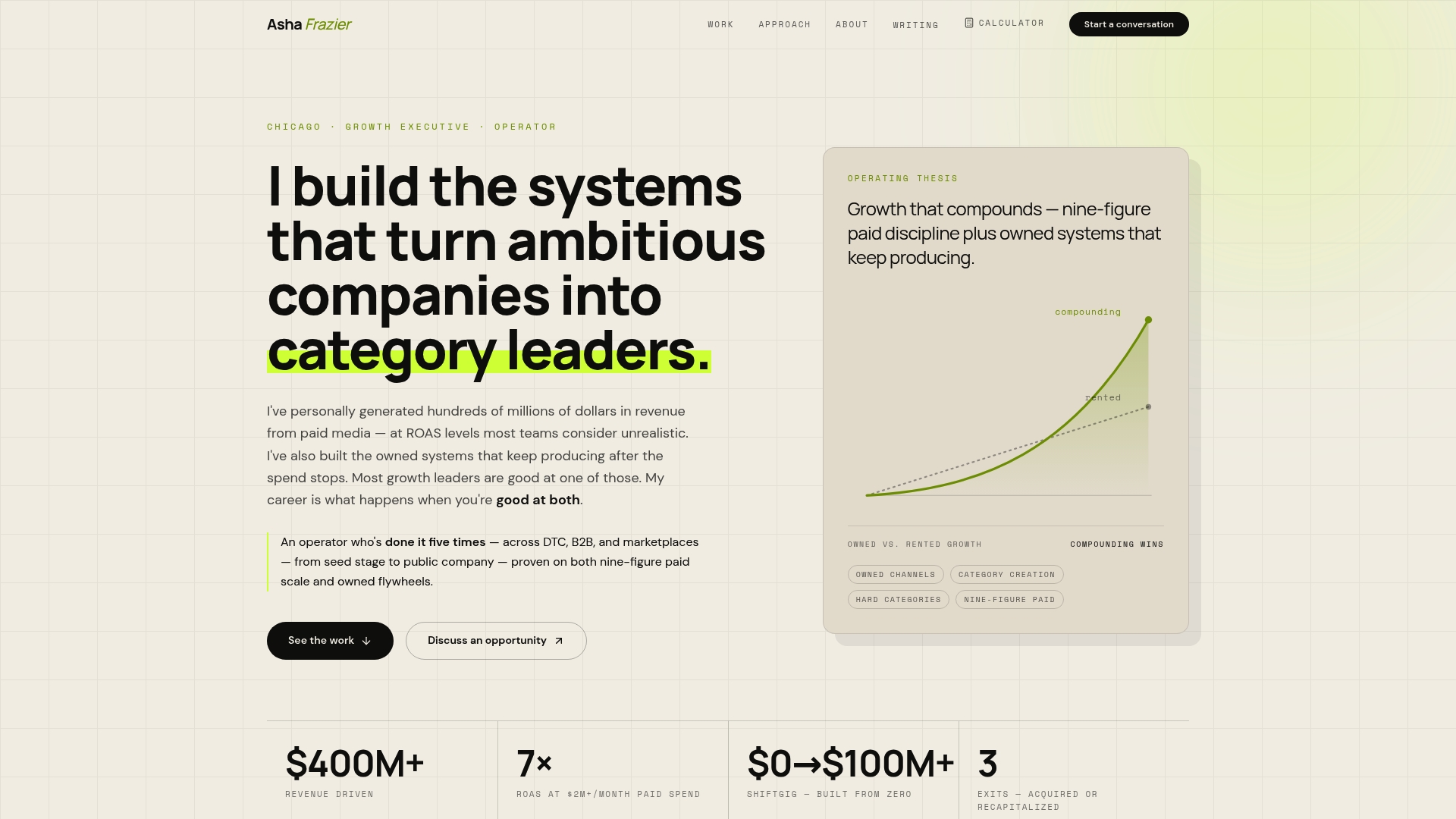
The average ROAS across Ashafrazier's client engagements is 7x, built on the same playbook this article describes: integrated paid and owned channels, pipeline-weighted measurement, and a scaling sequence that preserves signal quality as spend increases. If you want to know where your current program stands before committing more budget, the Growth Score Calculator gives you a structured read on your LTV, CAC, and payback period in minutes. Use it as your baseline before the next budget conversation.
Sources
- Google Ads for B2B SaaS: The Complete Operator's Playbook (2026)
- PPC for SaaS: 6 Essential Strategies for 2026 | WordStream
- PPC for SaaS | Search Engine Journal
- SaaS Advertising Guide: Free Trial to Paid Customer Campaigns
- Google Ads for Saas | COREPPC
- Google Ads for B2B SaaS: The Complete Practical Guide | Scalarly
- Gartner — B2B buying journey
Recommended
- Lowering CAC in a B2B Marketplace: From $150 to $11 Per Brand — Asha Frazier
- Things I've Learned — Asha Frazier
- The Boring Science of Scaling: How to Engineer Predictable Revenue from Seed to $100M+ — Asha Frazier
- Marketplace Growth: When to Push Supply vs. Demand (And What Actually Compounds) — Asha Frazier