
Budget monthly or hourly at market rates typical for fractional CMOs, with monthly retainers and hourly rates varying by engagement. Most companies land closer to $10,000 a month for 10 to 20 hours a week of senior marketing leadership. That's not a guess. It's the midpoint of what the market is actually charging right now, drawn from aggregated benchmark data showing average hourly rates near $177/hr, with a middle band running $125 to $200.
If you're a seed-stage founder, budget toward the lower end, $5,000 to $8,000 a month, for someone who's building your positioning and go-to-market foundation before you can afford full execution support. If you're Series A or later, expect $8,000 to $15,000 a month for someone running paid and owned channels together, managing an agency or internal team, and reporting on unit economics monthly. Growth-stage and PE-backed companies routinely pay $15,000 to $25,000-plus, because the job expands to include board reporting, M&A-adjacent marketing diligence, and cross-functional leadership that a junior operator can't touch.
Here's what that fee typically buys:
- Hours per week: 10 to 20, split between strategic direction and hands-on execution oversight, not a full 40-hour employee schedule.
- Leadership vs. execution: You're paying primarily for judgment and system design; execution usually runs through an agency, freelancers, or your internal team that the fractional CMO directs.
- Ramp time: Expect strategic clarity by day 30, a functioning growth system by day 60, and measurable revenue movement somewhere in the 90 to 180 day window.
Pro Tip: Treat the first month's invoice as a diagnostic cost, not a growth cost. A good fractional CMO spends week one auditing your funnel and unit economics before touching a single campaign, and that audit is worth every dollar even if revenue hasn't moved yet.
Key Takeaways
Fractional CMO rates typically run $5,000 to $25,000 a month or $200 to $500 an hour, with most companies budgeting near $10,000 a month for 10 to 20 hours of senior marketing leadership weekly.
| Point | Details |
|---|---|
| Headline benchmark | Budget $5,000–$25,000/month or $200–$500/hr, with $10,000/month as a common mid-market target. |
| Typical commitment | Most engagements run 10–20 hours a week, with strategic clarity by day 30 and revenue impact by month three to six. |
| Cost vs. full-time | Fractional engagements often cost 50–70% less in year one than a full-time CMO's total compensation. |
| Hiring checklist | Ask for two verifiable references, require a written 30/60/90-day plan, and put deliverables in the contract, not the pitch. |
| Negotiation lever | Cap hours and define a clear scope-change process before signing to prevent price creep mid-engagement. |
| Ashafrazier's approach | Ashafrazier operates as a hands-on fractional CMO integrating paid and owned channels, best suited to revenue-generating, multi-location, or PE-backed companies. |
Table of Contents
- What Are the Different Fractional CMO Pricing Models?
- How Much Do Fractional CMOs Actually Charge?
- What Factors Drive Fractional CMO Pricing Up or Down?
- Is a Fractional CMO Cheaper Than a Full-Time CMO?
- What Deliverables Should You Expect at Each Price Point?
- How Do You Evaluate and Hire the Right Fractional CMO?
- What Do Real Fractional CMO Engagements Look Like?
- When Does a Fractional CMO Actually Make Sense?
- How Does Ashafrazier's Fractional CMO Model Work?
- Sources
What Are the Different Fractional CMO Pricing Models?
Fractional CMO pricing isn't one number. It's five distinct structures, and picking the wrong one for your stage is how founders end up either overpaying for flexibility they don't need or underpaying for accountability they do.
Monthly retainer. This is the dominant model, and for good reason: it gives both sides predictability. You know your marketing consultant hourly rates translate into a fixed monthly number, and the CMO knows their income isn't tied to sporadic project work. The tradeoff is that retainers can drift toward vague scope if you don't pin down deliverables up front.
Hourly or advisory. Best for companies that need occasional strategic input, not sustained leadership. A fractional cmo hourly rate typically runs $200 to $500, and this model works well for board prep, a one-time channel strategy review, or advising an internal marketing hire. It's a poor fit if you need someone accountable for ongoing pipeline numbers, because nobody bills hours toward a result they're not managing day to day.
Day rate. Common for intensive workshops, offsite strategy sessions, or a rapid audit engagement. Day rates often land in the $1,500 to $3,000 range and suit companies that want a concentrated burst of expertise rather than an ongoing relationship.
Project-based. Fixed fee for a defined deliverable, like a go-to-market launch plan or a full funnel rebuild. This model rewards specificity. If the scope is written well, it's the easiest to budget for. If it's vague, it becomes the easiest to fight over.
Value-based or hybrid. Rarer, but growing among growth-stage companies willing to tie part of the fee to outcomes like revenue growth or CAC reduction, sometimes blended with a smaller cash retainer plus equity. This aligns incentives beautifully on paper. In practice, it only works when both sides agree on attribution methodology before the engagement starts, which is a bigger negotiation than most founders expect.
Before you sign anything, run through this negotiation checklist:
- Cap hours per week or month so scope creep doesn't quietly become a second job.
- Tie deliverables to calendar milestones, not vague "ongoing strategy" language.
- Set a 30 or 60-day notice period on both sides, not an open-ended arrangement.
- Define what happens if success milestones are hit early or missed. Does the fee change?
How Much Do Fractional CMOs Actually Charge?
The numbers cluster more tightly than founders expect once you separate them by seniority and hours committed. RankedCMO's pricing data puts most retainers between $5,000 and $25,000 a month, with hourly advisory work commonly priced at $200 to $500 and typical weekly commitment sitting at 10 to 20 hours.
That mid-market band lines up closely with what Growtal's founder guide reports: $6,000 to $12,000 a month, with initial strategic goals typically taking six to nine months to fully materialize. That timeline matters more than the price tag. A founder budgeting for a fractional CMO who expects Q1 revenue results from a Q1 hire is setting themselves up for disappointment regardless of what they're paying.
Three scenarios show how this plays out in practice:
- A seed-stage SaaS company pays $6,000/month for 10 hours a week. The CMO spends the first six weeks fixing a muddled offer and messaging problem before touching paid channels. Expected outcome by month three: a validated positioning statement and an early-stage funnel, not a revenue spike.
- A Series A DTC brand pays $12,000/month for 15 hours a week. The CMO restructures paid media spend, brings in an agency for execution, and builds attribution tracking. Expected outcome by month four: measurable CAC improvement and a repeatable acquisition channel.
- A growth-stage, multi-location business pays $20,000/month for 18 to 20 hours a week. The CMO manages a small internal team, reports to the board quarterly, and owns both paid and owned channel strategy. Expected outcome by month six: a compounding growth system with documented unit economics.
Industry premiums show up consistently in regulated or high-consideration markets, health care, financial services, and B2B categories with long sales cycles, where trust-building and compliance awareness add real complexity to the marketing function.
What Factors Drive Fractional CMO Pricing Up or Down?
Six variables move the price more than anything else: seniority, industry specialization, weekly hours, scope breadth, contract length, and geography or exclusivity requirements.

Seniority is the biggest lever. A CMO with a documented track record of scaling revenue in high-consideration markets commands a materially higher fractional CMO hourly rate than someone early in their consulting career, and for good reason: they've already made the expensive mistakes on someone else's budget.
Industry specialization compounds that premium. Fractional CMOs working with PE-backed companies often charge more because the job requires board-ready reporting and M&A-adjacent fluency that a generalist marketing consultant simply hasn't built. The same logic applies to regulated industries or anything with a long, trust-dependent sales cycle.
Scope breadth matters as much as hours. A CMO doing pure strategy costs less than one also managing agency relationships, running weekly stand-ups with an internal team, and owning execution oversight. Contract length cuts the other way: shorter, urgent engagements (interim coverage after a CMO departure, for instance) often carry a premium because you're paying for immediate availability, not a planned six-month runway.
Secondary drivers worth knowing about before you negotiate:
- Performance guarantees or milestone-based bonuses tend to raise the base rate, since the CMO is absorbing more risk.
- Equity requests in lieu of cash usually lower the monthly retainer but complicate the relationship if expectations aren't documented precisely.
- Tools and software licenses the CMO needs (attribution platforms, CRM access, ad accounts) sometimes get billed separately, sometimes folded into the retainer. Ask which.
- Urgency changes everything. Filling an emergency interim CMO gap costs more than a planned three-month-out engagement.
Founders have more control over price than they realize. Phasing the engagement (audit first, execution second) limits early spend. Capping scope to two or three core priorities instead of "own all of marketing" keeps the fee proportional to actual work. Structuring part of the fee around outcomes, rather than hours, shifts risk appropriately without inflating the base rate.
Pro Tip: Write the scope of work as a list of specific deliverables with dates, not a job title. "Build and launch a paid media testing framework by day 45" prices cleanly. "Improve marketing" invites both scope creep and rate creep, because nobody can price an undefined job.
Is a Fractional CMO Cheaper Than a Full-Time CMO?
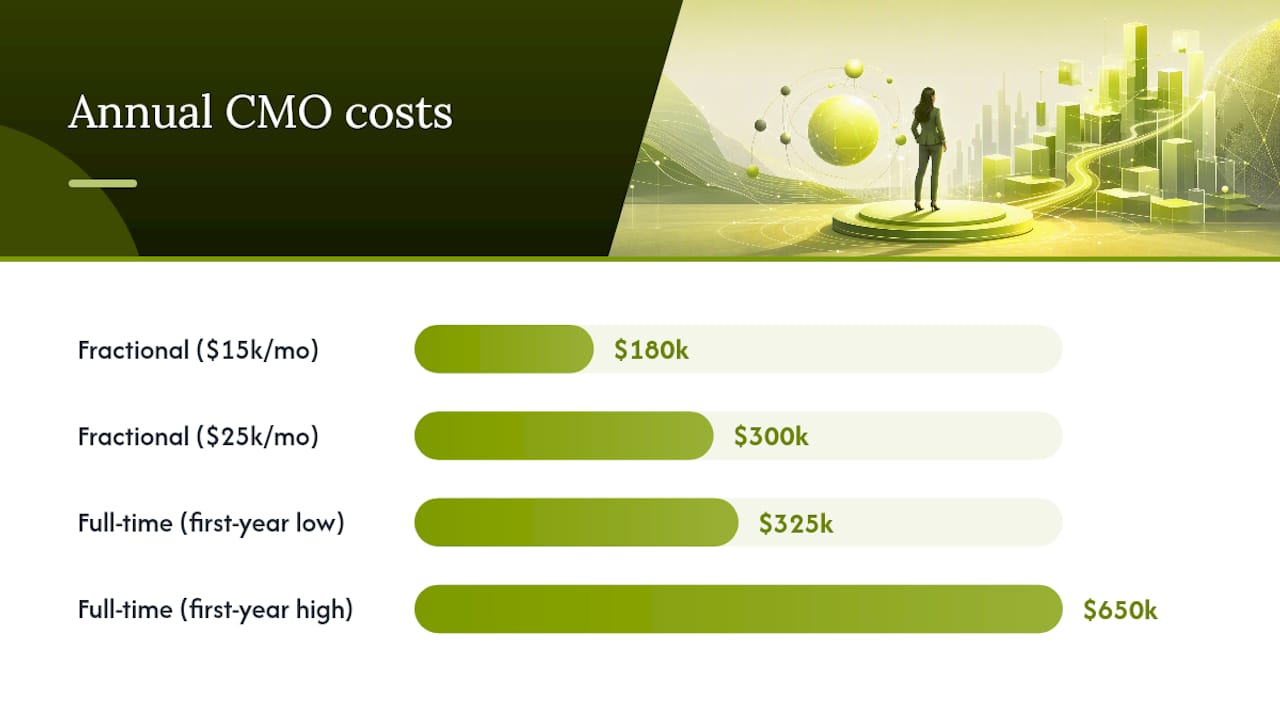
Yes, usually substantially. A full-time CMO's base salary commonly runs $250,000 to $400,000, and once you layer in bonus, equity, and benefits, total first-year cost often lands between $325,000 and $650,000. Benefits and payroll overhead alone typically add 25 to 35% on top of base salary, before you count recruiter fees that can run another 20 to 30% of first-year compensation for an executive search.
A fractional CMO at $15,000 a month annualizes to $180,000, and even the senior end of the range, $25,000 a month, comes to $300,000 a year with none of the recruiter fees, severance risk, or benefits load. Companies frequently report 50 to 70% total cost savings in year one comparing fractional to full-time, which is a wide enough gap that it should be the first number in any board conversation about marketing leadership.
The math isn't the whole story, though. Full-time hires bring things a fractional engagement structurally can't: dedicated capacity for cross-functional politics, deeper day-to-day team mentorship, and a single point of accountability who isn't splitting attention across two or three other clients. A fractional CMO working 15 hours a week for you is also working for someone else the other 25.
Here's a rough break-even framework: if your marketing function needs more than 30 hours a week of leadership attention, or you're managing a team of eight or more marketers who need daily coaching, the math starts favoring full-time despite the higher sticker price. If you need 10 to 20 hours of senior strategic direction and execution oversight, fractional wins on cost and speed, since you can typically onboard a fractional CMO in weeks rather than the three to six months a full executive search takes.
Quick situational rules worth pinning to your whiteboard:
- Hire fractional when you need a skill gap closed fast, or when your marketing spend doesn't yet justify a full-time executive salary.
- Hire full-time when you need deep, daily cross-functional integration and a team leader physically present for internal politics and culture-building.
- Compare the two paths directly before assuming an agency retainer is the cheaper alternative to either.
With marketing budgets flatlined at roughly 7% of company revenue, the pressure to prove ROI on every marketing dollar, fractional or full-time, isn't going away anytime soon.
What Deliverables Should You Expect at Each Price Point?
Price bands map to scope, and knowing that mapping is how you avoid paying senior rates for junior-level output, or worse, paying junior rates and expecting a senior scope of work.
Entry band ($5,000 to $8,000/month). Expect strategic audits, positioning work, and light execution guidance. This tier is right for pre-revenue or early seed companies that need direction more than hands-on management. Deliverables typically include a messaging framework, a channel prioritization plan, and monthly check-ins rather than weekly team leadership.
Mid band ($6,000 to $12,000/month). This is where most companies actually land. Deliverables should include active agency or freelancer management, a documented growth system covering both paid and owned channels, and a monthly KPI review covering CAC trends and pipeline health. If you're paying mid-band rates and getting entry-band involvement, that's your signal to renegotiate scope.
Senior band ($15,000 to $25,000-plus/month). Expect team leadership, board or investor-ready reporting, and ownership of the full growth system architecture. This tier should also include forward-looking work: LTV/CAC payback modeling, retention strategy, and often direct input into pricing or offer structure, not just campaign execution.
Regardless of band, insist on a measurement cadence you can actually hold someone accountable to:
- Monthly pipeline and revenue attribution review, not quarterly.
- CAC and LTV/CAC payback trend tracked against a stated target, not a vague "improving" claim.
- A documented 30/60/90-day plan established in week one, revisited at each milestone.
| Price Band | Monthly Range | Team Leadership | Reporting Cadence |
|---|---|---|---|
| Entry | $5,000–$8,000 | Advisory only | Monthly check-in |
| Mid | $6,000–$12,000 | Manages agencies/freelancers | Monthly KPI review |
| Senior | $15,000–$25,000+ | Leads internal team | Monthly + board reporting |
Contract language matters here as much as the number itself. Tie payment to delivered milestones and reporting cadence, never to a specific revenue outcome the CMO doesn't fully control, since that structure invites either inflated short-term tactics or disputes over attribution. A fractional cmo cost that's fair to both sides rewards process discipline, not just results that could be influenced by a dozen other variables.
How Do You Evaluate and Hire the Right Fractional CMO?
Hiring well here comes down to asking sharper questions than most founders think to ask, and knowing which answers should end the conversation immediately.
Run your discovery calls through this sequence:
- Ask for a specific example of a funnel or channel strategy they rebuilt, including what was broken and what the fix actually was.
- Ask how they've handled attribution in a business with a long or complex sales cycle. A vague answer here is disqualifying.
- Ask what a typical week of their 10 to 20 hours looks like, hour by hour. If they can't describe it, they haven't done this before.
- Ask directly about their approach to managing an existing internal team or agency relationship, since that's often the actual job.
- Ask for two references you can call, not just testimonials on their website.
Red flags that should make you walk away: anyone promising specific revenue results within 30 days, anyone who can't name concrete KPIs beyond "brand awareness," anyone unwilling to put hours and deliverables in writing, and anyone who won't provide a single verifiable reference.
Once you've picked someone, the contract should specify:
- Exact hours per week or month, with a defined process for scope changes mid-contract.
- Notice period for either party to exit, typically 30 to 60 days.
- IP ownership and confidentiality terms, especially around any proprietary frameworks or tools.
- Expense policy, particularly for ad spend management and third-party tool subscriptions.
- Performance milestones tied to the 30/60/90-day plan, not open-ended promises.
A standard fractional CMO job description template recommends specifying 10 to 20 hours a week and a six-month minimum commitment, with retainer language rather than employment terms, which keeps both the tax classification and the expectations clean from day one.
Pro Tip: When checking references, ask the former client one specific question: "What did you expect that didn't happen?" Every engagement has a gap between promise and delivery. How honestly the reference answers that question tells you more than any list of wins ever will.
What Do Real Fractional CMO Engagements Look Like?
Numbers on a page only mean so much until you see how they map to actual company situations. Here's how five common stages typically play out.
| Stage | Hours/Week | Monthly Fee | 30-Day Outcome | 90-Day Outcome |
|---|---|---|---|---|
| Pre-seed/seed | 8–10 | $5,000–$8,000 | Positioning audit complete | Funnel foundation live |
| Series A | 12–15 | $8,000–$12,000 | Attribution set up | CAC trend improving |
| Growth-stage | 15–20 | $15,000–$20,000 | Team restructured | Growth system compounding |
| PE-backed/mid-market | 18–20 | $20,000–$25,000+ | Board reporting live | Cross-functional alignment |
| Interim coverage | 20–25 | $15,000–$25,000 | Continuity secured | Handoff plan built |
A seed-stage SaaS company hiring at 8 hours a week for $6,000/month should expect strategic clarity, not execution volume, in the first month. A growth-stage DTC or marketplace business paying closer to $15,000 to $20,000/month should see CAC trending down within a quarter as attribution and channel testing mature.
Scope changes move price predictably. Adding a second market or product line to manage often adds a comparable premium, particularly for multi-location businesses where local nuance multiplies the work.
For onboarding, the first 30/60/90 days should follow a consistent rhythm regardless of price band: days 1 through 30 focus on audit and diagnosis, days 30 through 60 on building or fixing the core growth system, and days 60 through 90 on scaling what's working and cutting what isn't. Founders who skip the audit phase to "move faster" almost always pay for it later in wasted ad spend.
When Does a Fractional CMO Actually Make Sense?
The honest answer is that most founders reach for a fractional CMO too late, after they've already burned budget on an agency that executed tactics without a coherent strategy behind them, or after a junior marketing hire hit the ceiling of what they could own alone. The right moment is earlier than instinct suggests: the point where you have product market fit signals but your offer, messaging, or channel mix is still unclear enough that throwing more spend at it would be lighting capital on fire.
Two things separate founders who get real ROI from a fractional engagement from those who don't. First, they structure the first 30 days as a genuine audit, not a launch sprint, giving the CMO room to find the actual bottleneck (often the offer itself, not the channel) before committing budget. Second, they set one or two measurable targets for the first six months, tied to unit economics like CAC or payback period, rather than vague growth language that can't be checked against a number later.
Companies operating in high-consideration markets, where trust and timing matter more than volume, tend to see the clearest returns from this model, because the strategic thinking a senior operator brings compounds faster than tactical execution alone ever could. That's a pattern worth sitting with if you're deciding between fractional leadership and simply hiring another marketing generalist.
How Does Ashafrazier's Fractional CMO Model Work?
If everything above has you thinking through your own budget, here's the practical next step. Ashafrazier works as a hands-on operator, not an advisor who hands you a slide deck and disappears, building integrated paid media and owned channel systems directly inside your business rather than billing hours for generic strategy sessions.
This model fits companies generating meaningful revenue already, typically past early seed stage, that need both disciplines working together: paid acquisition and owned channels like content, email, and retention, compounding instead of competing for budget. It's a particularly strong fit for multi-location businesses and PE-backed companies that need board-ready reporting alongside execution, and for founders in high-consideration markets where trust and timing decide whether a customer converts at all.
Before you commit budget to any engagement, run your own numbers through the Growth Score Calculator to see where your CAC, LTV, and payback period actually stand. It takes a few minutes and gives you a clearer basis for the budgeting conversation than any industry benchmark alone can.
Sources
- Fractional CMO Cost: $5K–$25K/Month (2026 Real Pricing Data) | RankedCMO
- Gartner 2025 CMO spend survey press release
- Chief Marketing Officer salary data | Glassdoor
- Fractional CMO Responsibilities: A Guide for Founders