
Founder-led marketing is a repeatable system where a founder's market intelligence becomes the company's primary distribution engine rather than a personality showcase run on a whim. Early-stage founders with real domain expertise, especially in B2B and high-consideration markets, should treat it as their highest-leverage channel right now. The catch: it only works when you build it as a system with cadence and measurement, not as sporadic posting whenever the mood strikes.
TL;DR:
- Founder-led marketing is most effective when the founder has genuine domain expertise and can dedicate consistent weekly time to content creation.
- The system should focus on documenting real customer objections and insights, not personality-driven or sporadic posts.
- Success relies on choosing one primary channel, typically LinkedIn for B2B, and validating results before expanding to additional platforms.
- Tracking signals such as engagement, interest inquiries, and closed deals helps determine when to scale or pause efforts.
- Building artifacts like a voice document and repurposing procedures early allows one person to maintain the system during founder absences or burnout.
Table of Contents
- What Founder-Led Marketing and Founder-Led Growth Actually Mean
- Why Founder-Led Marketing Works: Trust, Economics, and Conversion
- When Founder-Led Marketing Fits, and When to Avoid It
- The Tactical Playbook: Channels, Content Mix, and a Weekly System
- Scaling Founder-Led Growth Without the Founder as Bottleneck
- Measuring the Funnel: From Resonance to Revenue
- Your 30-Day and 90-Day Founder-Led Marketing Sprint
- A Practitioner's View: Turning Founder Signal Into a Growth System
- Protecting Founder Time: A Working Trade-Off Model
- How Asha Frazier Helps Founders Scale This Motion
- Sources
What Founder-Led Marketing and Founder-Led Growth Actually Mean
People use "founder-led marketing," "founder-led growth," and "founder-led selling" interchangeably, and that sloppiness costs teams months. They are related but distinct.
Founder-led growth is the broader discipline: a founder personally driving the company's early growth motion, often across product, pricing, and acquisition simultaneously. Run this founder-led growth playbook instead of hiring a head of growth too early, because founders who run this work themselves uncover the highest-leverage levers faster, through direct customer interviews, journey mapping, and rapid experiments no outside hire could replicate on day one.
Founder-led marketing is the narrower, content-and-distribution slice of that motion. It is the discipline of turning what the founder already knows about the market, the buyer's language, the objections that kill deals, into an owned content and distribution system. Founder-led selling is narrower still: the founder personally closes early deals, often the same conversations that feed the marketing content.
Here is the distinction that matters most: system versus personality posting. Personality posting is a founder sharing a hot take because LinkedIn rewarded the last one with likes. A system is a founder documenting a real customer objection every week, publishing the response in a consistent format, and routing engagement back into product and sales. One is a mood. The other is a machine that gets smarter every month, because founder-led marketing externalizes market intelligence into distribution assets the company owns long after any single post fades from the feed.

A founder who writes a weekly breakdown of the exact question every prospect asked on sales calls is running a system. A founder who posts a photo from a conference with a caption about "grinding" is not running a system. Both are technically "founder content." Only one compounds.
Why Founder-Led Marketing Works: Trust, Economics, and Conversion
Buyers do not trust brands. They trust people, and in an unproven company, the founder is often the only person a buyer has any reason to believe. That trust transfers, imperfectly but measurably, from the founder to the product and the company behind it.
The economics back this up in a way that should reframe how founders allocate their own time. Founder transparency and building in public shift the relationship from a transaction to something closer to a partnership, and that shift shows up directly in engagement and conversion outcomes, often outperforming brand-only content with the same reach. A prospect who has watched a founder explain their reasoning for six months arrives at a sales call pre-sold on the person, which shortens the cycle and raises the close rate.
The inbound math founders underweight: Content that carries a founder's actual voice and specific point of view tends to produce lower acquisition costs than anonymous brand content, because it filters for buyers who already agree with the founder's worldview before the first call. That pre-qualification is the entire economic case for the channel: you are not buying attention, you are buying a warmer, cheaper lead.
The evidence trail is consistent across practitioner research. Founders who personally run growth in the early stage uncover the highest-leverage growth levers faster than a hired marketer could, simply because they were in every customer call that shaped the product. That knowledge, once it is written down and published on a schedule, becomes the raw material for every other growth motion.
A concrete pattern shows up across B2B software companies: a founder posts a weekly breakdown of a customer problem, a prospect comments with a specific objection, the founder answers publicly, and that exchange becomes the next week's content. The pipeline conversation is happening in public, for free, before a sales rep ever gets involved.
When Founder-Led Marketing Fits, and When to Avoid It
This motion is not universal. Running it at the wrong stage, or with the wrong founder profile, wastes time you cannot get back and can quietly damage credibility if the founder disappears mid-motion.
Founder-led marketing fits best when:
- The company is pre-seed through Series B, before category positioning has fully hardened.
- The founder has genuine domain expertise, not just enthusiasm, and can speak specifically about the buyer's problem.
- The sales cycle is long or high-consideration, where trust is the actual bottleneck to closing.
- The founder can commit real, protected weekly time, not "whenever things slow down."
- The market rewards a point of view rather than a commodity comparison.
It does not fit, or should pause, when the founder cannot commit consistent time, when the company is entering a phase of heavy regulatory scrutiny where personal opinion carries legal risk, or when the founder's public voice actively conflicts with the brand the company needs to project (a technical founder trying to force a consumer-lifestyle tone, for example).
The biggest risk is dependency: the company's entire distribution engine sitting inside one person's calendar. If the founder gets sick, raises a round, or simply burns out on posting, pipeline visibly drops. The mitigation is building the system described later in this piece from day one, documenting the voice and the topics so someone else can maintain cadence during gaps. The second risk is reputational: a founder's public missteps now attach directly to the company brand in a way an anonymous marketing account never would. Neither risk is a reason to skip the motion. Both are reasons to build it deliberately instead of improvising it.
The Tactical Playbook: Channels, Content Mix, and a Weekly System
Most founders fail at this not from lack of insight but from spreading thin across too many channels before any single one proves out. Pick one surface first.
1. Choose your primary surface based on where your buyer already spends attention. For most B2B founders, that is LinkedIn: treat it as a learning loop, not a billboard, wiring comments and DMs back into your next post's topic. For technical buyers, a newsletter often outperforms social because it reaches inboxes without algorithm gatekeeping. For consumer or high-trust categories, video or a podcast builds intimacy faster than text ever will.
2. Validate before you expand. Start with one surface and one learning loop, let it teach you which topics and formats actually move buyers, and only add a second channel once the first one is producing a measurable signal.
3. Run the 90/10 content mix. Roughly 90% of your output should be authority content (specific insight, frameworks, customer problems solved) and personal narrative (how you think, what you got wrong). The remaining 10% can be direct sales or product mentions. Flip that ratio and audiences smell the pitch before they trust the person.
Here is the weekly rhythm that fits inside three hours, the ceiling most founders can realistically protect:
- 30 minutes: Brain dump. Voice-memo or type every customer objection, insight, or question from the week's calls.
- 60 minutes: Draft the pillar piece. One long-form post, newsletter section, or video script built from the brain dump.
- 45 minutes: Publish and distribute the pillar piece across your primary surface, following content strategy platform best practices that pair owned posting with any earned or paid amplification available.
- 30 minutes: Repurpose. One pillar piece becomes three to five smaller posts, a LinkedIn comment reply, or a newsletter snippet.
- 15 minutes: Engage. Reply to every comment and DM personally; this is where the learning loop actually closes.
The repurposing pyramid matters more than most founders realize: a single 20-minute customer call recap can become one newsletter section, three LinkedIn posts, a Slack community share, and a slide in the next sales deck. Sample cadences and the 90/10 mix are well documented for founders who want a starting template rather than building one from scratch.
Pro Tip: Do not open a blank document to write your weekly post. Open your CRM or call recordings first. The best content you'll publish this week is a sentence a prospect already said out loud, verbatim, on a call you had on Tuesday.
Run these five experiments in your first month: a "what I got wrong" post, a customer objection breakdown, a behind-the-scenes product decision, a numbers-based result you can share honestly, and a direct response to a comment thread in your niche. Whichever gets real replies, not just likes, tells you what to double down on.
Scaling Founder-Led Growth Without the Founder as Bottleneck
The system breaks the moment it depends entirely on the founder's calendar. Scaling means encoding the founder's voice into artifacts a team can operate, not replacing the founder's presence with a ghostwriter pretending to be them.
Four moves compound over time:
- Show the work. Publish decisions, not just conclusions, so the audience sees reasoning it can trust.
- Social sell, don't just broadcast. Reply, DM, and engage in threads where your buyers already argue; broadcasting alone caps reach at your own follower count.
- Build cross-surface presence. A pillar idea on LinkedIn becomes a newsletter deep dive and a podcast talking point, multiplying reach without multiplying founder hours.
- Close the learning loop. Every comment, objection, and DM should feed back into the next week's topic list, because the compounding effect comes from encoding founder knowledge into systems, not from raw posting frequency.
The practical artifacts worth building early: a voice document capturing tone, phrases, and topics to avoid; a folder of annotated best-performing posts explaining why each one worked; a repurposing standard operating procedure a contractor can follow without the founder's input; and, once volume justifies it, a content operator who owns distribution metrics while the founder keeps producing the raw insight.
Pro Tip: Hire the content operator before you hire a ghostwriter. A skilled operator who repurposes and distributes your real voice compounds faster than a writer manufacturing a synthetic version of it.
A hybrid model works for most companies past the validation stage: the founder keeps producing the high-trust pillar content, while a small team handles repurposing, scheduling, and volume. That division protects the signal that makes the channel valuable in the first place.
Measuring the Funnel: From Resonance to Revenue
Track three tiers, in order: leading signals (comments, saves, reply rate), intent signals (newsletter replies, DM inquiries, calendar bookings), and revenue signals (source-tagged closed deals, inbound close rate).
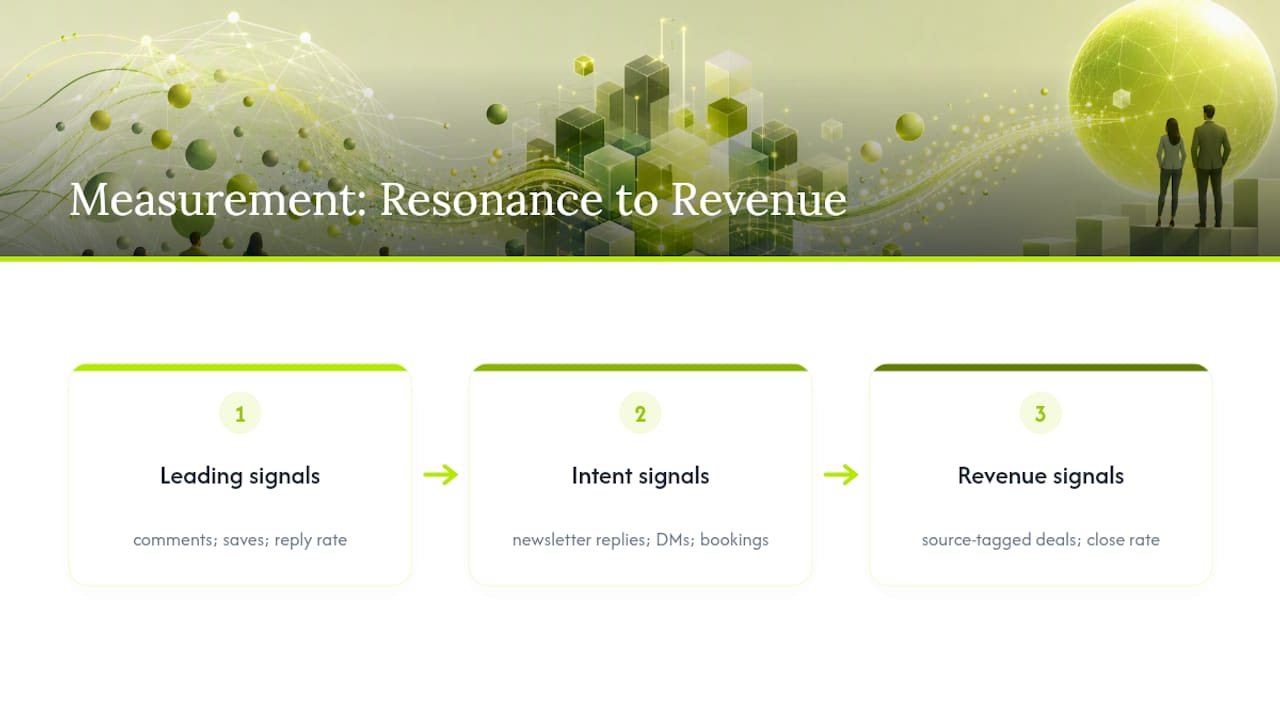
A minimal instrumentation plan takes an afternoon to set up: UTM-tag every pillar post, add a CRM field labeled "source: founder content," ask "how did you hear about us" on every intake form, and review inbound close rate monthly against your other channels. If founder-sourced leads close faster or cheaper than paid channels, that is your signal to invest more founder hours. If engagement is high but pipeline stays flat for two consecutive months, that is your signal to escalate: bring in paid distribution to amplify proven content, or hire the operator role described above before the founder burns out chasing volume alone.
Your 30-Day and 90-Day Founder-Led Marketing Sprint
Treat the first quarter as a controlled experiment, not a permanent commitment.
- Days 1 to 30: Publish four to eight pillar pieces on one surface. Run the weekly brain dump every week without exception. Set up UTM tags and the CRM source field before you publish post number one.
- Days 1 to 30, parallel: Repurpose every pillar piece into at least two smaller assets. Reply personally to every comment and DM within 24 hours.
- Days 31 to 90: Compare engagement trend, DM/reply volume, and any source-tagged pipeline against your baseline. Add a second surface only if the first shows a rising trend in intent signals, not just leading signals.
- Day 90 decision point: Accept and scale if inbound-tagged conversations or deals exist and cost less time per lead than your paid channels. Pause or redesign if engagement stayed flat for six or more consecutive weeks despite consistent output; that usually signals a topic or format mismatch, not a channel failure.
A Practitioner's View: Turning Founder Signal Into a Growth System
Fifteen-plus years building growth systems across paid and owned channels teaches you one thing quickly: founders who try to run marketing purely as personal branding eventually hit a ceiling, because personality does not scale, but a documented system does.
The founders who get the most out of this motion are the ones who stop thinking of their content as marketing and start thinking of it as market research they happen to publish. Every objection, every "wait, how does that work" comment, is free data most companies pay agencies to go find. The founders who waste this channel are the ones treating it like a diary instead of a distribution system.
The pattern that shows up across engagements: founder-led content sets the trust foundation, then paid distribution and structured funnels turn that trust into predictable pipeline volume, without diluting the voice that made it work in the first place. A detailed case study on rapid, revenue-focused turnarounds shows what that combination looks like applied under a real deadline.
— Asha
Protecting Founder Time: A Working Trade-Off Model
Founder time is the scarcest input in this entire system, scarcer than budget most quarters. The trade-off is simple to state and hard to honor: every hour on content is an hour not spent on product or sales, so the only defensible allocation is content that directly produces sales conversations, not content that produces likes.
Triage every piece of content against one question before you write it: will this specific post plausibly start a sales conversation within 30 days? If the honest answer is no, it belongs in the 10% personal bucket at most, not the core of your week.
How Asha Frazier Helps Founders Scale This Motion
Validating founder-led marketing is the easy part. Turning early signal into a durable growth engine, without losing the founder's voice along the way, is where most companies stall. Ashafrazier works as a fractional CMO for founders who have proven the motion works and now need paid media, funnel architecture, and attribution built around it, rather than another generic marketing hire learning the business from zero.
The fit is specific: companies in high-consideration markets, often B2B or ecommerce, where trust and timely execution decide whether a deal closes. Ashafrazier's fractional CMO engagements build the integrated paid and owned system around whatever founder-led signal already exists, rather than replacing it with anonymous brand content. Case work like the RealReal engagement shows how that combination plays out for companies past the early validation stage.
If you have run the 90 day sprint above and seen real intent signals, the next move is straightforward: run your numbers through the Growth Score Calculator to see where your CAC and payback period actually stand, then reach out through Ashafrazier to talk through whether a fractional engagement fits your stage.
Sources
- You’re Not Ready for a Head of Growth: Run This Founder-Led Growth Playbook Instead — First Round Review
- Founder-Led Marketing. The Complete Playbook for Turning Your Personal Brand Into Pipeline — Gallopeer
- Founder-Led Marketing: A Guide to Engaging Your Founder — CXL
- This Strategy Drives Startup Success: Founder-Led Marketing — Forbes
Recommended
- The Growth Marketing Playbook for Series A Startups: From Product-Market Fit to Scale
- The 60-Day Turnaround: Taking a Cash-Burning DTC Brand to a $100M Exit
- The Boring Science of Scaling: How to Engineer Predictable Revenue from Seed to $100M+
- Lowering CAC in a B2B Marketplace: From $150 to $11 Per Brand