
ABM and demand generation are not competing strategies. Run demand gen as your operating system, then deploy ABM as a targeted application against the accounts that surface the strongest intent. The single factor that flips the decision: your total addressable market (TAM) size combined with average contract value (ACV) and buying-group complexity.
Three signals that tell you which motion to prioritize first:
- Narrow TAM + high ACV + multi-stakeholder buying committee → start with an ABM pilot of 10–25 named accounts.
- Large TAM + low or mid-range ACV + transactional buying motion → scale demand generation first and use the signal it generates to select ABM targets later.
- Mixed signals (moderate TAM, moderate ACV, 3–5 stakeholders) → run parallel pilots and let 90-day data decide where to concentrate.
Pro Tip: If you cannot clearly define your TAM in a spreadsheet of named companies, you are not ready for ABM. Build the demand gen machine first.
The framing of ABM versus demand gen as rivals is largely a MarTech vendor positioning artifact. Strategically, they are layers of the same growth system, and the companies that treat them as mutually exclusive tend to underperform on both.
Table of Contents
- What does the ABM vs. demand gen decision actually mean?
- What demand generation actually does for your pipeline
- What account-based marketing actually does for your pipeline
- How do ABM and demand gen compare side by side?
- When should you prioritize ABM, demand gen, or both?
- How to combine ABM and demand gen into one integrated GTM motion
- What metrics should you track for demand gen and ABM?
- What timelines and budgets should you plan for?
- Your first-90-days implementation checklist
- When should you hire an external consultant or agency?
- Key Takeaways
- The operating system metaphor is not just clever framing
- How Ashafrazier helps you build this system
- Useful sources and further reading
What does the ABM vs. demand gen decision actually mean?
TL;DR: Most B2B organizations should run demand generation as the base motion and layer ABM on top for high-value accounts. The fastest test is a 90-day pilot running both in parallel with a shared account dashboard.
For leaders who need the short version:
- Who to involve: Your head of marketing and VP of Sales must co-own the target account list from day one. No joint ownership, no ABM.
- Pilot budget band: A credible pilot typically runs tens of thousands of dollars in combined media, content, and tooling spend, depending on your ACV and account tier size. Costs vary significantly by industry and existing tech stack.
- First 30-day KPI to watch: Account engagement rate on your pilot list. If a small share of target accounts show measurable engagement (ad impressions, site visits, content downloads) in the first month, your account selection or messaging needs adjustment before you scale.
The fastest validation test: run ungated demand gen content to your ICP for 30 days, identify which companies engage most, and use that signal to build your ABM target list for month two.
What demand generation actually does for your pipeline
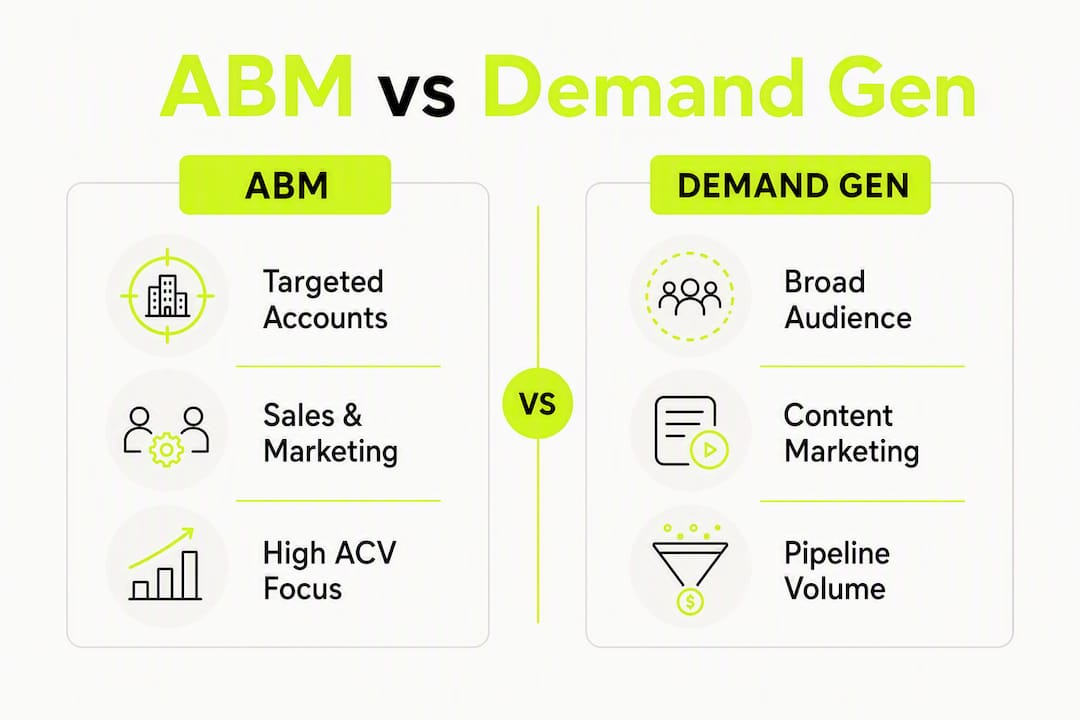
Demand generation is the operating system that builds category awareness, creates purchase intent, and captures that intent across a broad TAM. It is not a single tactic. It is the full-funnel infrastructure that makes every other growth motion more efficient.

The primary goals are long-term awareness, pipeline creation, and signal generation. That last one matters more than most teams realize: the engagement data demand gen produces is what makes account selection for ABM precise rather than guesswork.
Effective demand gen splits into two parallel tracks. Demand creation covers brand and awareness content, ungated thought leadership, SEO, webinars, and events. Demand capture covers high-intent assets: pricing pages, product comparison content, free trials, and retargeting against engaged visitors. The mistake most teams make is investing in one track while neglecting the other.
Typical tactics and channels:
- Ungated research reports and thought leadership (mid-funnel, builds trust and generates signal)
- SEO-driven content targeting category-level and problem-aware queries
- Paid social (LinkedIn, Meta) for awareness and retargeting
- Webinars and virtual events for engaged ICP segments
- Demand-capture assets: demo request pages, free trials, pricing calculators
- Retargeting campaigns against site visitors and content engagers
A practical example: a B2B SaaS company publishes an ungated benchmark report on industry conversion rates. The report generates a substantial number of downloads. The company uses intent tooling to identify which companies downloaded it, then routes the 40 highest-fit accounts to an ABM sequence. The demand gen content did double duty: it built awareness and produced the signal that fed ABM targeting.
Research suggests that a large majority of buyers have a vendor shortlist in mind before they begin formal evaluation. That statistic is the clearest argument for investing in demand creation early and consistently. You cannot win a deal you were never considered for.
Where demand gen breaks down: over-gating content, optimizing for MQL volume instead of pipeline, and failing to capture intent signals from engaged accounts. Teams that measure demand gen success by lead count alone are measuring the wrong thing.
What account-based marketing actually does for your pipeline

ABM targets a named list of high-value accounts and treats each one as a market of one. Marketing and sales coordinate deeply personalized, multi-touch campaigns across the entire buying committee, not just a single contact.
The primary goals are different from demand gen in a specific way: ABM is not trying to generate volume. It is trying to accelerate pipeline from accounts you have already decided are worth winning, increase deal size, and improve win rates on high-ACV opportunities.
Tactics and channels in an ABM motion:
- 1:1 content personalized to the account's industry, role, and known pain points
- Account-targeted advertising (LinkedIn matched audiences, display retargeting by company IP)
- Personalized landing pages and microsites for named accounts
- Executive dinners, private events, and direct mail for senior stakeholders
- Coordinated outreach sequences between marketing and sales (ABX, or account-based experience)
ABM programs typically run in two tiers. A 1:1 pilot covers 10–25 named accounts with fully custom content and direct sales coordination. A 1:many cluster program covers 50–200 accounts grouped by shared characteristics, using templatized personalization with account-level overlays. Most companies start with 1:1 to prove the model, then expand to cluster ABM once the playbook is validated.
Pro Tip: Never launch ABM without a signed-off target account list that both marketing and sales have approved. If sales does not believe in the list, they will not work the accounts, and the program will fail regardless of how good your content is.
The three most common ABM pitfalls: running the program without genuine sales buy-in, applying MQL-based metrics to an account-level motion (which makes ABM look like it is failing when it is actually working), and selecting target accounts based on firmographic fit alone rather than intent signal.
How do ABM and demand gen compare side by side?
| Dimension | Demand Generation | Account-Based Marketing |
|---|---|---|
| Scope | Broad TAM, high volume | Named account list, narrow focus |
| Primary goals | Awareness, pipeline creation, signal generation | Accelerate pipeline, increase deal size, improve win rate |
| Targeting/segmentation | ICP personas and segments | Named accounts and buying committees |
| Tactics/channels | Content, SEO, paid social, webinars, retargeting | 1:1 content, account ads, personalized pages, executive events |
| Content personalization | Segment-level | Account and stakeholder-level |
| Sales alignment | Loose handoff at MQL/SQL threshold | Joint ownership of target list and outreach cadence |
| Key metrics | Brand reach, organic traffic, pipeline influenced, CAC | Account engagement score, pipeline by account, deal size, win rate by tier |
| Typical budget/resource needs | Lower per-account cost, higher total volume spend | Higher per-account cost, concentrated on fewer accounts |
| Time-to-impact | 3–9 months for measurable pipeline | 6–12 months to meaningful deals |
Three GTM profiles and how the table applies:
- Startup with large TAM and sub-$20K ACV: Demand gen is the primary motion. ABM is premature until you have enough signal data and a sales team that can work named accounts.
- Enterprise seller with narrow TAM and ACV above $100K: ABM is the primary motion. Demand gen supports it by building category credibility and generating the intent signals that refine your account list.
- Product-led SMB with mixed ACV: Run demand gen at scale and use product usage data as the ABM trigger. Accounts that hit usage thresholds move into a targeted expansion or upsell ABM sequence.
The most expensive mistake in B2B GTM is treating ABM and demand gen as a budget trade-off. Companies that defund demand gen to fund ABM lose the signal engine that makes ABM targeting accurate. The programs feed each other, and cutting one starves the other.
A generic but instructive pattern: a mid-market software company running pure demand gen was generating high MQL volume but closing fewer than 8% of pipeline opportunities. After mapping their closed-won data, they identified that most revenue came from a minority of their accounts. They layered a 1:many ABM program on top of their existing demand gen motion, targeting accounts that matched their closed-won profile and showed intent signals. Within two quarters, average deal size increased and sales cycle length shortened, without reducing their demand gen investment.
The metric mismatch to avoid: do not measure ABM by MQL count. An ABM program targeting 50 accounts will never produce the MQL volume of a demand gen program targeting 5,000 companies. Measure ABM by account engagement rate, pipeline influenced per account, and win rate by tier.
When should you prioritize ABM, demand gen, or both?
The decision is not philosophical. It follows four measurable inputs.
- Evaluate your TAM. Count the number of companies that could realistically buy your product. If that number is under 2,000, ABM is likely your primary motion. Above 10,000, demand gen should lead.
- Assess your ACV. At lower ACV levels, the economics of 1:1 ABM rarely justify the per-account cost. At higher ACV levels, the cost of a personalized ABM sequence becomes justified relative to the deal value.
- Map your buying-group complexity. If a deal requires sign-off from more than three stakeholders across different functions, demand gen alone will not close it. ABM's coordinated multi-stakeholder approach is built for that buying motion.
- Check your intent signal availability. Do you have the tooling and data to identify which accounts are actively researching your category? Without intent data, ABM account selection defaults to guesswork based on firmographics, which underperforms.
Decision outcomes:
- High ACV + small TAM + multi-stakeholder buying group: Launch an ABM pilot of 10–25 accounts immediately. Use demand gen to build category credibility in parallel.
- Large TAM + low ACV + transactional buying motion: Scale demand gen. Use the engagement data it generates to identify which accounts warrant a light ABM overlay later.
- Moderate TAM + moderate ACV + 3–5 stakeholders: Run parallel pilots for 90 days. Let pipeline data from each motion determine where to concentrate budget in quarter two.
Pro Tip: Use your demand gen content engagement data as a free ABM targeting layer. Companies that repeatedly engage with your ungated content, visit your pricing page, and attend your webinars are telling you they are in-market. That is your ABM shortlist.
For guidance on which channels to prioritize in early-stage programs, the channel priority matrix framework helps teams avoid spreading budget too thin before they have signal data to guide allocation.
How to combine ABM and demand gen into one integrated GTM motion
The operating model is straightforward: demand gen is the base layer that runs continuously, generating awareness and signal across your full TAM. ABM is the targeted application that activates against the accounts that surface the strongest intent from that base layer.
The integrated play in four steps:
- Run demand gen content and paid programs across your ICP to generate engagement data.
- Use intent tooling (G2, Bombora, or first-party site behavior) to identify accounts showing in-market signals.
- Route those accounts into a tiered ABM sequence: 1:1 for your top 10–25 accounts, 1:many cluster for the next 50–150.
- Coordinate marketing and sales outreach on a shared account dashboard with agreed-upon routing rules and response SLAs.
Checklist for running hybrid plays at scale:
- Intent data tooling integrated with your CRM (lead-to-account matching configured and tested)
- Shared account dashboard visible to both marketing and sales
- Account tier definitions documented and agreed upon by both teams
- Playbooks by tier: what content, what outreach cadence, what escalation path
- Demand gen content library with account overlay templates for 1:many personalization
- Attribution model that tracks both account-level engagement and touch-level influence
A practical 1:many cluster recipe: take your best-performing ungated demand gen asset (a benchmark report, a framework, a research piece). Create five account-specific versions by swapping the intro paragraph, one data callout, and the case example to match each cluster's industry. Run account-targeted ads pointing to the cluster-specific version. Sales follows up referencing the specific content. You get 80% of the personalization impact at 20% of the production cost.
For teams dealing with inefficient funnels before they layer ABM on top, fixing the underlying B2B funnel mechanics first prevents the common failure mode of running ABM against a leaky pipeline.
Pro Tip: Before investing in ABM tooling, validate your lead-to-account match rate in your existing CRM. If less than 70% of your inbound leads are correctly matched to their parent account, your ABM reporting will be unreliable from day one.
What metrics should you track for demand gen and ABM?
The measurement frameworks for these two motions are fundamentally different. Using the same dashboard for both is one of the most common ways teams conclude that ABM is not working when it actually is.
Demand gen KPIs:
- Brand reach and share of voice (awareness layer)
- Organic traffic and content engagement rates
- Pipeline influenced by demand gen programs
- Cost per acquisition (CAC) by channel
- SQL-to-SQL conversion rate (as a quality signal, not a volume target)
ABM KPIs:
- Account engagement score (breadth of stakeholders engaged per account)
- Pipeline influenced by account, tracked at the account level
- Deal size uplift versus non-ABM accounts
- Account progression velocity (how fast accounts move through defined stages)
- Win rate by account tier
ABM measurement should center on account-progression stages and operational metrics like lead-to-account match rate and routing accuracy, not lead counts. An account that has five stakeholders engaged across three touchpoints is more valuable than five individual MQLs from five different companies, even though the MQL-centric dashboard would score them identically.
| Metric | Report to CEO | Report to Marketing Ops |
|---|---|---|
| Pipeline influenced by motion | Yes | Yes |
| Account engagement score | Summary only | Full detail |
| CAC by channel | Yes | Yes |
| Match rate and routing accuracy | No | Yes |
| Win rate by account tier | Yes | Yes |
| MQL volume | No | As a quality signal only |
Attribution guidance: combine account-level attribution (which accounts are progressing and at what rate) with touch-level attribution (which content and channels influenced progression). MQL-centric attribution alone fails for ABM because it counts individual contacts rather than account-level momentum. A shared growth marketing KPI dashboard that surfaces both views prevents the reporting mismatch that kills cross-functional trust.
For early signals in the first 30–60 days, watch account engagement rate and match rate. For long-term signals, watch pipeline influenced, deal size, and win rate by tier. Report the former to marketing ops weekly; report the latter to the CEO quarterly.
What timelines and budgets should you plan for?
Time-to-impact varies significantly by motion, and setting the wrong expectation with leadership is one of the fastest ways to get a program defunded before it has time to work.
Typical time-to-impact bands:
- Demand gen: 3–9 months for measurable pipeline contribution. SEO and content compound over time; paid channels produce signal faster but require ongoing spend.
- ABM: 6–12 months to meaningful closed deals. Account engagement builds in months 1–3; pipeline influence shows in months 3–6; closed revenue typically appears in months 6–12 for high-ACV deals.
- Hybrid pilot: expect early engagement signals in 30–60 days, pipeline influence in 90–120 days, and closed revenue in 6–9 months.
Budget bands (rough pilot guidance, varies by industry and ACV):
- Small pilot (10–25 ABM accounts + demand gen base): $30,000–$80,000 for 90 days, covering media spend, content production, and basic intent tooling.
- Expanded program (50–150 ABM accounts + scaled demand gen): $150,000–$400,000 annually, adding CRM orchestration tooling, additional content production, and dedicated program management.
- Enterprise-scale execution: $500,000+ annually, with full intent data stack, dedicated ABM platform, and cross-functional team.
Resource checklist:
- Demand gen manager or content strategist (can be fractional at pilot stage)
- Revenue ops or marketing ops resource for CRM configuration and reporting
- Sales development rep (SDR) aligned to ABM accounts
- Intent data tool (Bombora, G2 Buyer Intent, or first-party behavioral data)
- CRM with lead-to-account matching configured (Salesforce, HubSpot)
- Ad platform access (LinkedIn Campaign Manager at minimum)
| Phase | Months 0–3 | Months 3–6 | Months 6–12 |
|---|---|---|---|
| Demand gen | Launch content + paid programs, establish baseline | Optimize by channel, scale top performers | Compound organic, refine ICP targeting |
| ABM | Select accounts, configure tooling, launch 1:1 pilot | Expand to 1:many cluster, coordinate sales outreach | Measure win rate, expand or adjust tiers |
| Hybrid | Align teams, set dashboards, define tiers | Generate signal, route to ABM, measure engagement | Scale what works, defund what does not |
| Quick wins | Account list approved, dashboard live | First ABM accounts enter pipeline | First ABM-influenced deals close |
Pro Tip: Budget for at least two content iterations per ABM tier before evaluating performance. The first version of personalized content rarely converts at full potential. Build the testing budget in from the start.
For guidance on balancing investment across channels as programs scale, the marketplace growth supply-vs-demand framework applies directly to the question of when to push demand gen spend versus concentrating on ABM depth.
Your first-90-days implementation checklist
The 90-day pilot is the fastest way to validate which motion will scale for your business. Here is the prioritized sequence.
Days 0–30: Alignment and setup
- Define your ICP in writing: industry, company size, ACV range, buying-group roles, and disqualifying characteristics.
- Build your account tier list: 10–25 accounts for 1:1 ABM, 50–100 for 1:many cluster. Sales must approve the list before you proceed.
- Configure lead-to-account matching in your CRM. Target a match rate above 70% before launching ABM sequences.
- Set up your shared account dashboard with agreed-upon fields: account tier, engagement score, pipeline stage, sales owner, last touch.
- Select and integrate your intent data source. Even basic first-party behavioral data (site visits, content downloads) is sufficient to start.
- Establish baseline metrics: current CAC, average deal size, pipeline velocity, and win rate by segment.
Days 31–60: Execute and generate signal
- Launch ungated demand gen content to your full ICP: one research asset, one webinar, one paid social campaign.
- Activate account-targeted ads for your 1:1 ABM list. LinkedIn matched audiences by company name is the fastest setup.
- Begin personalized outreach sequences for 1:1 accounts, coordinated between marketing and sales.
- Run 1:many cluster ads with account-overlay content for your second tier.
- Track account engagement weekly. Flag any account that crosses your engagement threshold for immediate sales follow-up.
Days 61–90: Measure, refine, and decide
- Audit which demand gen content generated the most engagement from ICP accounts. Double down on that format.
- Review ABM account progression: how many accounts moved from "aware" to "engaged" to "in pipeline"?
- Identify the top five accounts showing the strongest multi-stakeholder engagement and escalate sales priority on those.
- Decide: does the data support scaling ABM tiers, shifting budget toward demand gen, or maintaining the hybrid split?
Pro Tip: Run a small personalization test in days 31–60: send two versions of your ABM content to five accounts each, one with full account customization and one with only industry-level personalization. Measure engagement rate. The lift data will tell you how much personalization investment is actually moving the needle before you commit to full 1:1 production costs.
The B2B CAC reduction case study illustrates how a structured demand gen overhaul can dramatically shift unit economics before ABM is layered on top, which is the sequencing that tends to produce the most durable results.
When should you hire an external consultant or agency?
There are four clear signals that you need outside help rather than trying to build this internally.
- You lack a revenue ops or marketing ops resource who can configure CRM lead-to-account matching and build account-progression reporting.
- Your marketing and sales teams have never shared a target account list or operated from a joint pipeline dashboard.
- You have no access to intent data and no process for identifying in-market accounts from first-party signals.
- You have attempted an ABM pilot before and it failed, but you are not sure whether the failure was in account selection, content, sales execution, or measurement.
Vendor evaluation checklist:
- Can they demonstrate CRM orchestration experience, specifically lead-to-account matching and routing configuration?
- Do they have a documented process for building account tier lists using both firmographic and intent data?
- Can they show anonymized case outcomes with ACV context and timeline? Ask specifically: what was the account engagement rate at 60 days, and what was the pipeline influence at 90 days?
- Do they have playbooks by ABM tier, or will they build your playbook from scratch on your budget?
- Can they set up attribution that tracks both account-level and touch-level influence in your existing CRM?
Key interview questions to surface real experience:
- "Walk me through the last ABM pilot you ran. What was the account list size, what was the ACV range, and what did account engagement look like at 30 and 60 days?"
- "How do you handle the situation where sales does not work the accounts marketing has targeted?"
- "What does your reporting look like at 90 days, and what metrics do you use to recommend scaling versus pivoting?"
The right external partner does not just run campaigns. They build the operational infrastructure, the shared dashboards, the routing rules, and the playbooks that your team can own and scale after the engagement ends. If a vendor cannot describe what you will own at the end of the engagement, that is a red flag.
Scope a short engagement of 30–90 days with three deliverables: a validated account tier list, a configured account dashboard, and a documented playbook by tier. If a consultant cannot commit to those three outputs in 90 days, the engagement is too open-ended to produce a clear return.
For readers evaluating whether a fractional CMO or an agency is the right model for this work, the fractional CMO vs. agency comparison lays out the trade-offs directly.
Key Takeaways
ABM and demand generation work best as a single integrated system: demand gen builds the signal engine, and ABM concentrates firepower on the accounts that signal matters most.
| Point | Details |
|---|---|
| Choose by TAM and ACV | Narrow TAM plus high ACV favors ABM; large TAM plus low ACV favors demand gen at scale. |
| Demand gen feeds ABM | Engagement data from demand gen programs is what makes ABM account selection precise rather than arbitrary. |
| Measure differently | ABM requires account-progression metrics; MQL volume is the wrong KPI for an account-level motion. |
| 90-day pilot is the fastest test | Run both motions in parallel for 90 days with a shared dashboard before committing budget to one lane. |
| Ashafrazier builds the system | Ashafrazier designs integrated growth systems that combine paid media and owned channels, including ABM and demand gen pilots, attribution setup, and playbook creation for B2B teams. |
The operating system metaphor is not just clever framing
The debate over ABM versus demand gen has consumed more marketing budget planning cycles than it deserves, mostly because MarTech vendors have a financial incentive to position their category as the answer. ABM platforms want you to believe demand gen is wasteful spray-and-pray. Demand gen platforms want you to believe ABM is too expensive and too slow. Both arguments are self-serving.
What actually works, based on running growth systems across high-consideration B2B markets: the companies that win are the ones that treat demand gen as infrastructure and ABM as a precision instrument. You do not choose between them any more than you choose between a foundation and a roof. The sequence matters. The signal flow matters. The shared ownership between marketing and sales matters more than either.
The failure mode I see most often is not choosing the wrong motion. It is launching ABM before the demand gen infrastructure is generating reliable signal, then concluding that ABM does not work. It does work. But it works on signal, and if you have not built the machine that produces signal, you are selecting accounts on gut feel and firmographic fit, which is expensive guessing.
The second most common failure is the opposite: running demand gen indefinitely without ever concentrating firepower on the accounts that are clearly in-market. That is lighting capital on fire at scale. The signal is there. The accounts are raising their hands. The team just has not built the routing system to act on it.
Build the operating system. Then deploy the application. In that order.
How Ashafrazier helps you build this system
Most B2B teams have the ambition to run integrated ABM and demand gen programs. What they are missing is the operational infrastructure: the account tier definitions, the CRM configuration, the attribution model, and the playbooks that make the system run without constant manual intervention.
Ashafrazier builds exactly that. Services relevant to this work include growth system audits (diagnosing where your current demand gen or ABM motion is leaking), pilot execution (standing up a 90-day ABM plus demand gen pilot with full playbook and dashboard), attribution setup, and fractional CMO engagements for teams that need senior growth leadership without a full-time hire.
Start with the Growth Score Calculator to get a rapid diagnostic of your current unit economics and identify where your growth system has the most leverage. If the numbers point to a structural problem in your acquisition or pipeline motion, book a discovery call to scope a short engagement with clear deliverables and defined success metrics.
Useful sources and further reading
The sources below informed this article and offer deeper technical execution guidance for teams building out ABM and demand gen programs.
| Source | What it covers |
|---|---|
| ABM vs. Demand Gen: There Is No Versus | Practitioner argument for treating demand gen as the OS and ABM as the application; useful framing for leadership alignment. |
| ABM Complete Execution Guide | Operational depth on CRM orchestration, lead-to-account matching, and account-progression metrics. |
| Demand Generation: Create and Capture Demand | Tactical breakdown of demand creation vs. demand capture and common pitfalls. |
| ABM vs. Demand Generation: How Are They Different? | Clear definitional comparison with practical guidance on TAM and ACV thresholds. |
| ABM vs Demand Generation: What's the Difference | Practical GTM perspective on running both motions and using demand gen signal to select ABM targets. |
| B2B Demand Generation Strategy Guide | Comprehensive demand gen strategy reference including the buyer consideration-set research. |
| Salesforce ABM Guide | Foundational ABM definition and pipeline quality framing from a primary CRM platform. |
For deeper operational how-to on growth system architecture, the Ashafrazier blog covers attribution setup, channel prioritization, funnel mechanics, and case studies across B2B and high-consideration markets. For intent data and ABM tooling, evaluate providers like Bombora and G2 Buyer Intent alongside your existing CRM's native account-matching capabilities before committing to a dedicated ABM platform.
Recommended
- Lowering CAC in a B2B Marketplace: From $150 to $11 Per Brand — Asha Frazier
- Marketplace Growth: When to Push Supply vs. Demand (And What Actually Compounds) — Asha Frazier
- Curing "Merry-Go-Round" Sickness: Why Your B2B Funnel Is Bleeding Cash (And the Exact Playbook to Fix It) — Asha Frazier
- Things I've Learned — Asha Frazier