
If your primary gap is predicting which accounts are in-market before your reps touch them, demo 6sense first. If your gap is activating those accounts through advertising, site personalization, and orchestrated plays, demo Demandbase One first. That single axis, prediction versus activation, drives the right decision for most US B2B revenue teams.
- Demo 6sense first if you run Salesforce, have a RevOps function, and need buying-stage prediction to prioritize outbound. Gartner Peer Insights shows 6sense at a 94% willingness-to-recommend versus 72% for Demandbase, with a reviewer rating of 4.7 versus 4.2.
- Demo Demandbase One first if you're marketing-led, run HubSpot, and need a DSP-backed advertising engine with strong site personalization out of the box.
Table of Contents
- What are 6sense and Demandbase One, exactly?
- 6sense vs Demandbase: head-to-head comparison
- How do you choose between these two platforms?
- What do G2 and Gartner reviewers actually say?
- Key Takeaways
- The part most buyers get wrong about ABM platform selection
- How Ashafrazier helps you run a sharper ABM vendor selection
- Useful sources
What are 6sense and Demandbase One, exactly?
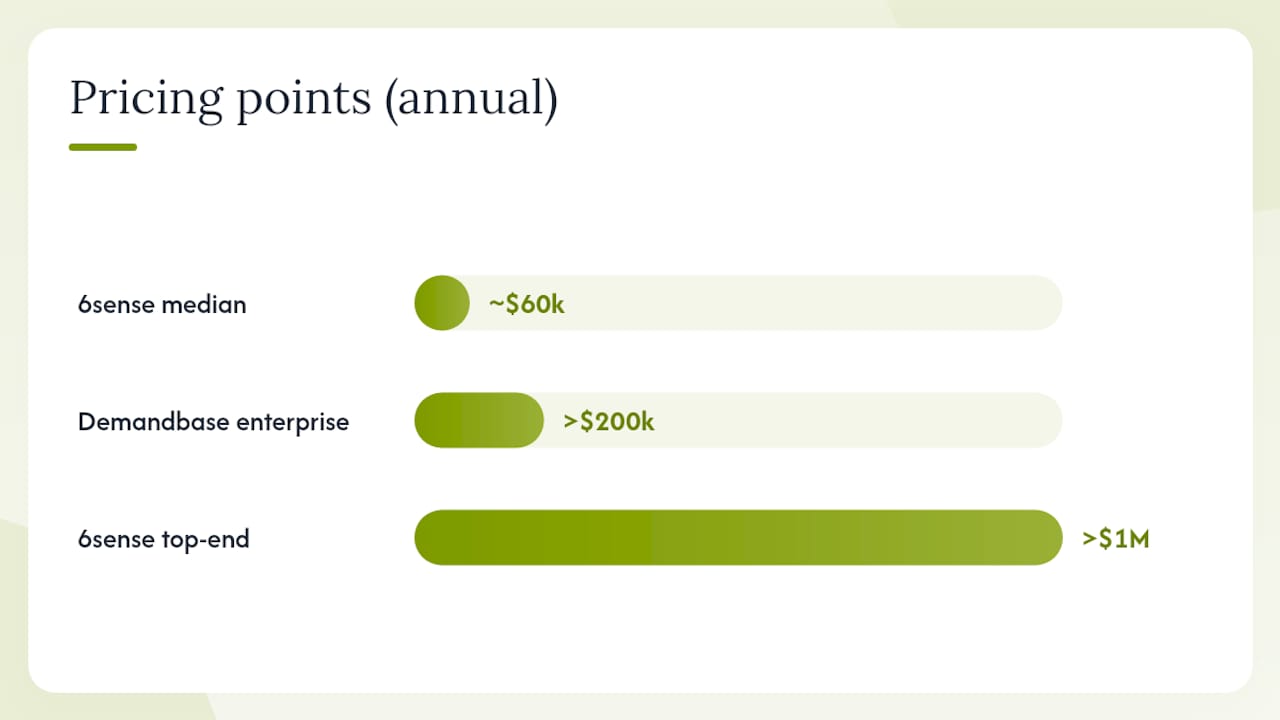
6sense is built outward from predictive analytics. Its core machine, Revenue AI, models buying stages across anonymous and known behavior, then surfaces those predictions inside Salesforce so reps know which accounts to call and why. It's strongest for software and technology buyers, where behavioral signals are dense and buying committees are large. According to operator comparisons, median 6sense contracts are typically in the mid-five-figure range, though enterprise deals can be significantly higher.
Demandbase One is built outward from advertising and orchestration. It started as a B2B DSP and grew into a full account intelligence platform, which means its ad targeting, site personalization, and cross-channel orchestration capabilities are genuinely mature. It covers non-tech verticals, including manufacturing, financial services, and healthcare, more broadly than 6sense does. Entry tiers can be lower, but enterprise deployments often reach six-figure amounts.
Pro Tip: The single integration mismatch that kills adoption is when intent signals surface in a dashboard your reps never open. Before signing either contract, confirm that account scores and stage predictions write directly to the CRM objects your reps already work in daily.
6sense vs Demandbase: head-to-head comparison
| Dimension | 6sense | Demandbase One |
|---|---|---|
| Best for | RevOps and sales-led orgs on Salesforce | Marketing-led orgs on HubSpot or Marketo |
| Core strengths | Predictive buying-stage modeling, Revenue AI | Account intelligence, B2B DSP, site personalization |
| ABM activation | Orchestration via CRM triggers and sequences | Native DSP, ad targeting, web personalization |
| Analytics & attribution | Pipeline attribution, influenced revenue | Campaign measurement, account engagement scoring |
| Ease of use | Steeper initial learning curve | Faster time to first insight for marketing teams |
| Integrations | Deep Salesforce, Outreach, Salesloft | Strong HubSpot, Marketo, LinkedIn Ads |
| Support & services | Dedicated CSM at enterprise tier | Onboarding team; support quality varies by tier |
| Pricing shape | Median ~$60k; top-end exceeds $1M | Entry tiers available; enterprise often exceeds $200k |
| Implementation timeline | 4–6 weeks (model training required) | 2–3 weeks for core account intelligence |
| Customer sentiment | 4.7 Gartner; higher G2 ease-of-use scores | 4.2 Gartner; higher G2 account-insights scores |
G2's side-by-side shows near-par overall ratings, with Demandbase scoring higher on account-level insights and 6sense pulling ahead on ease of use in several feature subcategories. UpLead's full comparison documents coverage differences in intent-signal volumes and keyword tracking counts that explain why each platform dominates different verticals.
Gartner Peer Insights: 6sense earns a 94% willingness-to-recommend versus 72% for Demandbase, a gap wide enough to treat as a genuine adoption signal, not just a vanity metric.
How do you choose between these two platforms?
The decision rarely turns on dashboards. It turns on which platform matches your operational bottleneck: finding in-market accounts or executing ad and personalization programs at scale.
Match to your org first:
- CRM fit — Salesforce-primary stacks favor 6sense; HubSpot or Marketo-primary stacks favor Demandbase.
- Primary use case — Outbound prioritization and pipeline prediction point to 6sense; paid ABM and site personalization point to Demandbase.
- Account volume — Both platforms require a meaningful account universe. Smaller target account bases often get better ROI from lighter stacks than from either enterprise platform.
- Ad spend budget — If you're committing real dollars to B2B display and LinkedIn, Demandbase's native DSP earns its cost. If you're not, you're paying for capability you won't use.
- RevOps headcount — 6sense's predictive models need someone to maintain them. No RevOps owner means the platform degrades over time.
Demo questions by persona:
- RevOps: "Show me exactly how an account score writes to a Salesforce opportunity field. What triggers the update and how often does it refresh?"
- Sales leader: "Pull a sample weekly digest for a rep with 80 accounts. What does it tell them to do Monday morning?"
- CMO: "Walk me through a live ad campaign. Who controls the DSP targeting, and what does the attribution report look like 30 days in?"
Pilot timeline:
- Days 1–30: CRM integration live, account list imported, baseline pipeline report established.
- Days 31–60: First intent signals flowing to reps, first ad campaign running, early engagement data collected.
- Days 61–90: Attribution report reviewed, growth marketing KPIs benchmarked against pre-pilot baseline, go/no-go decision made.
Red flags to watch: Low rep login rates in week two. Intent scores that don't correlate with pipeline movement after 60 days. Ad fees buried in a separate line item outside the platform contract. A vendor that can't show you a sample report from a comparable customer before you sign.
Pro Tip: Ask both vendors for a reference call with a customer in your exact vertical and CRM configuration. A reference from a manufacturing company on HubSpot tells you nothing useful if you're a SaaS company on Salesforce.
What do G2 and Gartner reviewers actually say?
G2 reviewer data and Toolradar's synthesis both point to the same split: 6sense earns consistent praise for revenue intelligence and buying-stage accuracy; Demandbase earns consistent praise for advertising execution and account-level engagement tracking.
| Platform | Gartner Rating | Willingness to Recommend | Common Praise | Common Complaint |
|---|---|---|---|---|
| 6sense | 4.7 | 94% | Predictive accuracy, Salesforce depth | Onboarding complexity, pricing opacity |
| Demandbase One | 4.2 | 72% | Ad targeting, site personalization | Support inconsistency, integration friction |
"6sense has transformed how our sales team prioritizes accounts. The AI-driven insights are incredibly accurate, and the Salesforce integration means reps actually use it." — Verified G2 reviewer
The willingness-to-recommend gap shown in Gartner reviews is a notable adoption signal in this comparison. It suggests that 6sense customers are more likely to have achieved the outcome they bought the platform for, which is the only metric that matters when you're committing a six-figure budget.
Key Takeaways
6sense wins on prediction and Salesforce depth; Demandbase One wins on advertising activation and faster deployment. The right choice depends entirely on your CRM, primary bottleneck, and budget for ad spend.
| Point | Details |
|---|---|
| Prediction vs. activation | 6sense fits outbound-led orgs needing buying-stage AI; Demandbase fits marketing-led orgs running paid ABM. |
| Gartner sentiment gap | 6sense's 94% willingness-to-recommend versus Demandbase's 72% is the clearest adoption signal in the data. |
| Implementation timeline | 6sense needs 4–6 weeks for model training; Demandbase reaches core functionality in 2–3 weeks. |
| True TCO | Full deployment cost typically runs 1.5x–2x the subscription once integration, data prep, and ad spend are included. |
| Ashafrazier's recommendation | Run the pilot with the team that owns your primary bottleneck: RevOps for 6sense, demand gen for Demandbase. |
The part most buyers get wrong about ABM platform selection
The conventional wisdom says to compare ratings and pick the higher score. That's the wrong machine to build your decision on. G2 and Gartner scores are close enough between these two platforms that chasing a half-point delta is a distraction. What actually predicts failure is buying a platform that doesn't match your operational bottleneck, then spending six months trying to force adoption.
The buyers I see get the most out of 6sense are the ones who already have a RevOps function, a clean Salesforce instance, and a sales team that trusts data. The buyers who get the most out of Demandbase are the ones running real ad budgets and a marketing team that owns pipeline. When neither condition is true, neither platform is the right first investment. A lighter stack, better attribution, and a cleaner offer will return more capital than a six-figure ABM contract with no one to run it.
If your addressable market is under 5,000 accounts or your ABM budget is under $50k annually, both platforms are likely oversized for your current stage. Build the unit economics first.
How Ashafrazier helps you run a sharper ABM vendor selection
Choosing between 6sense and Demandbase is a procurement decision with a six-figure price tag and a 12-month contract attached. Getting it wrong costs more than the subscription fee — it costs pipeline, rep trust, and six months of organizational momentum.
Ashafrazier works with B2B revenue teams to design the vendor selection process, structure the pilot, and build the attribution framework before the contract is signed. That means defining your operational bottleneck, mapping it to the right platform, and setting the 30/60/90 success criteria that tell you whether the tool is working before you're locked in. Use the Growth Score Calculator to stress-test whether an enterprise ABM investment is justified at your current CAC and pipeline volume, or work directly with Asha to run the full selection and implementation.
Useful sources
| Source | What it covers | Notes |
|---|---|---|
| Gartner Peer Insights: 6sense vs Demandbase | Verified reviewer ratings, willingness-to-recommend, side-by-side analyst view | Most authoritative sentiment signal; check for updated reviewer counts |
| G2: 6sense vs Demandbase One | Feature-area scores, overall ratings, ease-of-use comparisons | Best for granular feature subcategory breakdowns |
| G2: Demandbase One reviews | Raw reviewer counts, detailed user comments, feature scores | Use to read unfiltered user sentiment on support and onboarding |
| The Outbound Game: Demandbase vs 6sense | Operator-level verdict, contract size ranges, practical differentiators | Strong practitioner framing; useful for pricing context |
| Origami: 6sense vs Demandbase side-by-side | Intent coverage, CRM integration tendencies, implementation timelines | Best source for deployment timeline data |
| Toolradar: 6sense vs Demandbase | User-rating summaries, revenue intelligence vs. marketing-activation framing | Good corroboration source across review aggregators |
| UpLead: Demandbase vs 6sense | Coverage statistics, signal volumes, functional differentiators | Useful for data-coverage comparisons and keyword tracking counts |